Ohio Supreme Court rules in favor of AG Yost, making it harder to challenge denied public records requests
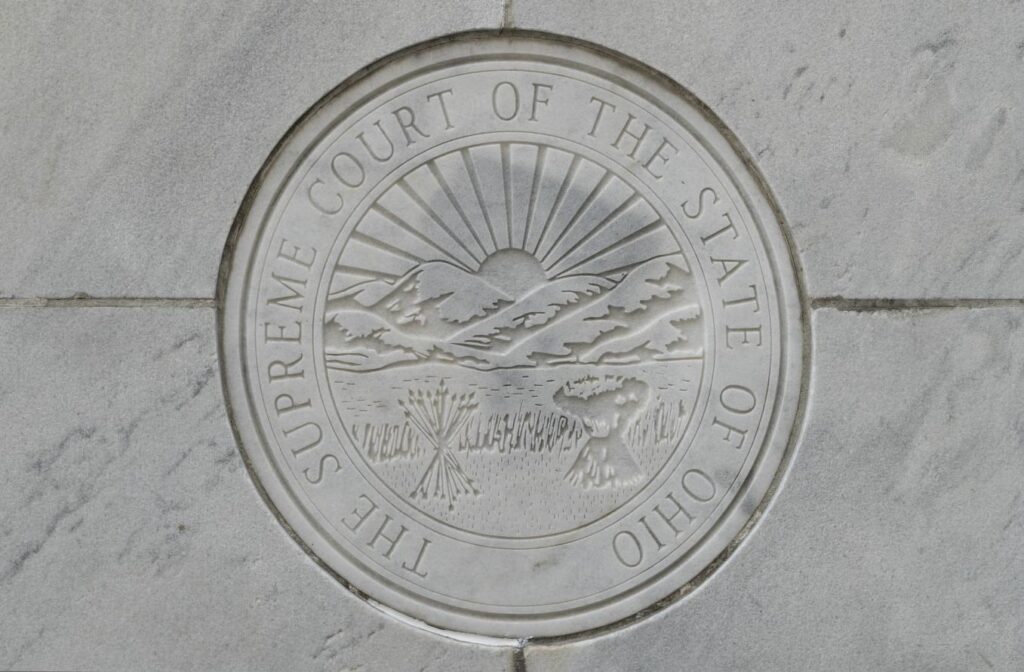
The Ohio State Seal, inscribed into the Thomas J. Moyer Ohio Judicial Center, home of the Ohio Supreme Court in Columbus, Ohio, designed by architect Harry Hake. (Highsmith, Carol M., 1946- Carol M. Highsmith Archive via the Library of Congress)
The Ohio Supreme Court on Wednesday overturned a ruling against Ohio Attorney General Dave Yost, ending a years-long legal battle and making it harder for others to challenge denials of public records requests.
The Center for Media and Democracy, a left-wing watchdog group that focuses on corporate lobbying, requested documents from Yost regarding the Republican Attorneys General Association and the Rule of Law Defense Fund, particularly those related to a 2020 RAGA meeting.
Yost’s office declined to provide the materials, saying that some of the documents did not exist, while others did not meet the definition of “record” established by the Public Records Act, according to Cleveland.com.
The group sued in March 2020.
In February 2023, the Columbus-based Ohio 10th District Court of Appeals ruled in favor of the CMD, ordering Yost to provide the requested records and explain during a two-hour deposition why he didn’t provide the information. Yost appealed the ruling.
This week, the Ohio Supreme Court vacated the ruling in a 6-1 decision, holding that the court “misapplied the law and abused its discretion,” Court News Ohio reported. The state’s highest court remanded the case to the 10th District Court of Appeals for further action.
The justices also said that the requested records did not meet the definition of “public records.”
“For the foregoing reasons, we conclude that the Tenth District Court of Appeals misapplied the law and abused its discretion in granting Armiak’s motion to compel discovery and in denying the attorney general’s motion for a protective order,” Justice Patrick F. Fischer wrote for the majority. “We therefore vacate the Tenth District Court of Appeals’ discovery order and remand the case to that court for proper consideration of Armiak’s discovery requests.”
In a dissenting opinion, Justice Jennifer Brunner, the only Democratic justice on the Ohio Supreme Court, however, argued that the appellate court’s ruling was consistent with the definition of public records and followed all of the necessary guidelines.
“I continue to believe that the review of the Tenth District’s discovery order by this court is unwarranted,” she wrote.
Every year, Yost releases manuals on Ohio’s Sunshine Laws, including the Public Records Act, writing in the 2026 manual that “Ohio’s Sunshine Laws empower the public to serve as a healthy check on its government.”
“This manual assists with the exercise of these laws, providing everything necessary to address both public records and open meetings. The Sunshine Laws protect our institutions against corruption and fraud. No elected official should oppose transparency. Those who do likely have something to hide,” he wrote. “Transparency is the surest way to foster trust and confidence in government. I encourage every Ohioan to advocate for it and every official to honor it.”