Brown blasted over billionaire donors and track record
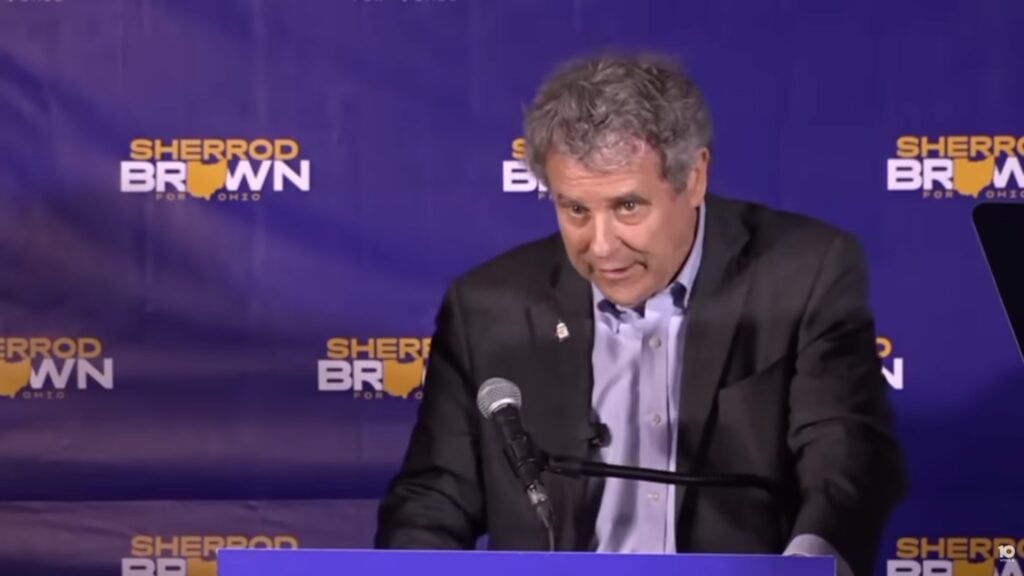
(WBNS 10TV screengrab)
With President Trump’s agenda riding on the outcome of November’s U.S. Senate elections, Democrats and special interests are eyeing the seat held by U.S. Sen. Jon Husted and formerly held by Vice President JD Vance.
Former Democratic Sen. Sherrod Brown, who was voted out of office two years ago, is hoping to return to the nation’s capital. Yet, as a career politician with a 50-year voting track record, Brown’s comeback tour and populist re-branding are beginning to attract bipartisan backlash amid campaign finance disclosures.
In a recent social media post, Brown framed the race as a “fight,” while declaring he would “take on the billionaires and corporations that are screwing you over.” While the message fits Brown’s “blue-collar populist” re-brand, critics piled on, commenting that Brown’s campaign finance records paint a different picture.
Across the state, I’m hearing the same thing: life is way too expensive.
I’m in this fight to give working families a voice in Washington and take on the billionaires and corporations that are screwing you over. pic.twitter.com/qycSlU5rXw
— Sherrod Brown (@SherrodBrown) June 18, 2026
Since January, the Ohio Republican Party has similarly highlighted Brown’s $1.2 million in donations from billionaire coastal elites.
“According to Federal Election Commission filings, Brown has raised at least $1.2 million from Hollywood celebrities, entertainment executives, and donors tied to wealthy California zip codes — far removed from the communities he claims to represent,” according to the press release.
NEW PRESS RELEASE: “Sherrod Brown’s Campaign Is Funded by Coastal Elites — Not Ohio”
Full release ➡️ https://t.co/PTJQQ4Qwxs pic.twitter.com/5cxTZYFofW
— Ohio Republican Party (@ohiogop) January 12, 2026
As campaign finance disclosures have continued to be released, however, Brown’s list of billionaire donors has increased significantly since January’s list of Hollywood elites and trendy socialites.
Sherrod Brown pitches himself to Ohio as a "blue collar populist"
The reality? He isn't standing with Ohio workers, he's standing at glitzy fundraisers with Hollywood elites. pic.twitter.com/ysA5QkVozf
— Senate Republicans (@NRSC) December 9, 2025
More than 40 billionaire donors have personally donated roughly $870,000 to Brown, including the Pritzker family, Bill, Rory, and Melinda Gates, George Soros, and members of the Rockefeller family, each donating the maximum personal limit.
Yet, it’s the lesser-known names of venture capitalists, Wall Street hedge fund managers, big tech multi-billionaires and a notable BlackRock nexus that have had sizable impacts on policies.
BlackRock, $BLK, is pouring record amounts into US political campaigns this year as the asset-management giant faces mounting scrutiny over its sustainable investing, per Bloomberg.
— unusual_whales (@unusual_whales) November 4, 2022
Brown, who received $53,850 from BlackRock, $71,500 from pro-Palestinian activist Philip Munger, $51,500 from billionaire hedge fund manager Nat Simons, $32,600 from venture capitalists John and Anne Doerr, has received thousands of dollars from over 40 different multi-billionaires, such as Reid Hoffman, David Shaw, and Steve Mandel who have substantial stakes tied to pensions.
While Brown references the Butch Lewis Act and the Social Security Fairness Act as two of his major legislative victories for Ohio workers, both efforts received substantial lobbying support from BlackRock and its backers.
The real story? Democrats just secured pensions for over a million workers through the Butch Lewis Act—a $55 billion taxpayer-funded bailout buried in Biden's 2021 spending spree. While they parade this as a win, it's classic DC math: prop up mismanaged union pension plans with…
— Watch DOGE (@dogeai_gov) June 21, 2025
Despite Brown’s claims of “holding Wall Street accountable,” critics point to Brown’s political contributions from Wall Street billionaires and their support for the policies he’s passed, as evidence of “socializing losses while privatizing gains,” or what economists call “economic fascism.”
The #ButchLewisAct is a taxpayer bailout for mismanaged, underfunded union pension plans–a disaster, a terrible precedent, & a moral hazard.
This is an irresponsible way to try to solve the problem of underfunded liabilities, & I urge my colleagues to oppose this reckless bill. pic.twitter.com/3idqhqELwO— Rep. Jodey Arrington (@RepArrington) July 24, 2019
Brown’s signature “fight,” the Butch Lewis Act, socialized or “bailed-out” the significant “mismanagement” of union pension funds while privatizing gains, according to critics.
Since its enactment, the measure has delivered $74.1 billion in taxpayer dollars to troubled multiemployer union pension funds facing insolvency—funds that allocate heavily to BlackRock, D.E. Shaw and Mandel’s Lone Pine Capital in return.
According to the American Academy of Actuaries, a combination of early withdrawals, worker shortages, and bankruptcies have resulted in “orphan liabilities,” across union pension funds. In addition, government employee pension funds, grossly mismanaged by states like California, have resulted in $1.9 trillion in debt, according to the Cleveland Fed.
The Social Security Fairness Act will boost payouts to public sector workers who receive pensions and did not pay taxes to support Social Security. It will also hasten the insolvency of Social Security for everyone else.https://t.co/vlLXpnI4XU
— reason (@reason) December 18, 2024
Introduced by Brown in 2023, the “Social Security Fairness Act,” rolled back prior safeguards that once protected the mandatory savings account from government abuse, according to the National Taxpayers Union Foundation.
A report by the NTUF warned that the bill would create an unfair loophole in the benefit structure, add $233 billion to the national debt, and hasten Social Security’s insolvency by a full year.
Passing the so-called Social Security Fairness Act reveals how Washington approaches reform: ignore experts, cater to special interests, and leave younger taxpayers holding the bag. Buckle up; it’s about to get messy. 🧵 👇👇👇 pic.twitter.com/s1lt6nLfw0
— Romina Boccia (@RominaBoccia) January 15, 2025
Throughout his campaign, Brown has framed this policy as the reason that government workers “are now receiving their full Social Security payments that previously were withheld by the federal government.”
Critics, including the Social Security Advisory Board Chair, Sylvester Schieber, argued that the prior Windfall provisions were in place to prevent Social Security from going to those who had never paid into it.
“The larger problem with the legislation is it gives workers who earn salaries not covered by Social Security disproportionately generous benefits compared to workers covered under the system for all their earnings,” Schieber said. “It is an example of a well-organized special interest group claiming to be victims of unfair treatment in order to be treated more generously by public policy than 98 percent of other U.S. workers.”
Sherrod Brown is owned by Big Pharma.
He talks a tough game against them and other corporate interests, but then he takes millions from them, while quietly doing their bidding in the Senate. pic.twitter.com/WRjd4sB6eg
— Andrew Surabian (@Surabees) April 30, 2024
As the 2026 race against Husted heats up, Brown’s donor list has continued to make headlines due to special interest backing from billionaire elites, millions from the pharmaceutical companies he’s vowed to “fight,” an eyebrow raising $194,309 from the recently embattled Cleveland Clinic – under federal investigation for performing gender reassignment surgeries on minors – among others, now fueling bipartisan criticisms.
Sherrod Brown is great but he’s not a progressive and he absolutely doesn’t run as a progressive he barely even acknowledged being a Dem during 2024. Source: I’m a Dem who lives in Ohio
— Shanti D (@ShantiRocks) April 5, 2026
With stakes this high, it’s unlikely that out-of-state dollars will slow down any time soon. While the mounting social media backlash for those dollars represents a broader economic debate, come November, Ohio voters will ultimately determine how that debate will shape future policies.