SAWYER: Ohio Doesn’t Need Another Study. It Needs This Relief, Now.
Columbus closed the books this year with roughly $1.2 billion more in tax revenue than anyone budgeted for: income tax collections ran about $699 million ahead of projections, sales tax another $520 million over. That’s money Ohioans overpaid into the system at the exact moment gas is running above $4.50 a gallon statewide and diesel has hit a record $6.76. A family filling a 15-gallon tank once a week is handing over roughly $300 a year in state gas tax alone, and truckers absorbing thousands more are passing those costs straight into the price of groceries and everything else on store shelves.
The gap between what the state is collecting and what it’s doing with it is the real story here. Earlier this year, a modest bipartisan idea from state Rep. Ty Mathews would have cut the gas tax in half for 90 days, paid for out of that same surplus. It went nowhere. Gov. DeWine dismissed it as a “grave disservice” to the state, and House Speaker Matt Huffman never brought it to a vote. So the surplus sat there while Ohioans kept paying full price at the pump.
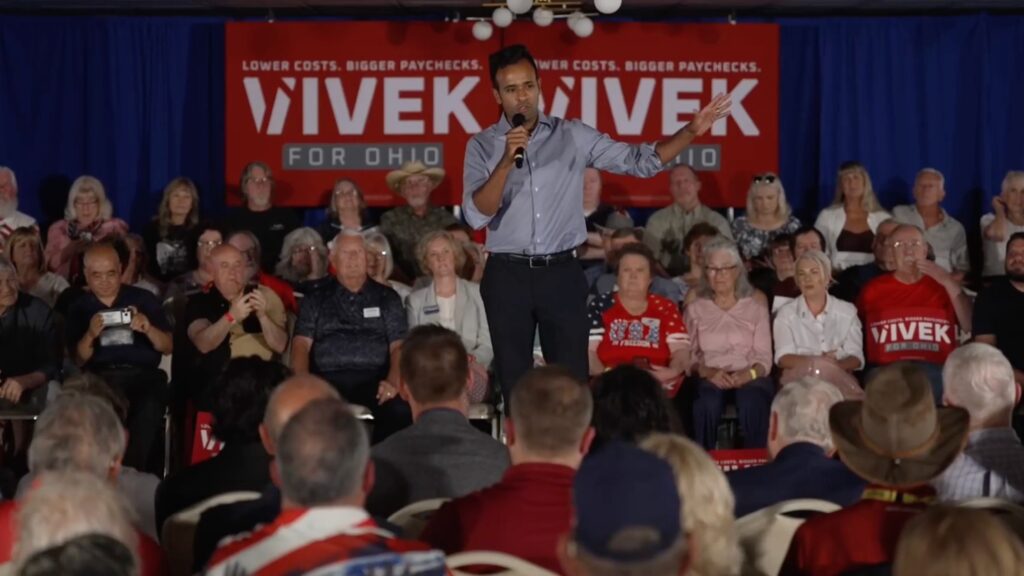
Vivek Ramaswamy’s approach breaks from that pattern in a specific way: instead of asking the legislature to consider an idea, he’s built one with the legislature’s leadership already at the table. He has been working directly with Speaker Huffman and Senate President Rob McColley on a package designed to move through the Statehouse within days, not months.
The core of it is a full 90-day suspension of Ohio’s fuel taxes, the 38.5-cent-per-gallon tax on gasoline and the 47-cent tax on diesel, rather than the half-measure floated earlier this year. The lost revenue would be backfilled first from ODOT’s existing cash balance, then the General Revenue Fund, with the state’s existing funding formulas left intact so federal highway matching dollars, ongoing construction contracts, and winter road maintenance are never put at risk.
That’s where the state’s $1.2 billion surplus does the real work: it’s large enough to cover the suspension on its own in most scenarios, without touching a dollar of reserves. But the plan doesn’t stop there. If the cost of the suspension were to run past that surplus, it calls for a temporary draw on the Rainy Day Fund rather than leaving road projects underfunded or the suspension cut short. That draw wouldn’t be left as a permanent hole, either. Ramaswamy has pointed to a federal agreement that lets Ohio keep a larger share of the savings from the Medicaid fraud crackdown he proposed earlier this year, and those recovered dollars would go toward replenishing whatever the Rainy Day Fund had to cover, so the state’s reserves end the year no smaller than they started it.
There’s also an accountability piece that’s often missing from gas tax holidays elsewhere: a requirement that supplier invoices reflect the tax change, limits on retailer credits so they only apply when the savings are actually passed to customers, and regular public reporting on pump prices and road funding so the relief doesn’t quietly evaporate before it reaches drivers.
This is the kind of detail that separates an actual governing plan from a talking point. It’s also a contrast that’s been hard to miss on the campaign trail: one candidate has spent months negotiating a specific, funded proposal with the legislature’s top two Republicans, while his opponent, Amy Acton, has offered little beyond general statements and has largely stayed off the debate stage where these plans would face real scrutiny.
The same reasoning that applies in Columbus applies in Washington. On top of Ohio’s tax, drivers pay a federal 18.4-cent gasoline tax and 24.4-cent diesel tax that Congress has shown no urgency about touching, even as prices squeeze the same families twice. A bill already sitting in Congress, the Gas Tax Relief Act, would suspend both federal fuel taxes for 90 days, with the option to extend if conditions warrant. If Ohio can figure out how to suspend its own gas tax without shortchanging road funding, there’s no excuse for the federal government to keep collecting its share while household budgets buckle under the same pressure.
None of this requires new debt or a new bureaucracy. It requires spending a surplus that already exists on the problem it was, in effect, generated by, and it requires Congress to match that urgency instead of treating the federal gas tax as untouchable. Ohio doesn’t need another economist’s survey on whether a tax holiday helps. It needs the legislature to pass this plan, and it needs Washington to stop sitting on its hands while it does.
Dakota Sawyer is Principal and CEO of Statesman Limited, a government affairs and political consulting firm.