Acton win could spell gridlock in Columbus

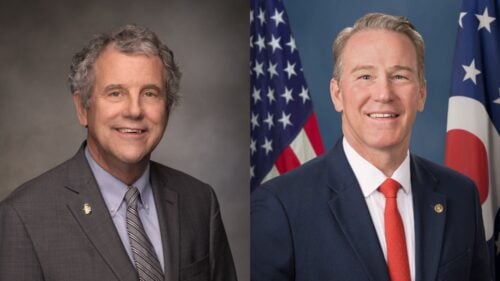
An April 2026 view of the Ohio Statehouse. (Photo by T.A. DeFeo)
As the new reality takes hold in Columbus, Ohioans could be in for gridlock in the near future.
Buckeye State Dems notched a historic evening, with Amy Acton knocking off Republican Vivek Ramaswamy in the gubernatorial race. While Dems also broke Republicans’ supermajority in the state House, Republicans still hold majorities in the state House and the state Senate.
In the immediate term, Tuesday’s outcome likely means lawmakers are headed for an action-packed lame-duck session later this year.
As Signal Ohio reported, Republicans might seek to limit the governor’s powers before Acton even takes office. Such a move would require either the buy-in of Republican Gov. Mike DeWine, who isn’t always aligned with legislative Republicans, or a veto-proof majority.
Under the state’s constitution, the Senate can review and approve — or reject — gubernatorial appointments, including administrative department directors. Those appointments could include the director of Budget and Management and members of the Public Utilities Commission of Ohio.
According to Ballotpedia, Republicans held a trifecta, controlling the state House, state Senate and the governor’s office. In the state House, Republicans, who picked up a supermajority in 2012, held a 64-34 majority, with one seat vacant.
Democrats needed to flip six seats in the state House to break the supermajority. They appear to have flipped at least 10 seats and maybe even 12, Statehouse News Bureau reported.
The win could have far-reaching implications for Acton, a political newcomer, and state lawmakers, making it harder for Republicans to override Acton’s vetoes.
In a statement, Democratic Legislative Campaign Committee President Heather Williams said the “victories will have lasting impacts,” pointing to Acton’s veto power over the Republican-majority legislature.
“Democrats have just blown up the political map,” Williams said. “Ohio Democrats broke the Republican House supermajority for the first time since 2012, and ended the trifecta by electing Governor Amy Acton, who will have her veto power protected thanks to DLCC’s decisive wins in the state legislature.”
Acton’s campaign promises included passing a “working families tax cut,” starting a program to forgive medical debt, and vaguely promising to lower utility costs. While lowering utility costs could draw some bipartisan support, depending on the specifics of any plan, the other two might be an uphill battle.
The biggest question mark might be how Acton, seen by some in Democratic circles as a first step toward more socialist policies, plans to govern. It remains somewhat opaque, as she eschewed several media requests from Ohio.News and generally barred video recording during her campaign events.
“My promise to Ohio, to those who voted for me and those who did not, is that I will work with anyone and everyone, and I always have to make life better for Ohioans,” Acton said, according to the BBC.
Acton may indeed have to work with “anyone” — and everyone, even Republicans — if she wants to advance her agenda in a divided Ohio.