Advice and consent? Sherrod Brown pledges to block all Trump judicial nominees
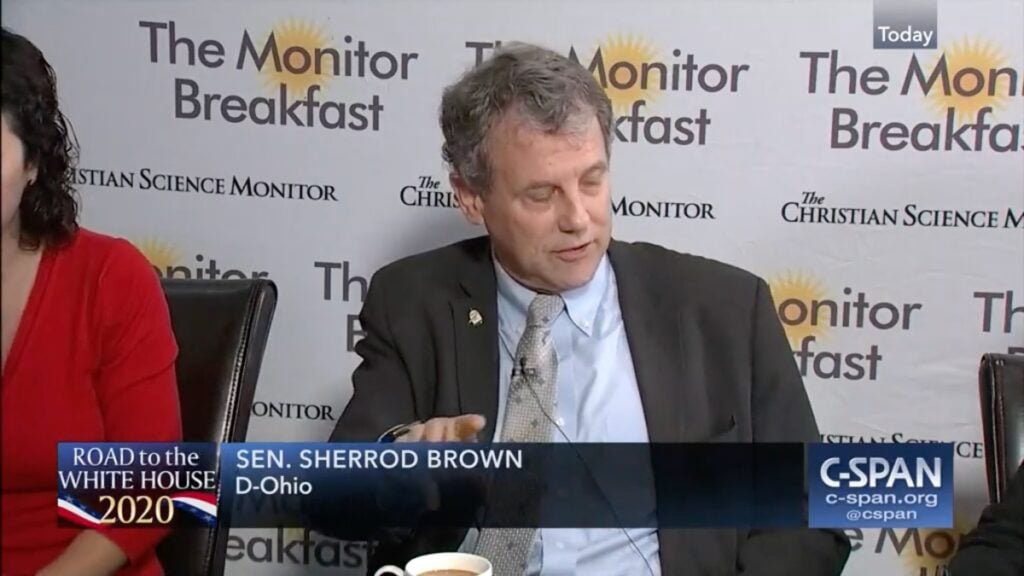
Democrat Sherrod Brown, who hopes to return to the U.S. Senate and previously said packing the Supreme Court was an option, raised alarms Tuesday when he pledged during an interview to block judicial nominees put forward by President Trump if they returned to the Senate.
Speaking on MS NOW’s 11th Hour, Brown said, “we’re not, obviously, confirming judges that are Trump judges,” while discussing his priorities if elected. Brown faces Republican U.S. Sen. Jon Husted in next month’s general election.
Calling it “a curious pitch,” New York Times columnist Jonathan Turley criticized Brown’s policy of automatic opposition — regardless of the nominees’ qualifications — as a pledge to purge the courts through attrition.
Ohio Democratic Senate nominee Sherrod Brown just pledged that he will not vote to confirm any Trump judicial nominees regardless of their qualifications. So not only would the Democrats pack the Court, but they will block any new judges to purge the courts through attrition.
— Jonathan Turley (@JonathanTurley) October 14, 2026
The sentiment underscores bipartisan concerns about an erosion of the Senate’s intended role as the “anchor” of the government, as structured by the founding fathers. Fearing mob rule, or direct democracy, the founders created the Senate as the “tea saucer” into which legislation is poured, “cooling the intemperate passions” that tend to influence the attitudes of the general public and members of the House of Representatives.
To temper the House’s “feckless passions,” the founders required a 60-vote threshold for legislation to pass the second 100-member chamber. However, after partisan obstruction efforts, the Senate no longer requires that 60-vote consent threshold for judicial nominees.
In 2013, then-Majority Leader Harry Reid and Senate Democrats used the “nuclear option” to eliminate the filibuster for lower-court and executive-branch nominees. The nuclear option, which permanently alters Senate precedent, has since permanently lowered the voting threshold to a simple majority for all lower-court nominations as well as Supreme Court nominations.
After years of escalating partisan obstruction, a bare majority of just 51 votes — or 50 plus the vice president – is now sufficient for confirmations. Without that 60-vote “cooling saucer,” the road has also been paved for more drastic structural changes, which Brown has previously signaled openness to.
In an October 2020 appearance on MSNBC’s ReidOut, Brown responded to questions about packing the Supreme Court by stating that “every option’s on the table” and that “most Democrats, most progressives will tell you that.”
Insane. Democratic Party leaders are explicitly pledging to pack the Supreme Court–increasing the number of justices from 9 to 13–the moment they get the presidency and control of the Senate. This would be the end of an independent judiciary in the United States of America. 1/
— Robert P. George (@McCormickProf) May 15, 2026
Arguing at the time that Republican appointments under McConnell had already “packed the court” at multiple levels, Brown justified the expansion as an available partisan response.
The Constitution, which assigns the Senate the role of providing “advice and consent” on presidential nominations under Article II, Section 2, was designed by the founders to check executive power. The Madisonian separation of powers, built as a series of checks and balances, was created to prevent a dictatorship from arising from popular consent.
This is the Democrat Party as it exists today. The national co-chair of the Democratic Socialists of America proudly confirmed their agenda:
Abolish the U.S. Senate.
Replace the presidency and Supreme Court.
Abolish ICE and national borders.
Close prisons, end law enforcement.…— Sheriff Mark Lamb (@sherifflamb1) July 28, 2026
Noting partisan consent, some critics have expressed skepticism about the future of the Senate’s role as a deliberative body and that of the Constitutional Republic, should the erosion of these checks and balances continue.
Though “a Republic of we can keep it,” as November approaches, fears mount over the long-term stakes presented by short-term majorities.