Auditor flags $1.4 million in improper Medicaid payments to addiction medicine provider
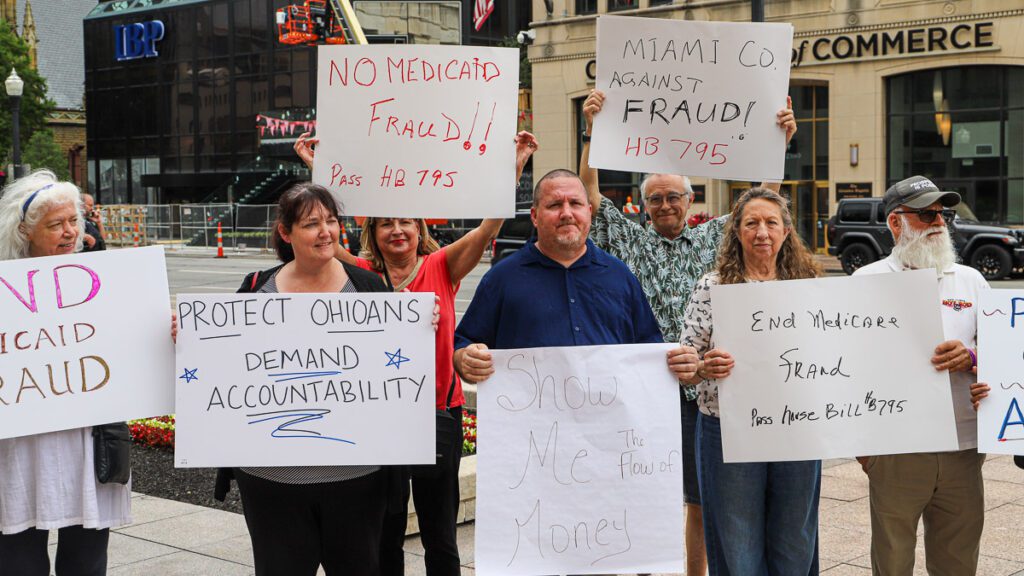
Ohioans participate in an Americans For Prosperity-Ohio rally at the Ohio Statehouse against Medicaid fraud. (Photo by Todd DeFeo)
Days after Rep. Mike Dovilla, R-Berea, said Ohio “shouldn’t be writing the check” when Medicaid eligibility cannot be verified, Auditor of State Keith Faber released a compliance audit identifying more than $1.2 million in improper payments to the New Destiny Center, a Summit County substance abuse provider.
According to the report, New Destiny Treatment Center was paid about $11.5 million from Jan. 1, 2021, through Dec. 31, 2023, for substance-use disorder, mental health and related services. Auditors said the problems included missing documentation, treatment plans that did not match the services billed, and failures to obtain required prior authorization.
Protecting Medicaid means protecting both vulnerable Ohioans and the taxpayers who fund the program. Our audits have exposed serious problems and driven reforms to improve eligibility checks and accountability. Rep. @mikedovilla has been a strong legislative partner in advancing… pic.twitter.com/TYXzheMU7b
— Keith Faber (@KeithFaber) September 1, 2026
Of 78 treatment-plan reviews, 60 authorized a higher level of care than was actually provided, and four had no treatment plans at all. In addition, of the 425 payments reviewed, 45 were issued without prior authorization — violating state rules requiring treatment plans and prior authorization before admitting patients to long-term inpatient stays. Those errors were part of a projected $1.1 million in improper payments.
Faber’s office audits Medicaid providers under an agreement with the Ohio Department of Medicaid. With added interest, the Auditor of State’s Office is recommending repayment of about $1.4 million for the New Destiny Treatment Center as part of that recently completed compliance audit.
While the Summit County audit is a provider-level compliance exam, not a criminal indictment, it offers another data point in Faber’s running argument that Ohio has “no shortage of warning signs” and needs tighter controls before claims are paid.
If Ohio can’t verify that someone is eligible for Medicaid, Ohio shouldn’t be writing the check.
The @OhioAuditor just exposed a serious hole in our system. I’ll introduce legislation requiring real-time data matching, documented eligibility verification, and independent audits.… https://t.co/iOH2elcuZi
— Rep. Mike Dovilla (@mikedovilla) August 27, 2026
The findings come on the heels of a separate public-interest audit released by Auditor Faber on citizenship and immigration verification, prompting Dovilla to announce legislative actions.
That review found 10% of sampled Medicaid recipients could not have status confirmed. Dovilla pledged legislation for real-time data matching, documented verification and independent audits. “If Ohio can’t verify that someone is eligible for Medicaid, Ohio shouldn’t be writing the check,” Dovilla said.
Dovilla, who has spent more than a year pressing eligibility and provider-integrity issues, worked to include language in the state’s operating budget that directs cooperation between Medicaid and the auditor on the Aged, Blind and Disabled caseload. Lawmakers this year also passed broader program-integrity measures after months of debate over electronic visit verification, high-risk providers and penalties.
While progress has been made, this week’s $1.4 million finding is the latest example of why Republicans, like Dovilla, say Medicaid integrity must be a legislative priority in the coming session to protect services for the state’s most vulnerable populations.