Columbus City Schools Board lays off almost 300 to address a $50 million ‘budget shortfall,’ while spending $60 million on facility updates
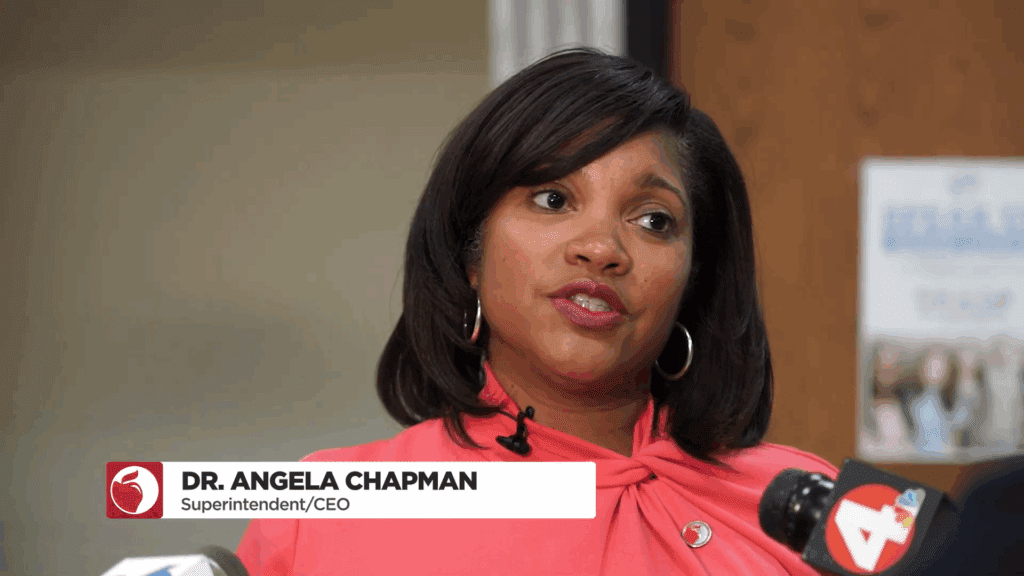
Angela Chapman, Columbus City Schools Superintendent/CEO
The Columbus City School Board of Education approved laying off almost 300 teachers and staff at a Tuesday meeting to reduce its bloated budget, while also finding $60 million to update the schools and sports facilities.
The Columbus Dispatch reported that of the 299 people who will lose their jobs, 212½ of them will be faculty and 86½ will be staff.
Even though the decision to fire all these people was unanimous, Board President Antoinette Miranda said the vote to cut positions was not easy.
“We have to make that hard decision. You leave with a very heavy heart because this affects people and their families,” Miranda said, according ot the news source. “It affects the students. It affects the community.”
Superintendent Angela Chapman suggested laying off staff, saying the district would save $25.9 million. Chapman said at a press conference before the meeting that the cuts were chosen to have as little impact on students as possible and are “furthest away from the classroom,” The Dispatch reported.
“All of these positions matter,” she said. “These are employees and colleagues who have served our district, served our students. These are tough decisions.”
A district spokesperson told the news source that 112 of the roles were filled. The remaining position cuts were due to vacancies and retirements, according to the report.
Columbus Education President John Coneglio said the district was forced to lay off so many people because the state government didn’t fund them properly, adding that their district has taken one of the biggest hits.
“I think we wouldn’t be in this mess if the legislature could figure out a way to fairly fund our schools,” he said.
As a result of so many people no longer working at the Columbus schools, Chapman said those who managed to keep their jobs would be forced to work longer to compensate for the worker shortage.
“We will have to think about how we can work together to address the needs of our students, the needs of our families with fewer resources and fewer hands to make it happen,” she said. “We will have to call on each other to do that work in support of the students.”
Substitute teachers urged the district to raise the salaries of standard substitute teachers, especially given that they will now be doing even more work.
“When teachers are absent, students will be forced to sit in other classrooms, which are overcrowded, and not get the quality instruction they deserve,” Kim Maupin, a building substitute at Avondale Elementary, told the Columbus newspaper.
Board Member Patrick Katzenmeyer said that he was “angry” at the fact that he and other board members “were forced to make this vote because of the state’s divestment in public schools,” adding that he “wondered how we got to this place as a society where we’re funding private stadiums instead of public school teachers.”
Last year, Chapman also announced a $50 million budget cut. It was also previously reported that the school district could go bankrupt by 2030, despite having billions in its budget and millions in ongoing cuts.
Despite this financial situation, Chapman announced on Monday that the district will spend $60 million on building refreshes, sports complex upgrades, and energy-efficient improvements across dozens of schools, according to another report by The Dispatch.
“It is exciting for every student who will walk into a stronger, brighter, and more welcoming school because of the work that’s beginning this summer,” she said, The Dispatch reported.
U.S. News and World Report reported that “32% of elementary students tested at or above the proficient level in reading, and 25% at or above that level in math.”
The news source added that “26% of middle school students tested at or above the proficient level for reading, and 17% tested at or above that level for math.” Only “33% of high school students tested at or above the proficient level for reading, and 11% tested at or above that level for math,” according to the report.
Similar numbers were also reported by The Public School Review and the Thomas B. Fordham Institute, resulting in the school district earning only a two-out-of-five rating on Ohio’s 2024 state report card, according to WOSU Public Media.