D.C. delays threaten Ohio’s rush to expand grid ahead of projected energy shortages
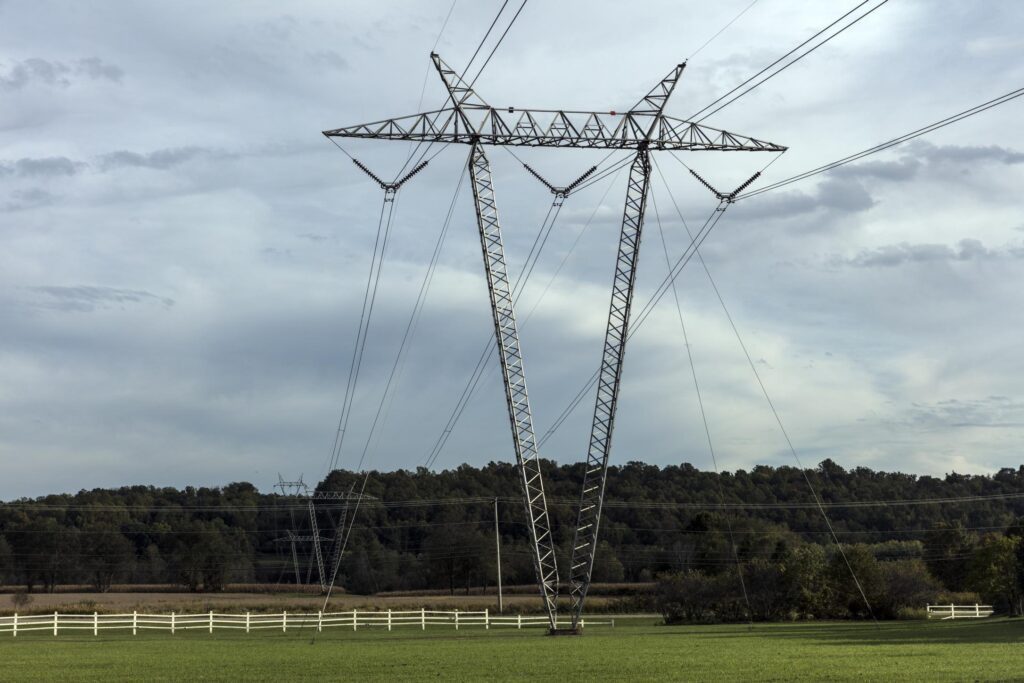
A line of enormous power towers and electric cables in Muskingum County, Ohio. (Photographs in the Carol M. Highsmith Archive, Library of Congress, Prints and Photographs Division.)
Ohio’s push for energy grid expansion faces persistent hurdles from federal permitting delays, even as state reforms aim to accelerate growth and meet rising demand from data centers, manufacturing and economic development.
Amid warnings of grid failures and energy shortages as early as 2026 from PJM Interconnection, a new report from Americans for Prosperity highlights how Washington’s slow and unpredictable federal permitting system has stalled three major Ohio energy projects involving transmission, generation and related infrastructure. Representing more than $1.5 billion in initial economic benefits, the report exposes how these federal delays have cost the state an estimated 6,000 jobs and up to $65 billion in overall lost economic potential.
Central to these delays, the report identifies the often-ambiguous and burdensome federal processes under the National Environmental Policy Act, which create bottlenecks and override state progress toward a reliable power supply.
House Bill 15
Championed by groups like The Buckeye Institute, a Columbus-based free-market think tank, House Bill 15 is a proactive approach that will streamline state-level approvals through the Ohio Power Siting Board. The law, signed into effect by Republican Gov. Mike DeWine last year, creates Priority Investment Areas on brownfields — contaminated former industrial sites — and on former coal mine lands.
“Ohio has shown what’s possible when policymakers embrace smart, free-market energy reforms,” AFP-OH State Director Donovan O’Neil said in a statement. “Thanks to state-level leadership and commonsense permitting improvements, Ohio is already attracting billions in private investment and moving major energy projects forward. That success should be celebrated.
“But this report makes clear that Ohio’s progress is happening despite a broken federal permitting system, not because of it,” O’Neil added. “Three major Ohio projects, representing more than $1.5 billion in economic benefits and hundreds of good-paying jobs, are still stuck in Washington’s slow-walking approval process.
Local governments can petition the Ohio Department of Development to designate these sites, prioritizing areas hit by coal industry decline. Once approved, projects qualify for expedited OPSB review, including decisions in as little as 45 days for certain applications — far faster than the previous averages of 18 months or more.
HB 15 also offers incentives, such as five-year tangible personal property tax exemptions for transmission infrastructure in PIAs, plus up to $10 million in Brownfield Remediation Program grants for cleanup and preparation.
“If the federal government followed Ohio’s lead and fixed its permitting system, the economic and energy benefits we’re already seeing could be multiplied many times over,” O’Neil said. “Faster permitting would mean lower energy costs, more reliable power, stronger job growth, and a truly abundant energy future for families and businesses alike.
“Ohio is proving the model works,” O’Neil added. “Now Washington needs to get out of the way.”
Land for Development
With over 567,000 acres of former mine lands and 50,000 acres of brownfields suitable for energy development, Ohio is leading the nation in the redevelopment of contaminated or condemned land while preserving agricultural farmlands.
Even environmental advocates have praised the approach as a “win-win.” According to The Nature Conservancy, Ohio is turning environmental liabilities into assets while supporting diverse energy sources and creating jobs.
“Ohio residents face a real risk of energy shortages and rising energy prices in the future and we want to thank the governor and lawmakers for seeing this threat and addressing it now before it’s too late,” Rebecca Mellino, climate and energy policy associate with The Nature Conservancy in Ohio, said in a release when the measure was signed into law. “House Bill 15 will help incentivize renewable energy siting on some of Ohio’s least usable land, including former industrial sites, landfills and abandoned mines.”
Given that environmental groups like TNC are a frequent driver of federal permitting delays. About 30% of federal energy-related projects from 2010-2018, requiring Environmental Impact Statements, faced predevelopment litigation, with 89% of those cases involving claims of NEPA violations.
Reasons for the Holdup
In short, centralized authority within a massive bureaucratic wasteland.
Often referred to as the “Magna Carta” of U.S. federal environmental law, NEPA establishes national environmental policy and requires federal agencies to assess the environmental impacts of their proposed major actions. Through processes like Environmental Impact Statements and Environmental Assessments, the Council on Environmental Quality oversees the implementation of rules and regulations.
While NEPA and the CEQ do not have express preemption over the states or private industry, they have been given broad leeway to interpret environmental policies. Largely procedural, NEPA reviews can delay or influence federally involved energy projects for years.
And then there’s the Endangered Species Act, the Natural Gas Act of 1938, the Atomic Energy Act of 1954, the Federal Power Act, the Energy Policy and Conservation Act, the Inflation Reduction Act, and laws stacked upon laws that create a federal nexus of authority, often overriding states’ rights and now hampering grid stability.
While the Trump administration is working quickly to reverse or reform previous rules that have hindered expansion of the energy grid, the executive branch can only decentralize authority that earlier administrations had interpreted as being delegated to it by Congress. True reform of the underlying statutory mandates themselves can only be done by Congress.
Last week, DeWine signed on to support a White House Domestic Energy Council effort to ask the regional electricity transmission organization PJM, which serves Ohio and other states, to better address supply-and-demand issues caused by data centers.
The Republican governor signed the “Statement of Principles Regarding PJM.” In doing so, DeWine joined a bipartisan group of governors, United States Secretary of the Interior Doug Burgum and United States Secretary of Energy Chris Wright; Burgum and Wright are chairman and vice-chairman of the council.
As Ohio demonstrates leadership in innovative land-use concepts that address where the energy grid can expand, experts warn that ensuring grid stability will require Congress to overhaul permitting and to resist increasingly centralized authority.
“House Bill 15 made Ohio a national leader in smart, free-market energy policy, and we are already seeing tangible results from these Buckeye Institute-championed policies with more than $4 billion in investment,” Rea S. Hederman Jr., executive director of the Economic Research Center and vice president of policy at The Buckeye Institute, said in a statement.