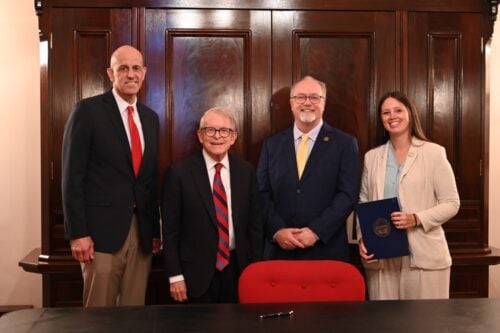
DeWine again stands up for Haitians following Supreme Court ruling

Gov. Mike DeWine continues to criticize the Trump Administration’s decision to end Temporary Protected Status for hundreds of thousands of Haitians in the country, including an estimated 15,000 living in Springfield, a city that has faced economic challenges for decades.
Following a June 25 U.S. Supreme Court ruling, the Trump Administration can now remove TPS protections that have allowed thousands of Haitian and Syrian immigrants to remain in the country. More than 350,000 Haitians nationwide currently have TPS.
Haitians fled their country after a devastating earthquake, and studies show Haitian immigrants began arriving in Springfield around 2013. For many, the United States was not their first stop; some came directly from Haiti, but “many others” arrived from countries like Brazil and Chile.
“These are people who have helped Springfield really come back,” DeWine told CBS News. “The Haitians who are living there and employed there, they came there to work, and they came there because there were jobs that were not being filled by other people.”
The Republican governor, who is now in the swan song of his political career, pointed to Haitians who have filled jobs in an economically challenged city. It’s hardly the first time he has spoken up for the Haitians in the state.
“Haiti is hell today. So you’d be sending people … back to hell,” DeWine added in his interview with CBS. “Very few of these Haitians will voluntarily go back to Haiti. If they have to leave, they’ll go someplace else. They want to work. They want to support their family. They don’t want to go back to Haiti.”
The TPS remains in effect until it is formalized in federal courts nationwide. Once it formally ends, Immigration and Customs Enforcement is expected to descend on cities with large Haitian populations, including Springfield, Time reported.
Ohio-based author Joshua Lisec, whose new book, “Haitians of Springfield,” touted as the first oral history of the Haitian immigrant community in Springfield and is set to hit shelves this fall, previously told Ohio.News that Springfield is “far worse than the headlines demonstrate.”
Lisec said there is “a resentment” among some residents after thousands of Haitians arrived in Springfield “in a very short period of time.” The new arrivals were perceived as receiving priority for opportunities: “the priority of the entire county becomes Haiti first, Haitians to the front.”
However, “it has not become racial resentment, to the credit of the people of Springfield,” Lisec told Ohio.News via email before DeWine’s interview. “If there is any bitterness and hate, it is, interestingly, towards the entirely white and, should I say, even Republican leadership within the county, within the city. It’s a white-on-white conflict. This is my understanding.
“And the gentry of Springfield have used the Haitian influx as both a hand offensive weapon and a hand shield against the working class. It is truly a caste system within Springfield,” Lisec added. “You know, there’s the white working class, and then there’s the cosmopolitan elite who see themselves as the betters of the area. And they are truly a land-owning, business-owning, and investor gentry. And it’s rough.”
Springfield’s population peaked around 1960, surpassing 82,700. In the following years, its population steadily declined, dropping to about 60,000 in 2010. Today, the city’s population is hovering around 58,000 residents.
Lisec said he suspects thousands have already left Springfield in the wake of the Supreme Court ruling, and expects more will continue to leave.
Only a few years ago, celebrities like Conan O’Brien stood up for Haiti. The television host produced a MAGA-inspired red hat and a T-shirt with the slogan “Haiti is great already.”