DeWine announces data center tax exemption pause as study committee highlights success of policy reforms

As the Ohio Joint Study Committee on Data Centers convened to assess the rapid expansion of data centers and their implications for energy infrastructure and ratepayers, Republican Gov. Mike DeWine directed the Ohio Tax Credit Authority to pause consideration of new data center tax exemption requests.
The pause is set to remain in effect while the committee studies the growth of data centers.
“As this work is ongoing, I believe it is appropriate for the Ohio Tax Credit Authority to pause its consideration of new data center tax exemptions while the full impact of data center growth in Ohio is being reviewed,” DeWine said in a release.
The Ohio Tax Credit Authority will stop accepting new data center tax exemption proposals after Monday, when it will consider an existing request. While the governor paused tax exemptions, the action does not ban data centers.
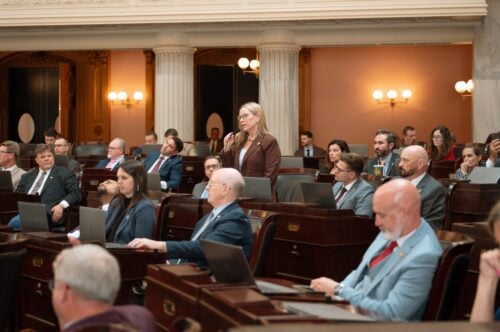
Today, the Select Committee on Data Centers convened for the first time, hearing testimony from agency leaders including the Department of Development, the Department of Natural Resources, and the Public Utilities Commission of Ohio. pic.twitter.com/IwmhbHxNRq
— Ohio House GOP (@OHRGOPCaucus) May 27, 2026
On Wednesday, lawmakers heard testimony highlighting explosive industry growth alongside proactive state measures to ensure new facilities pay their fair share without burdening Ohio families and businesses.
PUCO Chair Jenifer French opened her remarks by acknowledging the trend’s dual nature.
“Data centers have become more common in our everyday lives and are becoming integral to ensuring our national security,” she stated. “While these facilities are becoming more important, they have also driven electricity demand at a pace that has never been seen before in our PJM region.”
Unfortunately, there are often significant misconceptions about how much water data centers use. The facts show the industry takes responsible resource management seriously. Check out this fact check on water usage from The Washington Post ⬇️ https://t.co/YQ7zR9Stio
— DataCenterCoalition (@DCC_org) May 20, 2026
French detailed that AEP Ohio received requests for more than 30,000 MW of data center load, prompting the development of a pioneering tariff.
“In July 2025, the PUCO approved the new tariff. To our knowledge, it was the first data center specific tariff approved in the country,” she explained.
The tariff requires collateral, minimum demand charges, long-term contracts of 8–12 years, and exit fees. As a result, AEP has secured 5,642 MW under the agreement.
“This tariff unquestionably helped AEP Ohio to refine the amount of load in its data center queue, thereby saving other ratepayers millions of dollars in unnecessary infrastructure,” French added.
Similar tariffs are advancing for FirstEnergy and AES Ohio. French also noted ongoing reviews of transmission cost allocation to better assign Federal Energy Regulatory Commission approved costs to data centers currently classified in industrial or commercial categories.
Data centers are more than the buildings behind the internet.
New @PwC report shows their impact on jobs, investment, and economic growth nationwide.
Read more: https://t.co/otgXnalI4V pic.twitter.com/DlzA0JtpRE
— DataCenterCoalition (@DCC_org) May 13, 2026
The industry overview presented to the committee painted a picture of substantial economic upsides. Ohio’s data centers supported 24,120 direct jobs, contributing $14.1 billion to the state’s GDP in 2024, generating $1.1 billion in taxes net of incentives. Nationally, the sector is projected to reach 80 GW of demand by 2030, up from 25 GW in 2024.
PJM is taking a number of actions to maintain reliability and promote affordability amid historic demand growth led by data centers. Asim Z. Haque, EVP of Governmental and Member Services, testified May 27 in the Ohio legislature before the Select Committee on Data Centers.
PJM… pic.twitter.com/lrPPjyc9DJ
— PJM Interconnection (@pjminterconnect) May 27, 2026
Testimony on electricity costs emphasized supply-demand imbalances in PJM.
“For generation, the primary driver is the supply/demand imbalance,” noted Asim Z. Haque, EVP of PJM’s Governmental and Member Services. Retirements of older plants, especially coal, are outpacing additions, tightening the supply/demand balance and contributing to higher capacity prices, Haque emphasized.
“In the last three years, PJM has seen very little new supply interconnect to the grid,” Haque said. “Currently, there are ~53,000 MW of projects that have their agreements to connect to the system. This means these projects have completed all electrical study processes with PJM so they can safely plug into the grid. Yet, we’re seeing very little construction take place.”
Haque’s presentation noted global supply chain issues, financing difficulties, and disruptions due to siting and permitting as reasons for the lag in new supply added.
However, officials credited reforms from House Bill 15 — which recently began taking effect — with helping accelerate new generation strategies.
French highlighted over 2,000 MW of behind-the-meter dispatchable generation authorized or pending in 2025, as well as major projects, including a proposed 10 GW natural gas facility in Piketon.
Ohio’s policy reforms, such as directing the PUCO to ensure large users cover their full share, appear to align with the Trump administration’s push for private-sector leaders to pay for the necessary grid expansions.
President Trump’s Ratepayer Protection Pledge is putting America first.
He’s calling on the nation’s leading AI companies to build, bring, or buy 100% of the energy they need for their data centers.
No more sticking Americans with the bill. ⚡ pic.twitter.com/pCxacrTfjy
— The White House (@WhiteHouse) May 19, 2026
The Ratepayer Protection Pledge, recently announced by the White House, was signed on March 4, 2026, by companies like Microsoft, Meta, OpenAI, and Amazon.
The initiative protects consumers from price hikes while supporting AI growth by requiring participants to build, bring, or buy all new power generation needed for their data centers. Sharing the cost of expanding America’s electrical grid, the companies have also agreed to pay 100% of the cost of new power delivery and infrastructure upgrades.
President Trump’s Ratepayer Protection Pledge is a WIN for Ohio.
Major tech companies will cover the cost of new power generation — delivering stronger economic growth, American jobs, and affordable electricity prices for Ohioans.https://t.co/6kMH4A9Zgr
— U.S. Department of Energy (@ENERGY) May 22, 2026
In addition, the agreement requires the private sector to negotiate separate rate structures so costs are not shifted to household ratepayers.
Ohio is advocating regionally and federally for reforms, including a potential PJM auction for large-scale users. If approved, PJM would be able to facilitate the separated rate structure to help ensure that data centers bear the full costs of new generation.
The hearing, which reflected Ohio’s pragmatic policy approach, welcomed high-wage jobs and investment while also examining forward-looking strategies focused on continuing to safeguard reliability and affordability for all Ohioans.