DeWine issues order allowing Ohio Colleges to offer 2022 athletes a fifth year and access to NIL opportunities
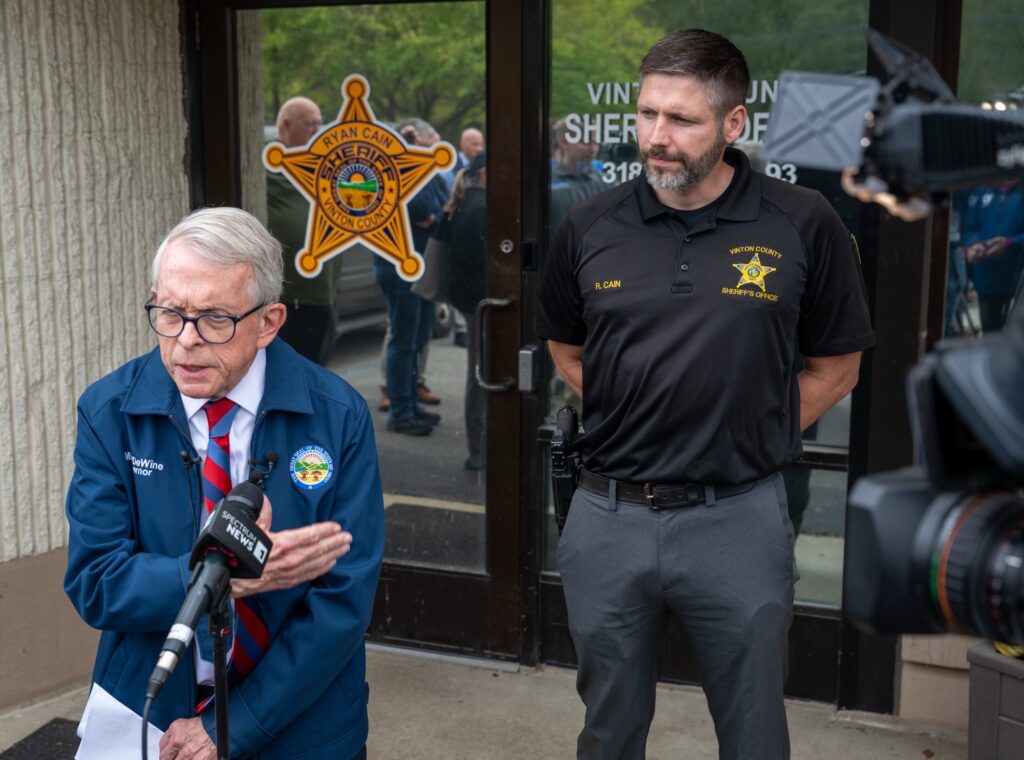
Gov. Mike DeWine and Vinton County Sheriff Ryan Cain provide an update on ongoing recovery efforts following recent flooding.
Republican Gov. Mike DeWine signed an executive order allowing colleges to keep athletes on the roster and eligible for Name, Image and Likeness compensation.
The move follows a landmark 2025 case, which found the National Collegiate Athletic Association’s compensation restrictions violated antitrust law. The NCAA has since adopted a new age-based eligibility rule, prompting legal challenges from student-athletes.
Named after former Arizona State swimmer Grant House, a landmark case was settled in 2025 against the NCAA. That case resolved long-running claims that NCAA compensation restrictions violated antitrust law.
Starting in the 2025-26 academic year, under the House settlement, Division I schools that opt in can directly share athletic revenue with current athletes after the NCAA and Power conferences agreed to pay roughly $2.8 billion over 10 years to Division I athletes who competed between about 2016 and 2024.
In June, however, the NCAA adopted a new age-based eligibility rule. Under the association’s implementation guidance, athletes who graduated high school in 2022 and have already completed four seasons are now denied a fifth year based upon that technicality.
Athletes from that class and their lawyers have since challenged the restriction in multiple courts. Arguing that the NCAA’s June age-based rule is unfair, athletes contend that the rule treats them differently from the classes immediately before and after them, and deprives them of opportunities to continue competing while earning name, image, and likeness compensation—sharing in the revenue schools now distribute under that 2025 House v. NCAA settlement agreement.
A lower-court judge in the federal Wisne v. NCAA case initially ruled in the athletes’ favor and granted the fifth year. An appeals court blocked that ruling, and a three-judge panel of the U.S. 10th Circuit Court of Appeals has heard arguments but has not yet decided. Additional cases have proceeded in state courts with mixed results for the NCAA.
The DeWine order gives the state’s colleges and universities the option to allow otherwise eligible athletes from the high-school class of 2022 to compete in the 2026-27 season despite the NCAA’s guidance.
According to DeWine, the order is about fairness.
“When the rules change, fairness has to remain part of the equation,” DeWine said in the statement. “We want Ohio’s student-athletes to have the same opportunity as student-athletes in other states.”
Lt. Gov. Jim Tressel, a former championship-winning coach at Ohio State and Youngstown State, supported the step.
“It’s important we do not deprive our current student-athletes of the same opportunities enjoyed by their peers,” he said in a release.
NCAA President Charlie Baker sent the following memo to members in the wake of Ohio Gov. Mike DeWine's executive order saying players from the freshman class of 2022 should have a fifth year of eligibility. pic.twitter.com/IoAfyaUkoa
— Amanda Christovich (@achristovichh) October 13, 2026
Following the order, NCAA President Charlie Baker responded in a letter to member schools. He said DeWine “cannot legislate NCAA eligibility rules” and that “one elected official seeking to make their own rules for their own schools’ advantage is a terrible way to run athletic competitions.”
Baker again urged Congress to pass the Protect College Sports Act to create clearer national standards on eligibility, compensation, and related litigation.
The order, which does not require schools to grant the extra year, simply permits them to decline to enforce the new NCAA restriction while legal challenges continue. Athletes must still remain academically eligible, stay within applicable age and enrollment limits, and not have signed professional contracts.
Ohio’s eight Division I programs have not yet announced how they will apply the governor’s order.
Related Stories

Undercover video shows Ohio Dem canvassers being taught to lie to voters about Flock cameras
Some fear that Acton is ‘extremely dangerous’ as questions mount over resignation and emotional stability