Distilling Freedom: Ohio Distiller’s fight to check federal overreach and reclaim individual rights
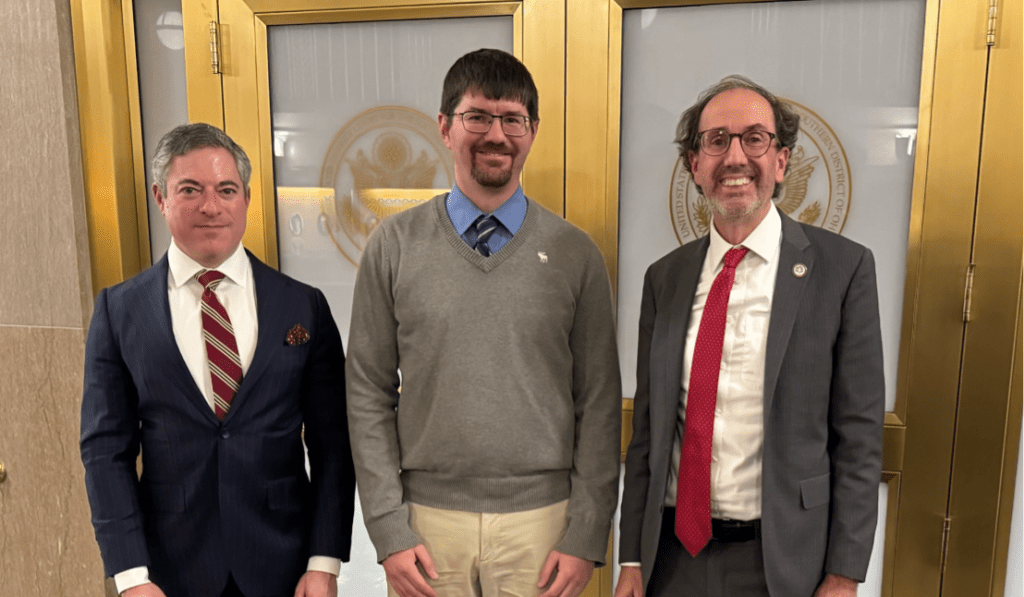
Pictured left to right: Andrew M. Grossman, John Ream, and Robert Alt. (Photo courtesy of The Buckeye Institute)
In an era when federal authority has expanded far beyond the Constitution’s enumerated powers, a lawsuit brought by a Licking County brewer seeks to restore limitations on congressional overreach and reaffirm the separation of powers that safeguards individual liberty.
As previously reported in Ohio News, John Ream, owner of the Trek Brewing Company in Newark, was threatened with fines and up to five years in jail if he chose to proceed with brewing spirits at home for personal consumption.
Ream argued the ban exceeds Congress’s authority under the Commerce Clause and taxing power — Article I, Section 8 — as supplemented by the Necessary and Proper Clause, and violates the Tenth Amendment by intruding on powers reserved to states and individuals.
On March 20, 2025, U.S. District Judge Edmund A. Sargus Jr. in the Southern District of Ohio dismissed the case, ruling Ream lacked the standing to challenge the constitutionality of Congress’ 1868 prohibition.
“Ream lacks standing to obtain pre-enforcement review of the challenged statutes,” the decision stated.
A catch-22, the court decision would essentially require Ream to violate the law — facing an “imminent threat of prosecution” rather than the threat of enforcement — to establish standing.
“The district court’s ruling denies Mr. Ream the ability to vindicate his constitutional rights without risking criminal liability by actually violating the home-distilling ban,” Attorney Andrew M. Grossman stated. “Fortunately, the Sixth Circuit’s own precedent allows Mr. Ream to challenge this unconstitutional law without opening himself up to prosecution.”
Ream, through the Buckeye Institute, challenged the dismissal for lack of standing, arguing that requiring a violation would force plaintiffs to risk felony prosecution just to access judicial review, contrary to constitutional protections.
In addition, Ream requested that the government provide substantive proof that Congress has the authority to regulate matters of non-commercial personal use. Oral arguments took place on Dec. 10, 2025, with post-argument reports indicating the panel appeared receptive to Ream’s arguments.
In an apparent turn of events, the court ordered the government to prepare to address the constitutional merits, not just standing.
The day after oral argument, the U.S. Court of Appeals for the Sixth Circuit sent a second letter directing “the government to file… a supplemental brief not to exceed 5,000 words… addressing the merits of the plaintiff’s constitutional claims.” The government filed its brief on January 7, and The Buckeye Institute’s new supplemental brief responds to the government’s attempted justification of the home-distilling ban.
“Under the government’s theory, Congress could regulate or even ban the most mundane domestic activities—including home cooking, baking, gardening, and occasionally babysitting neighbor kids,” said Andrew M. Grossman, a senior legal fellow at The Buckeye Institute and a partner in BakerHostetler’s Washington, D.C., office, who presented Buckeye’s argument as a lead attorney in the case. “This is precisely the sort of ‘police power’ the U.S. Supreme Court has recognized is reserved to the states and denied to the federal government.”
In the government’s supplemental brief, attorneys argued that the home distilling ban is a valid exercise of Congress’s taxing power and the Necessary and Proper Clause, claiming authority over any action that may result in taxable revenue.
While the appeal remains pending, five prominent groups have joined the Buckeye Institute — including the Cato Institute, Americans for Prosperity Foundation, and Liberty Justice Center — by submitting supporting amicus briefs to the court.
The case draws parallels to the 2024 ruling in Hobby Distillers Ass’n v. Alcohol & Tobacco Tax & Trade Bureau, where a federal judge declared similar home-distilling restrictions unconstitutional and issued a permanent injunction against enforcement for certain plaintiffs.
As the Sixth Circuit weighs the appeal, Ream’s challenge underscores the need to curb federal power when it criminalizes purely private, non-commercial activity in the home. A victory could help reclaim constitutional boundaries, ensuring Congress is limited to only exercising the powers the constitution grants — preserving the separation of powers that protects everyday freedoms from centralized government overreach.
Related Stories
Don’t know whether the Democrat is anti-war? Just ‘spitball and improvise,’ Dem organizer says in undercover video

Rep. Michelle Teska urges legislative action to require English proficiency rules amid public safety concerns