Early voting tops 1.19 million in Ohio as registered Democrats lead in ballots cast so far
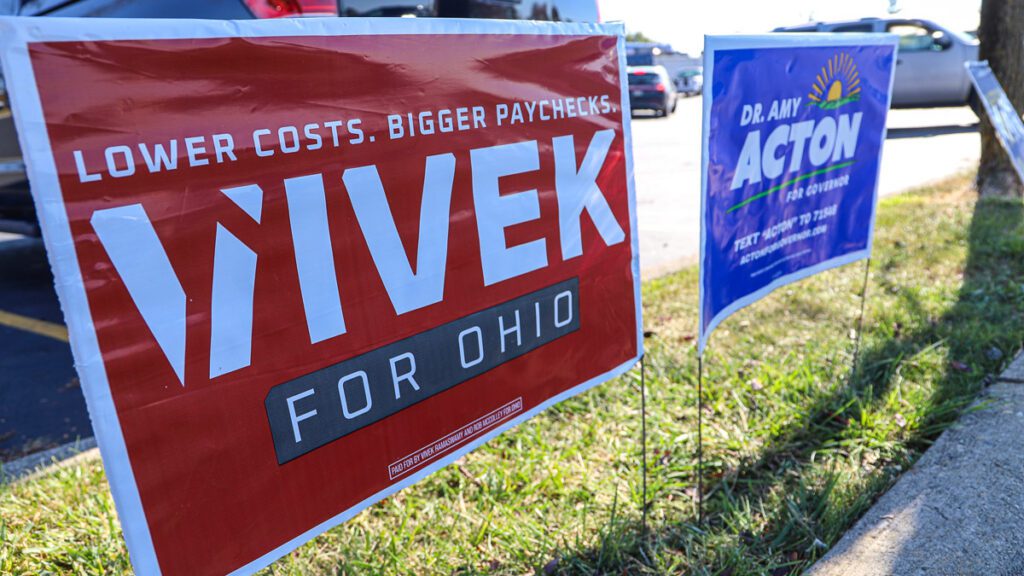
Campaign signs in Delaware. Image Credit: Todd DeFeo/Ohio.News
Nearly 1.19 million Ohioans have already voted with a week remaining until the Nov. 3 election, according to the Ohio Secretary of State’s office.
At the current rate, early voting is on track to exceed the roughly 1.39 million early votes cast in the 2022 midterm, which set a record.
The state’s daily absentee voter file shows a clear partisan gap so far. About 40% of Democratic-affiliated voters have cast ballots, compared with just 25% of Republican-affiliated voters.
Election officials emphasized that early totals reflect only ballots already returned and do not yet indicate final partisan results. Thus far, the numbers translate to around 392,361 votes from Democrats and 339,115 from Republicans.
According to analysts, the proverbial wild card this cycle appears to be unaffiliated voters—those who have not voted in a partisan primary since 2024. Just days away from the midterm election, another 557,614 ballots have come from unaffiliated voters, nearly double the amount of unaffiliated ballots received by this time in 2022.
TargetEarly, a Democratic data firm, has modeled the early vote using voters’ electoral history, demographics, and geography. While the firm cannot determine how anyone actually voted, its estimates currently show 49% of early ballots coming from Democrats, 43% from Republicans, and 8% from independents that the firm cannot confidently classify.
By comparison, at the same point in 2024 the split was 41% Democrat, 50% Republican, and 9% independent. In 2022, it stood at 44% Democrat, 40% Republican, and 16% independent.
The numbers suggest a more Democratic-leaning early electorate than in either of the last two cycles, along with potentially higher overall turnout than 2022.
According to analysts, Democratic voters appear more motivated to cast ballots early this year. One possibility, they say, is that some Democrats who typically vote on Election Day are shifting to early voting, “simply moving their usual support rather than expanding it.”
In early vote jargon, that caveat means those votes are still the same votes the party would likely have received later—they are simply being cast on a different day. The total number of Democratic votes has not necessarily grown, but the timing has shifted from Election Day into the early-voting window.
Ohio, however, remains a Republican-leaning state with more registered Republican voters overall. The final outcome will depend heavily on turnout on Nov. 3, as early in-person voting continues through Sunday, Nov. 1.
Election officials have emphasized that voters, still holding mail ballots, must return them by 7:30 p.m. on Election Day this year, while reminding voters that a valid photo ID is required for in-person voting.
Related Stories

Ramaswamy plans to probe property tax increases if elected governor
Vivek Ramaswamy on Amy Acton: ‘If you cannot debate, you cannot lead the state’