Former Ohio State president answers veteran’s lawsuit over stalled app deal
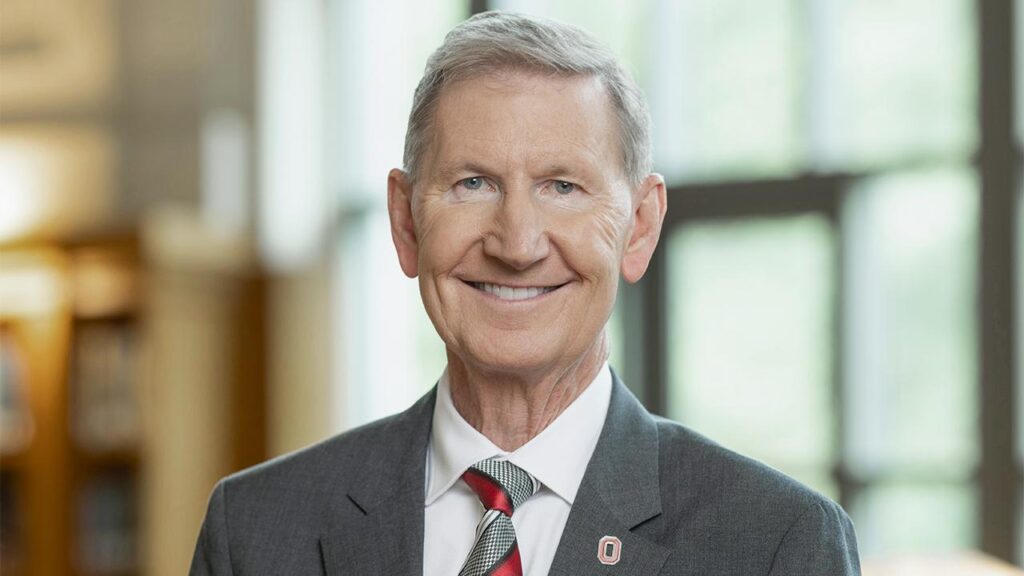
Five months after he resigned as Ohio State University president, Ted Carter has answered a lawsuit stemming from the very same controversy that led to his resignation.
Carter left the university on March 7 after telling trustees he had an “inappropriate relationship” with someone seeking public resources for a private business.
Ex-Ohio State president Ted Carter may have given podcaster at center of ‘inappropriate relationship’ cozy on-campus office: reports Ohio State officials are investigating an LLC registered at a campus building to Krisanthe Vlachos, the host of a small-t… https://t.co/Bk7wTNAttn pic.twitter.com/UZD2TqW85j
— UnfilteredAmerica (@NahBabyNahNah) March 11, 2026
That person was later identified as Columbus-area podcaster Krisanthe Vlachos. An internal OSU investigation concluded that Carter had used his office and position to help her access public resources.
According to the OSU report, those resources included access to donors, staff time, paid travel, and a contract for her podcast.
The details and extent of that access were made public in June, when Paul Hylenski, a disabled Marine veteran and founder of the Maryland-based software company Vet Mentor AI, filed a lawsuit against Carter, Vlachos, OSU and JobsOhio.
“On June 26, 2025, through the efforts and influence of Mr. Carter, Ms. Vlachos signed a $93,716.00 contract with WOSU, a Public Broadcasting System member owned by OSU, for podcast production services covering 50 episodes and space, without cost to her, within WOSU’s location,” the lawsuit details.
That location, on public property, is of material importance to the case because, as the filing outlines, it is where Ms. Vlachos registered her company, VetEarnUSA, LLC, when she registered it with the Ohio Secretary of State on Dec. 20, 2025, the very same day that Hylenski refused to give Vlachos a 25% ownership share of his company and make her the CEO.
That’s when things began to fall apart, Hylenski’s lawsuit claims, adding a detailed timeline of events.
During the summer of 2025, Carter and Vlachos met Paul Hylenski at a rodeo. Over the next six months, Hylenski, Vlachos and Carter developed a partnership: Hylenski had the tech, an Ohio version of his app that connects veterans to benefits, medical care, housing and employment; Vlachos had the vision; and Carter had the resources to make it happen.
“During September 2025, with the support, guidance and direction of Mr. Carter, Ms. Vlachos conducted multiple discussions with Mr. Hylenski about obtaining funding to advance their venture, during which Ms. Vlachos stated with certainty that she could get Mr. Carter to set up an introduction with Les Wexner, a significant and influential donor to OSU,” the filing alleges, adding an estimated valuation of around $5 million to $6 million.
As Vlachos and Hylenski continued to meet over that six-month period, Carter promised to open doors at OSU, JobsOhio and the Ohio Department of Veterans Services and with donors, according to the lawsuit.
The partnership concept was to run Vlachos’s “Connect to Power” VA support tools using Hylenski’s existing app technology as “the engine.”
As promised, those meetings began taking place in October with OSU, JobsOhio, and Veterans Services. However, when Vlachos attempted a solo pitch, the response was that the app was “not viable” and would not be a good return on investment.
Hylenski was asked to pitch the partnership in December to assure state entities that the technology was not only possible but currently in operation and helping veterans. Hylenski says that the pitch at JobsOhio went well, with stakeholders at OSU and veterans-services officials expressing such enthusiasm for the app that he believed a deal was coming.
On Dec. 20, however, Hylenski alleges that Vlachos demanded 25% equity in his company and the CEO job, or else “he would lose Ohio.” The partnership dissolved, with Hylenski being left out of future meetings.
Hylenski is also alleging defamation surrounding “not viable” comments.
OSU’s later report also quoted people calling Vlachos’s concept “not viable.” Hylenski calls that false, notes follow-up emails after the December meeting, and says his product is live and serving veterans. He also alleges Carter and Vlachos tried to rebuild the idea without him after the split.
On Aug. 19, Carter answered through attorney Austin Richards, his first on-the-record response since resigning. He admitted he was president, resigned March 7, and spoke at a line-worker rodeo.
He denied nearly everything else, including attending that event with Vlachos. He says there was no contract, the claims fail as a matter of law, and the suit is frivolous. He asked the judge to dismiss it and award him legal fees.
JobsOhio filed a similar denial. Vlachos had not answered as of this week. The attorney general, representing OSU, asked the Court of Claims to treat Carter and the university as separate and to rule that Carter does not have state-employee immunity.
A telephone conference is set for Sept. 14.