House passes bill to increase penalties for killing law enforcement officers
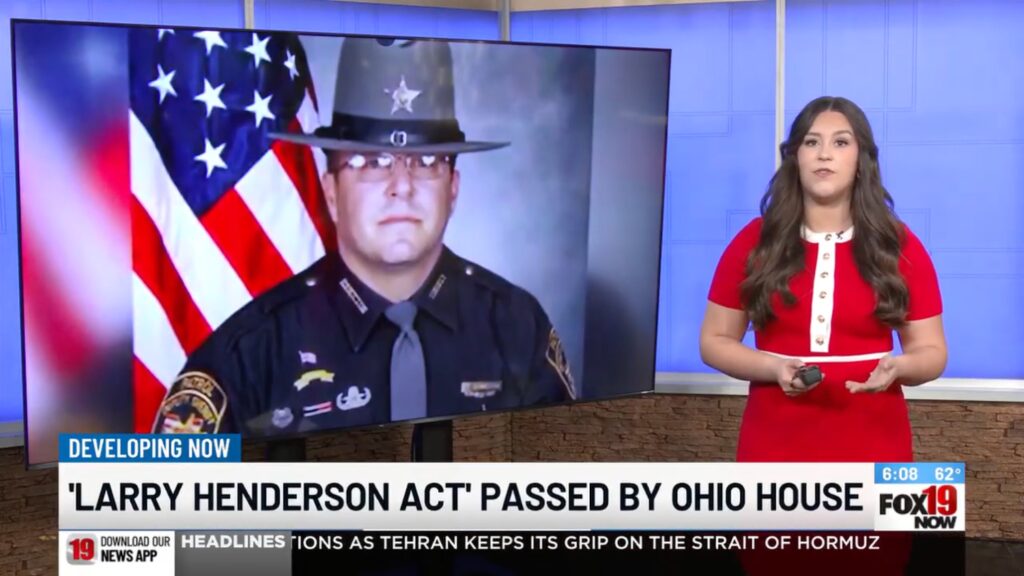
The Ohio House of Representatives has passed a measure to increase the penalties for anyone convicted of killing a police officer in the line of duty. However, the move was far from unanimous.
The House voted 89-4 in favor of House Bill 372, the Larry Henderson Act. Sentencing would be limited to two options: the death penalty or life imprisonment without the possibility of parole.
The Ohio legislation follows a nationwide increase in assaults on officers and first responders and aims to amend Ohio’s law by limiting mandatory minimum sentencing for adult offenders convicted of the aggravated assault of a peace officer, prosecutor, first responder, or military member.
The measure honors Deputy Larry Ray Henderson Jr., a 57-year-old Hamilton County Sheriff’s Office special deputy and U.S. Marine veteran with nearly 34 years of service. He was killed on May 2, 2025, after authorities say he was deliberately struck and killed by a vehicle driven by Rodney Hinton Jr. while directing traffic at the University of Cincinnati’s spring commencement.
According to officials, the incident occurred the day after Rodney Hinton Jr. and his family had met with Cincinnati police to review body-camera footage of the fatal shooting of Hinton’s 18-year-old son, Ryan Hinton. While fleeing from a stolen vehicle, the younger Hinton reportedly drew a gun, at which time he was shot by an unnamed Cincinnati police officer.
Prosecutors alleged the vehicle ramming was a deliberate and targeted attack on Henderson because he wore the uniform and badge.
FBI LEOKA data shows assaults on officers reached a 10-year high of 85,730 in 2024 — a rate of 13.5 per 100 officers. National Fraternal Order of Police reports documented 347 officers shot in the line of duty in 2025, with 67 ambush-style attacks resulting in 90 officers shot and 22 killed.
Testifying on behalf of the Northern Ohio Fire Fighters, Sam Gmetro argued that violence against first responders represents a direct attack on public safety itself.
“HB 372 has provisions that simply take away the possibility of parole, making the penalty, decided by the jury and judge — the death penalty or life imprisonment without the possibility of parole,” Gmetro told lawmakers. “NOFF feels this makes sense as killing a first responder is certainly a direct attack on safety, and those trying to provide it. Thus, that perpetrator must now stay in prison where they belong, without the ability of parole.”
Recent reports show Cleveland EMS has documented 30 reported assaults on workers since January 2023, according to Commander Jonathan Wearstler, who oversees EMS operations.
Surveys from the Police Executive Research Forum document these downstream impacts on communities.
Post-2020, agencies saw resignations rise sharply — up 47% in some periods through 2022 — and applicant pools drop significantly, with 69% of agencies reporting declines. Overall, precincts are losing sworn officers faster than they can replace them, with recruitment remaining about 5% below 2020 levels through 2025.
While all four members of the House who voted against the legislation were Democrats — Reps. Christine Cockley, D-Columbus, Veronica R. Sims, D-Akron, Juanita O. Brent, D-Cleveland and Tristan Rader, D-Lakewood. Only Brent and Rader issued public statements about their votes.
Taking to Facebook, Rep. Brent said “the legislation builds a dangerous tier system that essentially decides some lives are worth more than others.” “[W]hen we take away a judge’s power to choose the most just path, we are no longer practicing justice; we are practicing automation.”
In a press release following the vote, Rep. Rader said, “I will not support any bill that requires or encourages the death penalty for any crime. State sanctioned killings must end.”
Sponsors of the legislation, Reps. Cindy Abrams, R-Harrison, and Phil Plummer, R-Dayton, testified that the bill aims to provide stronger deterrence against attacks on those who protect Ohio’s communities. Emphasizing the role that mandatory minimum sentencing plays in deterrence, Abrams clarified that the bill does not add the death penalty, which already exists in state law for such convictions.
Henderson’s widow, Lori Henderson, testified emotionally before the House Judiciary Committee. She described the unbearable trauma of repeated parole hearings that force families to relive their loss indefinitely.
“Justice is not truly served when victims’ families are condemned to a lifetime of reliving their loss through endless parole proceedings,” she said. “Once the trial is over and a sentence is given, families should not have to fear being dragged back into that same nightmare every few years.”
Her daughter, Adrianna Henderson — joined by the parents of officer Jamieson Ritter, also killed in the line of duty – emphasized the need for permanent closure and respect for the sacrifices made to serve the public.
The Larry Henderson Act — which has also been introduced at the federal level by Republican U.S. Sen. Bernie Moreno — could soon become the law nationwide. While the Ohio bill advances for consideration by state senators, Republican Gov. DeWine has not publicly indicated whether he would sign or veto it should it head to his desk.
Related Stories

Undercover videos show Democrats have a disconnect, with some insiders saying the party takes minorities for granted

In Ohio press conference, Vance announces $42 million in SNAP fraud, including $30 million in Buckeye State