LaRose: Nine illegal noncitizens possibly voted in Ohio elections

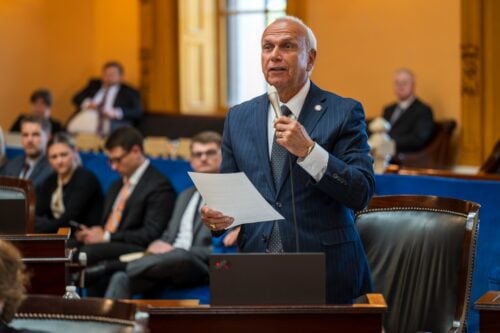
In this June 2025 photo, Ohio Secretary of State Frank LaRose certifies the official results of the 2025 Primary and Special Election, marking the completion of the statewide canvass by Ohio’s 88 county boards of elections and formally affirming the winners. (Courtesy Ohio Secretary of State's Office)
Nine illegal noncitizens may have recently voted in Ohio, lending credence to concerns about voting integrity.
The nine were among 78 noncitizen voter registrations that the Secretary of State’s Election Integrity Unit uncovered as part of a continuing audit of Ohio’s Statewide Voter Registration Database. Ohio Secretary of State Frank LaRose has referred evidence of voter registrations and voting activity to Ohio Attorney General Dave Yost’s office for possible prosecution.
A spokesman for LaRose did not respond to a request from Ohio.News about the illegal votes and how they were able to register. A spokeswoman for Yost did not respond to a request from Ohio.News about whether the office would proceed with prosecutions.
“My office has a zero-tolerance policy for election crime in Ohio, and I’m hopeful that our prosecutors will as well,” LaRose said in a release. “Even one illegal vote can spoil the outcome of an election, which is why we established the first-ever Election Integrity Unit in this state to root out lawbreakers and demand accountability and justice.”
“States have the responsibility to keep accurate voter rolls and ensure election integrity,” LaRose added. “In order to meet that responsibility, we need more access to data from the federal government. I will continue to push until we have the resources we need to do our jobs to the standard Ohioans deserve.”
Election Security
LaRose has regularly touted Ohio’s role as a leader in election security, and his office said it has referred to prosecutors hundreds of election crime cases since taking office in 2019.
During his first five years in office, LaRose’s office referred 633 people to law enforcement. The office alleged they voted multiple times in the same state, voted in two different states, participated in election fraud involving dead people or perpetuated registration and voting violations by noncitizens.
As of September 2024, 621 of those referred had not been charged by their respective county prosecutor.
“We respect prosecutorial discretion, and we don’t necessarily expect all 633 referrals to lead to criminal charges, but only 12 out of 633 shows a second set of eyes might be needed here to determine whether prosecution of these crimes is justified,” Hun Yi, director of investigations for the Secretary of State’s Public Integrity Division, wrote in a letter to Yost.
“Accordingly, county prosecutors have had more than ’a reasonable time’ to prosecute the violations and apparently have chosen not to do so,” Yi added. “We hereby respectfully request that you use your authority under Ohio Revised Code Section 109.95 to review these cases, utilizing your own discretion, and prosecute the violations as you see appropriate.”
State law allows the Secretary of State to “investigate the administration of election laws, frauds, and irregularities in elections in any county, and report violations of election laws to the attorney general or prosecuting attorney, or both, for prosecution.”
Public Integrity Division
LaRose has said that prompted him to create a Public Integrity Division in 2022. The division consolidated longstanding investigative functions, such as the investigation of election law violations and campaign finance reporting, and focused full-time resources on investigations and enhancing support for criminal prosecutions.
Investigators, including those with backgrounds in the Ohio State Highway Patrol and law enforcement, have focused on improving their collaboration with the Bureau of Criminal Investigation and the Federal Bureau of Investigation to improve the evidence provided for potential prosecution.
As part of the state’s two-year budget, an amended version of House Bill 96, state lawmakers made the Election Integrity Unit permanent. In doing so, lawmakers eliminated the Ohio Elections Commission, a half-century-old commission created amid the Watergate scandal.