LaRose sends voter registration data to feds while disagreeing with Trump on mail ballots
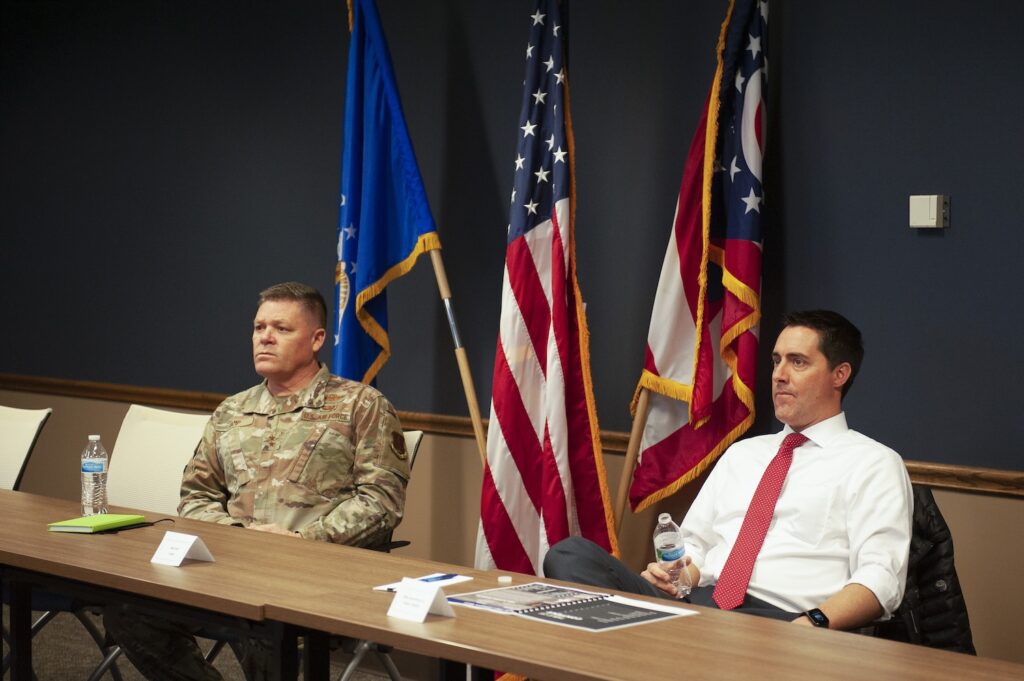
Frank LaRose, Ohio’s 51st Secretary of State, and Ohio’s Assistant Adjutant General for Air, Maj. Gen. James Camp, listen as Col. Michael DiDio, commander of the Ohio National Guard’s 180th Fighter Wing present’s a unit briefing during a visit to the wing in Swanton, Ohio, Dec. 15, 2021. LaRose visited the wing to learn more about Ohio’s state’s only F-16 Fighting Falcon Squadron, providing 24/7 support to the nation’s Aerospace Control Alert Homeland Defense Mission. Air National Guard photo by Senior Master Sgt. Beth Holliker.
Ohio Secretary of State Frank LaRose sent Ohio’s personal voter registration data for nearly 8 million Ohioans to the U.S. Department of Justice to prove that the Buckeye State follows federal election law, while also disagreeing with President Donald Trump on mail ballots, suggesting that they should not be completely abolished.
LaRose told the DOJ in a Feb. 13 letter that he provided voter data, including names, addresses, dates of birth, the last four digits of voters’ Social Security numbers, and driver’s license numbers.
“Really just to look at what the state law says and to make sure that there’s an understanding in place about the protection of that data, and then of course to comply with federal law, which is what we’re bound to do, and it’s also the right thing to do,” LaRose said, according to 10WBNS.
LaRose also said that he is confident the voter data is secure, adding that the federal bureaucrats who violate their own data privacy laws “would face criminal liability for doing so,” according to the news source.
However, Steve David, Ohio Director of All Voting Is Local, a voter advocacy organization, criticized LaRose, saying that the transfer of voter registration data exposes voters’ sensitive personal information, the news source reported.
Collin Marozzi, advocacy director for the American Civil Liberties Union of Ohio, also told The Columbus Dispatch that the DOJ’s use of state voter rolls to create a national registration list is bad news for the United States.
“It seems like we went out of our way to give millions of Ohioans’ sensitive information without any guarantees,” he told The Columbus Dispatch. “It was like a wink and a nod and a handshake that everything’s going to be above board here.”
While LaRose provides the information to the Trump administration, federal judges in Michigan, California, and Oregon dismiss lawsuits filed by the DOJ, ruling that states are not required to hand over unredacted voter data to the federal government.
“The centralization of this information by the federal government would have a chilling effect on voter registration, which would inevitably lead to decreasing voter turnout as voters fear that their information is being used for some inappropriate or unlawful purpose,” U.S. District Judge David Carter of California wrote in his January ruling.
U.S. Rep. Shontel Brown, D-Ohio, one of the most vocal federal lawmakers from Ohio, also criticized her home state and LaRose for giving away the sensitive information to the Trump administration.
“Shame on Ohio and Secretary of State LaRose for handing confidential voter information to the federal government,” she said in a statement. “This isn’t about election security. Our elections are safe and secure. This is just another cynical attempt by Donald Trump to sow fear, create chaos, and undermine future elections. And the rubber-stamping Republicans down in Columbus are happily playing along.”
While LaRose is on the same page regarding sharing sensitive information with the federal government, he disagrees with Trump on mail ballots, according to Signal Ohio. Trump is calling for a nationwide ban on the practice, but LaRose thinks that the system should be left in place.
“When done right, voting early by mail has proven to be effective, efficient, and secure,” LaRose’s spokesperson Ben Kindel told Signal Ohio. “Ohio has the right checks and balances in place to keep mail-in voting accountable, but other states don’t. That’s what we should be focused on fixing.”
Related Stories
Guatemalan pleads guilty to making false statements as part of unaccompanied minor smuggling scheme in Ohio

Migrants who flooded border under Biden dispersed across nation’s heartland, including Ohio