Ohio businesses gain faster exit from competitive electric suppliers under new rule
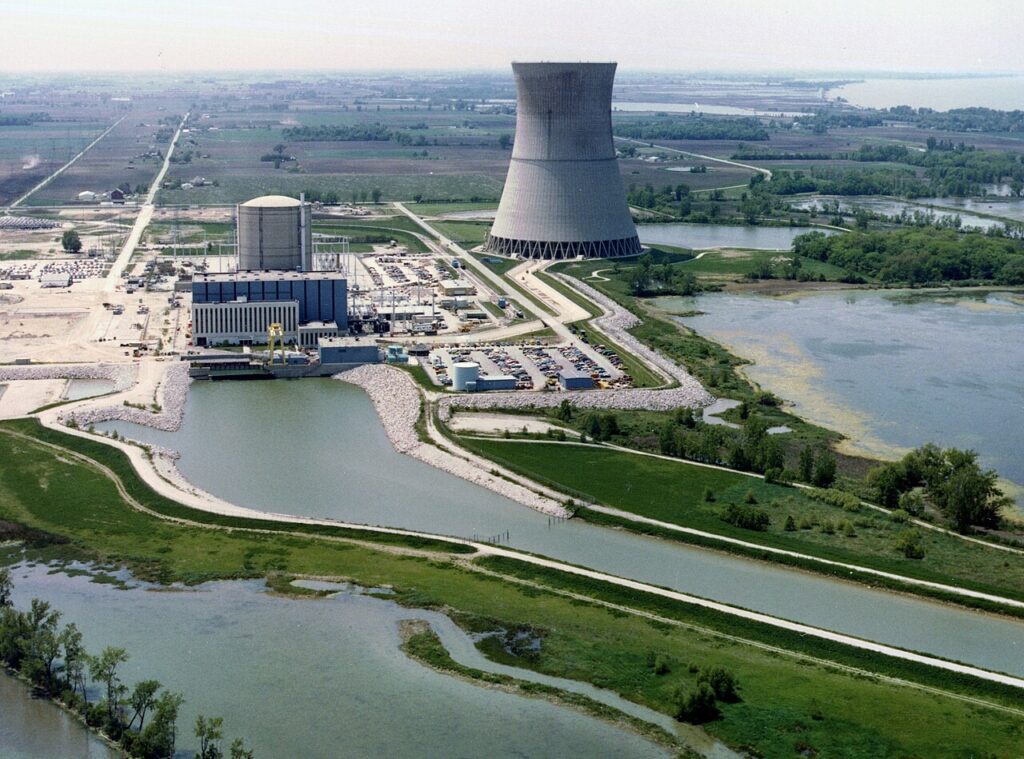
Davis-Besse Nuclear Power Station
Large Ohio businesses now have a streamlined path to switch back from competitive supply arrangements, such as renewable portfolio standards, to their local utility’s default electricity rate under new rules finalized this month by the Public Utilities Commission of Ohio.
The regulation – implemented as a result of House Bill 15, which Republican Gov. Mike DeWine signed into law in May 2015 – is part of a forward-looking consumer protection provision following the FirstEnergy bribery scandal, currently being adjudicated. HB 15, effective August 2025, broadly reformed Ohio’s competitive retail market, repealing remnants of 2019’s controversial House Bill 6 subsidies while strengthening consumer protections.
The new rule requires electric distribution utilities to complete an expedited return of “mercantile” customers — commercial or industrial users consuming more than 700,000 kilowatt-hours annually or part of national accounts — to the standard service offer, or SSO, within three business days of a certified request.
Following the federal rollback of renewable incentives, competitive suppliers offering 100% renewable or green plans – backed by renewable energy credits – may face higher costs without federal credits. For large energy consumers, those plans may become less competitive vs. the utility’s SSO, which often includes a mix of sources procured via auctions.
The SSO, often set through competitive auctions, serves as the default generation rate when customers do not choose a third-party competitive retail electric supplier. The new rule, adopted in PUCO docket 25-741-EL-ORD, applies “regardless of billing cycle” and rejects exceptions for operational delays—despite pushback from AEP and Duke.
PUCO emphasized in its March 2026 order that the statute “requires that the EDU ‘complete the request within three business days.’”
The commission noted that “nothing in the statute permits the Commission to provide additional timing allowances based on billing cycles or operational preferences.”
The rule also permits utilities to recover administrative costs of processing expedited requests through “reasonable fees” charged to CRES providers, not customers—balancing the policy goal of seamless switching with uncompensated burden.
Proponents argue that HB 15 is leading to increased energy production in Ohio, including a December announcement from Vistra that it had entered into 20-year power purchase agreements with Meta to supply more than 2,600 megawatts of zero-carbon nuclear energy from three plants in the PJM Interconnection: the Perry and Davis-Besse plants in Ohio and the Beaver Valley plant in Pennsylvania, according to a news release.
Ohio’s industries are growing in leaps and bounds, and I was honored to join @AEPnews and @ENERGY recently to celebrate the historic investment being made in Piketon.
This site will be home to a $33 billion, 10 Gw natural gas generation facility, including 9.2 Gw of natural gas… pic.twitter.com/yWYobI0tmR
— Representative Dave Taylor (@RepDaveTaylor) March 23, 2026