Ohio Consumers’ Counsel urges stronger review of advanced transmission technologies
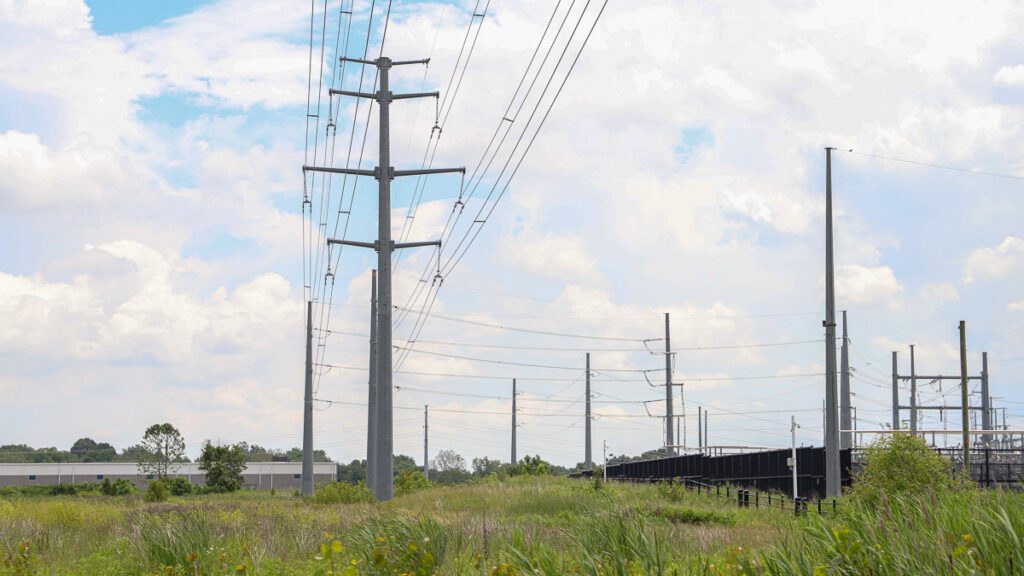
Power lines in New Albany. (Photo by Todd DeFeo)
The Office of the Ohio Consumers’ Counsel continues to urge greater regulatory oversight of advanced transmission technologies before consumers foot the bill for the turbocharged utility grid upgrades.
In a news release, the OCC urged the Public Utilities Commission of Ohio to strengthen the framework with “clear, transparent and standardized cost-benefit calculations.” Ohio consumers ultimately pay transmission costs through their electric bills, according to the OCC, a state agency that advocates for Ohio’s residential consumers on utility rates and services.
PUCO adopted a methodology for utilities to evaluate the costs and benefits of advanced transmission technologies, as required by House Bill 15.
Advanced transmission technologies — including higher-capacity wires, line sensors and power-flow devices — can help utilities move more electricity across existing transmission lines and potentially avoid or delay more expensive grid upgrades. While ATTs do not generate electricity on their own, they can provide the extra grid capacity required to power data centers quickly and efficiently.
Ohio ranks among the larger U.S. data center markets, and the demand continues to grow.
OCC urged the PUCO to require utilities to demonstrate that proposed investments are needed, cost-effective, and beneficial to consumers. The OCC also asked the PUCO to compare them with reasonable alternatives before asking consumers to pay.
“New technology can make the electric grid work smarter and save consumers money. But innovation is not a blank check,” Ohio Consumers’ Counsel Maureen Willis said. “Before consumers pay millions for a transmission project, utilities should have to show that it is needed, that it beats the alternatives, and that the benefits justify the cost.”
The PUCO approval came a day after Gov. Mike DeWine announced that the U.S. Department of Energy awarded Ohio a $273 million grant to update Ohio’s existing high-voltage electric infrastructure through the Speed to Power through Accelerated Reconductoring and other Key Advanced Transmission Technology Upgrades (SPARK) initiative.
According to the governor’s office, the PUCO will receive $137 million to work with transmission utilities to “implement advanced transmission technologies to increase the capacity of the transmission grid, allowing it to carry more energy, rather than build new infrastructure.”
Ohio has laid the groundwork for deploying advanced transmission technologies by enacting Ohio House Bill 15, a sweeping energy reform law DeWine signed on May 15, 2025. The legislation requires utilities and regulators to explore cost-effective advanced transmission technologies before pursuing conventional high-voltage grid expansions, the Ohio Capital Journal reported.
In February, the PUCO published a report on opportunities from advanced transmission technologies.
The OCC initially supported House Bill 15, saying the legislation “moves Ohio closer to a regulatory framework that better balances consumer protections and utility interests.” However, in August, the OCC pressured federal regulators to resolve a three-year-old complaint aimed at addressing Ohio utilities’ “unchecked investment in local transmission and supplemental projects,” the Ohio ratepayer advocate said, per UtilityDive.
The OCC filed the complaint with the Federal Energy Regulatory Commission in 2023, asking FERC to review supplemental transmission charges for need, prudence and cost-effectiveness.
Since the complaint was filed, FirstEnergy, AEP and other Ohio utilities have planned more than $4.3 billion in local transmission without adequate oversight. The OCC contends that local transmission and supplemental project plans have “ballooned,” partly to handle large-load data centers owned by companies such as Meta, Amazon and Google.