Ohio House passes childcare fraud crackdown bill amid growing scrutiny of publicly funded programs
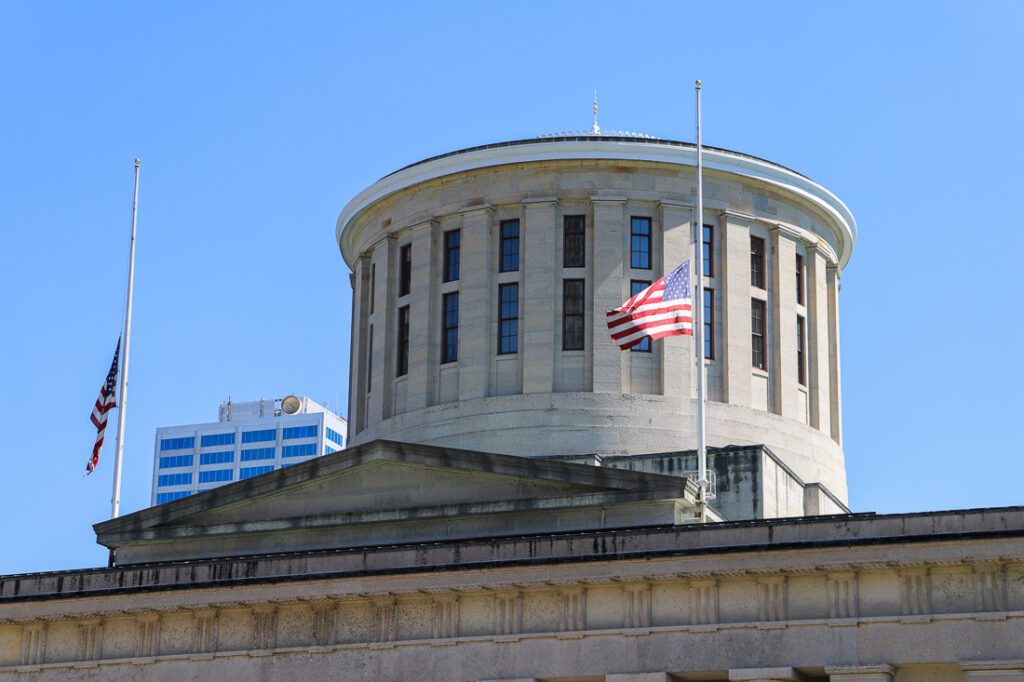
An April 2026 view of the Ohio Statehouse. (Photo by T.A. DeFeo)
Amid a statewide effort to crack down on fraud in publicly funded programs, the Ohio House has approved legislation designed to strengthen investigations and enforcement against suspected childcare fraud.
House Bill 647, sponsored by state Reps. Phil Plummer, R-Dayton, and Tom Young, R-Washington Township, passed the House this week and now heads to the Ohio Senate for consideration.
The legislation follows months of increased attention on publicly funded childcare programs after state officials launched program integrity reviews and uncovered approximately $1 million in overpayments among a sample of Ohio childcare providers.
The legislation also comes as lawmakers and state officials continue examining fraud concerns in Medicaid and other taxpayer-funded programs, an issue that has dominated legislative discussions throughout the year.
“H.B. 647 will establish guardrails and accountability when dealing with publicly funded child care fraud,” Plummer said in a statement. “We have identified fraud in the system, and this bill will close the exploited gaps and hold bad actors accountable.”
Young described the legislation as part of a broader effort to strengthen public confidence in a system relied upon by thousands of Ohio families.
“HB 647 is a step in the right direction that sets the stage for greater accountability to keep the system that so many families rely on credible,” Young said.
The bill would give the Ohio Attorney General explicit authority to investigate suspected fraud involving publicly funded childcare programs and pursue criminal or civil actions when appropriate. It would also allow the Department of Children and Youth to suspend provider agreements, recover improperly paid funds, and terminate contracts when evidence demonstrates fraud, misuse of public funds, or other violations.
The legislation also establishes statutory definitions for both “fraud against the publicly funded child care program” and “misuse of public funds,” while creating new procedures for coordination between the Department of Children and Youth, the Attorney General’s Office and local prosecutors in suspected fraud cases.
The bill arrives as Ohio officials continue examining potential abuse within publicly funded childcare programs.
In January, the Department of Children and Youth launched statewide program integrity reviews following national attention surrounding large-scale childcare fraud investigations in Minnesota and concerns from Ohio lawmakers about whether similar schemes could occur in the Buckeye State.
Last month, the department announced it had stopped funding to 10 childcare providers after identifying roughly $1 million in overpayments during a review of 400 publicly funded childcare providers. State officials said the sample represented a statistically valid review of Ohio’s approximately 5,200 providers participating in the system.
The affected providers were located primarily in Franklin County, though centers in Cuyahoga and Hamilton counties were also included in the review.
Based on the sample, state officials estimated the overpayments represented approximately 1.6% of the nearly $969 million spent annually on taxpayer-funded childcare programs in Ohio.
Department of Children and Youth Director Kara Wente said at the time that program integrity had become a central focus for the agency.
“Any dollar not used to support children and families is unacceptable,” Wente said when announcing the findings.
State officials projected the overpayments identified in the sample could represent millions of dollars statewide if similar rates were found across Ohio’s publicly funded childcare system.
The childcare investigations have unfolded alongside broader concerns raised by state officials regarding fraud and improper payments across multiple public benefit programs.
Ohio Auditor Keith Faber recently told lawmakers his office has identified significant weaknesses in Medicaid and other public assistance programs. Faber said his office has received more than 200 fraud-related tips this year and has identified billions of dollars in questionable, improper, or high-risk payments across various government programs.
The House’s approval of HB 647 marks the latest effort by Ohio lawmakers to strengthen anti-fraud enforcement as state agencies continue reviewing publicly funded childcare, Medicaid, and other taxpayer-funded programs.
Related Stories

Don’t know whether the Democrat is anti-war? Just ‘spitball and improvise,’ Dem organizer says in undercover video

Rep. Michelle Teska urges legislative action to require English proficiency rules amid public safety concerns