Ohio improves SNAP accuracy, which could save Buckeye State residents millions
Ohio has improved its payment accuracy rate for the Supplemental Nutrition Assistance Program, officials announced Thursday.
SNAP is a federal program that distributes more than $270 million in benefits to about 1.4 million Ohioans every month, according to an ODJFS release.
H.R. 1, also known as the One Big Beautiful Bill Act, introduced a new cost-sharing provision in 2025, which required all states to pay a portion of SNAP benefits based on their payment accuracy rate.
“We have been working closely with counties to improve payment accuracy by reducing common errors in the SNAP program,” Ohio Department of Job and Family Services Director Matt Damschroder said in the release. “Together, we’ve made significant progress over the past year and remain committed to becoming even more efficient stewards of these critical public resources.”
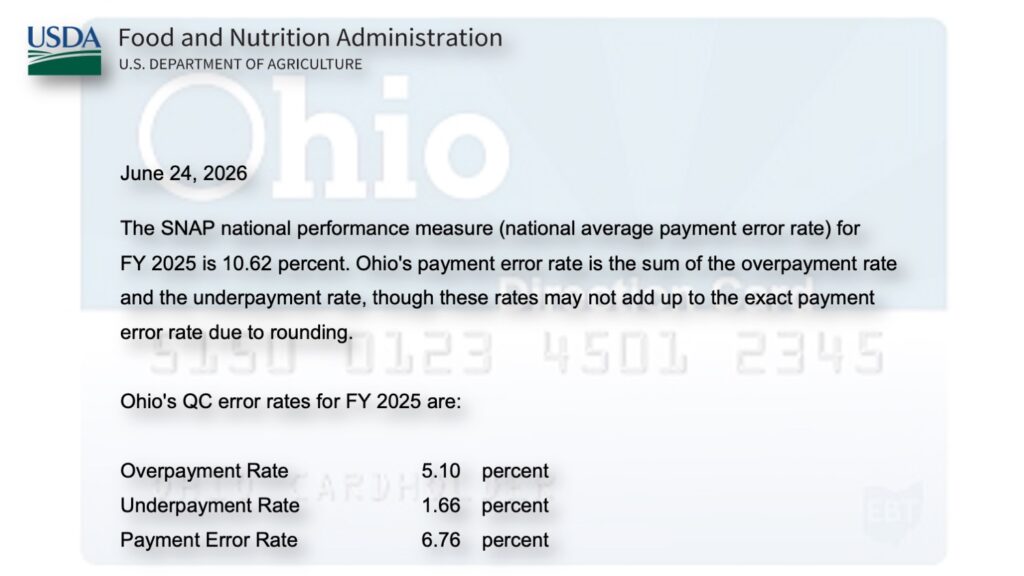
On Wednesday, the U.S. Department of Agriculture’s Food and Nutrition Administration released SNAP accuracy updates that indicated that the Buckeye State’s federal fiscal year 2025 error rate was 6.76%. Ohio’s most recent official error rate of 9.13% in federal fiscal 2024 was an improvement, for which Ohio was “commended” by the FNA, according to the press release.
“Thank you for providing USDA with your State agency’s data for the SNAP Information Database,” FNA’s Acting Administrator Shiela Corley wrote in the Wednesday letter. “We appreciate your continued efforts in providing the requested data and look forward to continuing to assist Ohio in identifying, addressing, and preventing SNAP integrity issues.”
READ IT HERE: Acting Administrator Shiela Corley’s letter to Director Matt Damschroder
Corley added that “Ohio’s proper administration of SNAP is essential to ensuring the Program operates efficiently, effectively, and with integrity and accountability.”
“The Midwest Regional Office is your partner in reducing payment error rates. Together, we are stewards of taxpayers’ money, and our collaborative efforts will improve program integrity,” she wrote.
Corley also said that both federal and state government officials have a “historic opportunity” to improve SNAP and other similar programs.
“As Secretary Brooke Rollins wrote in her February 13, 2025, letter to government partners that administer USDA’s nutrition assistance programs, we have before us a historic opportunity to improve nutrition programs to both better serve individuals who need additional support and to lift millions of Americans out of dependency into hopeful futures,” she wrote. “Consistent with the Secretary’s vision for nutrition programs, it is imperative that we take swift action to minimize instances of fraud, waste, and program abuse.”
The recent discovery is good news for Ohio taxpayers because, starting on Oct. 1, 2027, every state’s cost share will be based on its official error rate. The federal government will continue to fund 100% of benefit costs for states with error rates under 6%. Those states that have error rates higher than that will pay an increasing percentage of benefit costs.
Ohio government officials reduced the state’s error rate by “identifying common errors and working with counties to reduce those errors,” according to a release. Among the errors the state found were “a recipient’s failure to report income, incorrect reporting of a household’s composition, failure to report a job, and incorrect calculation of financial information such as income and expenses.”