Ohio is ‘very well situated’ to produce energy for data centers as Senate Republicans outline debate
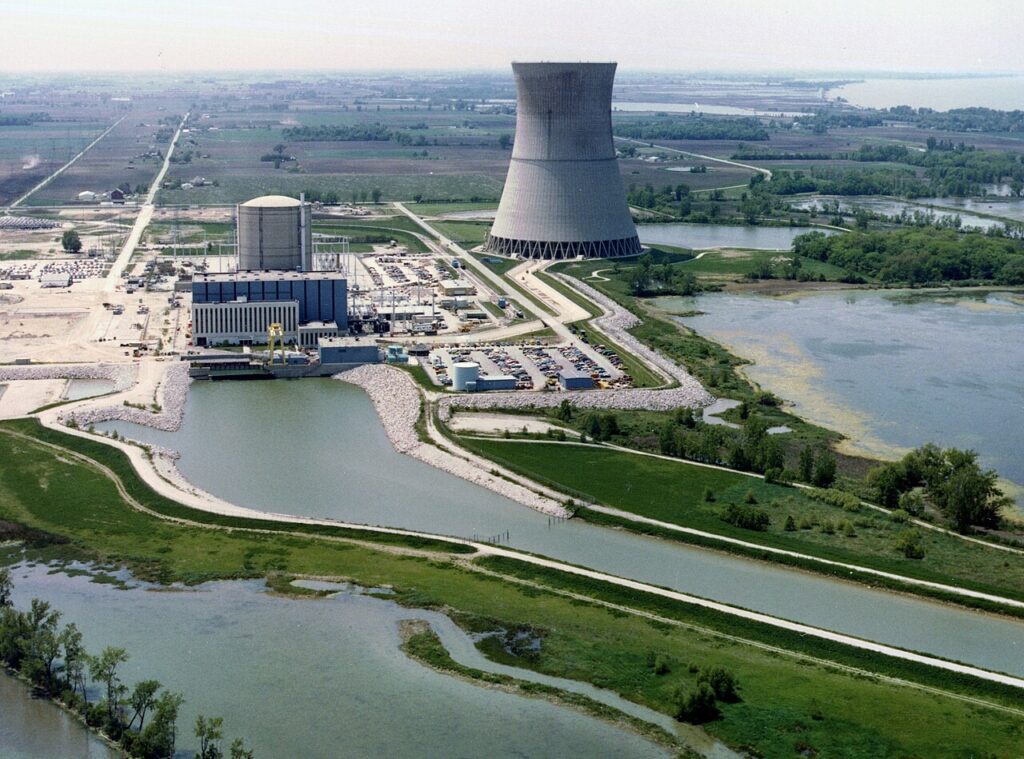
Davis-Besse Nuclear Power Station
Amid discussions and concerns over data centers and producing reliable energy for them, Ohio Senate Republicans say they are taking steps taken to meet the urgency of the moment.
In a Senate Republican podcast, Senate Education Chairman Andrew Brenner warned that “the Chinese Communist government does not want us in control of our data.” Adding that the CCP is willing to destroy its own environment, Brenner, R-Delaware, reaffirmed the urgency of outpacing adversaries in AI and tech infrastructure.
There’s just one main problem: America’s outdated and decommissioned energy infrastructure.
Under the Biden administration’s Federal Plan for Equitable Long-Term Recovery and Resilience, coal mines, coal plants, and hydroelectric dams were rapidly decommissioned or scheduled for retirement. While the Trump administration has quickly reversed Biden-era policies and decommissioning efforts, government reports indicate that wind, solar and natural gas would need to increase by 50-90% to meet anticipated 2050 demands.
According to Ohio lawmakers, one solution appears to be the long-tested, now-commercialized use of Small Modular Reactors.
Similar to the technology that has safely powered submarines for decades, SMRs are inherently safe, Adrienne Schweer, a representative of Oklo, a 13-year-old company that’s currently commercializing SMR technology, said. Schweer contrasted these sodium-cooled fast fission nuclear SMRs with older versions.
“What makes them so different is that a fast fission reactor has a different safety profile, it’s called inherently safe,” Schweer highlighted while explaining that the technology has been well tested.
“We’re taking a set of nuclear technologies that America built and ran in the Department of Energy labs for hundreds of operating years, but were never commercialized.”
In partnership with META, Schweer said the company is currently building 16 SMRs that will output over 1.2 gigawatts of electricity. Enough to power about 1.2 million homes, the reactors will power META’s entire Pike County data center campus, behind-the-meter, and take up just 200 total acres.
Acknowledging the technical and regulatory hurdles that will need to be figured out, Ohio lawmakers like Sen. Jerry Cirino, R-Kirtland, said the future of nuclear energy is very positive.
“There’s no question to me that the expansion of our current traditional nuclear plants, the two that we have, is going to be critical,” Cirino said in a Senate Republican podcast. “But SMRs, small modular nuclear reactors, are going to become something that’s very important to our nuclear energy future.”
Senate leaders also argue that data centers drive jobs, tax revenue and tech growth.
Sen. Brian Chavez, R-Marietta, noted that facilities create ongoing construction work, serve hundreds of meals daily and use closed-loop water systems with one-time draws. Chavez, who said that data centers are “absolutely a matter of national security,” emphasized the consistent employment opportunities that data centers provide.
“They start working on the data center, and by the time they get to the end, they’re already starting back at the beginning because they need to be retooled. They need to change out the servers. They need to be rewired. So it is constant work going on there, and they’re paying taxes,” Chavez said in a Senate Republican podcast.
In a recent podcast, Ohio Senate Republican Caucus Spokesman John Fortney interviewed industry stakeholders about measures to meet Ohio’s surging energy demands while ensuring responsible development on U.S. soil.
Attending The Future of Nuclear Energy Forum at Perry High School, Fortney interviewed Asim Haque, executive vice president at grid operator PJM Interconnection and former Public Utilities Commission of Ohio chairman.
Explaining that high demand is increasing costs for the currently limited energy supply, Haque told Fortney that Ohio ranks very high in load growth and is “very well situated” to meet growing energy demands.
On a Senate Republican podcast discussing House Bill 15, a free-market solution to the alleged cronyism of HB 6, Fortney asked Haque whether the bill’s legalization of off-grid, or behind-the-meter, power generation for large users would help affordability. While avoiding the political aspects of the legislation, Haque responded that it’s a “totally acceptable and good way to meet … this increase in demand.”