Ohio lawmakers launch bipartisan Joint Data Center Committee amid adversarial degrowth campaigns
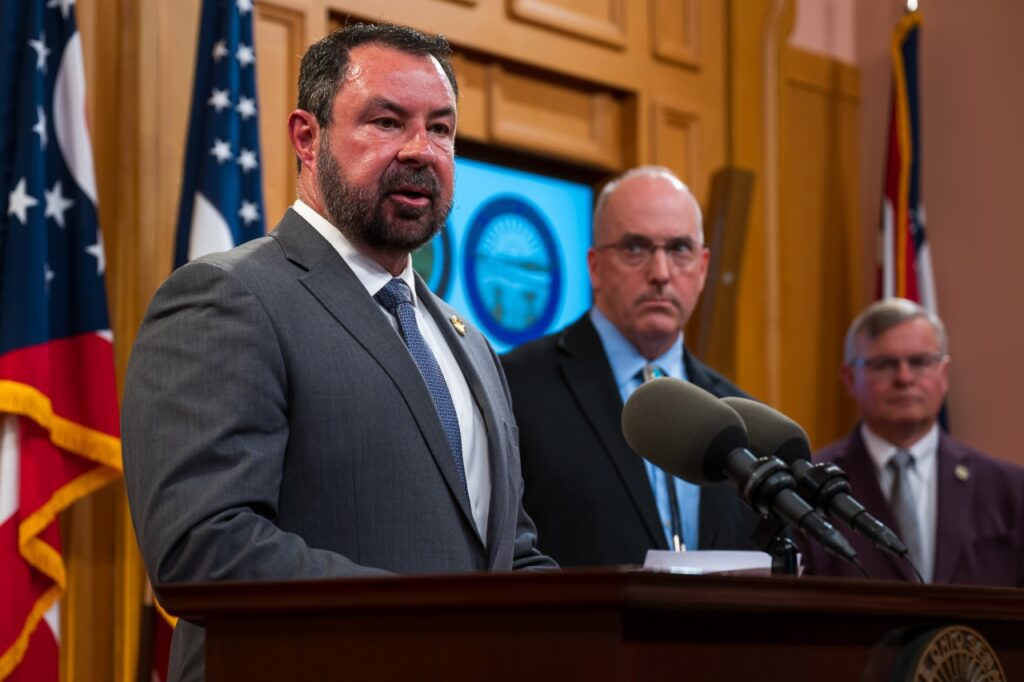
Ohio lawmakers last week announced the formation of a bipartisan, bicameral Joint Data Center Committee to study the economic, environmental, and national security implications of the state’s booming data center sector.
Co-chaired by Rep. Adam Holmes, R-Nashport, and Sen. Brian Chavez, R-Marietta, members hosted a press conference to outline the Committee’s work.
Ohio, known for incubating technological leaps from the airplane to the lightbulb, is home to roughly 200 data centers with more planned as artificial intelligence drives explosive demand for computing power. Yet, as competing narratives flood social media, some of which have ties to foreign adversarial funding sources, Chavez described the effort as a “fact-finding mission to understand the perceived and actual impacts of data centers and to share reliable information with local officials and concerned citizens.”
“We’ve spent a considerable amount of time traveling the state looking at data centers,” Chavez said. Emphasizing local engagement, Chavez said the committee has worked to identify both state and local community economic impacts of data center development, while “generally just increasing public awareness.”
“Energy and information are not only the economic drivers for the 21st century; they are also a national security imperative,” Holmes said. Acknowledging the crucial timing of sound data center development policies that benefit all Ohioans, Holmes warned “we simply can’t afford to be relying on other nations for our information resources.”
Senators noted that at the end of the day, “the issue is fundamentally about AI” and the fight to secure critical infrastructure amid degrowth initiatives that seek to “bring the U.S. economy to its knees.”
In an edition of The President’s Podcast, produced by the Ohio Senate Republican caucus, those strategic risks were further highlighted.
Former Congressman Bill Johnson, now president of Youngstown State University, expanded on the dangers of our over-reliance on foreign nations, drawing parallels to past outsourcing mistakes and Covid-era supply chain disruptions.
Warning that the U.S. came “so close to becoming a service-oriented economy because we were outsourcing so much of our manufacturing,” Johnson highlighted past mistakes that nearly hollowed out domestic capabilities.
While many examples exist from food production to energy, Johnson referenced the computing company Compaq, which outsourced assembly, motherboards, programming, and more until “the only thing left in the United States… were big buildings with their names on it.”
Johnson tied this to current threats: “We simply can’t afford to be relying on other nations for our information resources.”
He described how adversaries embed vulnerabilities, such as nefarious code in transformers purchased from China that collect data on the U.S. electric grid and transmit it back. Similar risks appeared in attempted railcar components designed to spy while traveling on American rails.
These vulnerabilities point to a sophisticated strategy. Johnson and podcast host John Fortney discussed how adversaries could cripple the United States through a multi-pronged approach — targeting the electric grid, energy systems, transportation networks, and data infrastructure — without ever firing a shot.
Relying on foreign manufacturing and technology creates backdoors for espionage and disruption, turning economic dependencies into strategic weaknesses.
In a discussion with Sen. Jerry Cirino, R-Kirtland, the topic turned to the organizations that have politicized data centers and why.
Amid ballot efforts to ban data centers, Cirino said he’s amazed at how little the public knows about the facilities, even though they’re currently in operation without issue. While pointing out the financial incentives for activists to raise money on perceived issues, Cirino said the real issue is whether Ohioans want adversarial nations like China controlling their data.
For Cirino, that would be like repeating America’s 30-year-old mistake of offshoring manufacturing, which has hollowed out the middle class and consolidated markets into an oligopolistic system where basic supply chains are now dependent on foreign imports and an ever-expansive foreign policy.
The committee will examine energy costs for ratepayers, water use, land and wildlife impacts, noise, light, and electromagnetic emissions, and the sector’s role in public safety and national security. Leaders aim to position the state as a national model while balancing local control and property rights with supply chain and cybersecurity risks.
The bipartisan Committee, which includes Democratic House Rep. Chris Glassburn, D-North Olmsted, and Sen. Willis Blackshear Jr., D-Dayton, will hold its first public hearings on May 27 and May 28, with proceedings streamed on The Ohio Channel.
Related Stories

Don’t know whether the Democrat is anti-war? Just ‘spitball and improvise,’ Dem organizer says in undercover video

Rep. Michelle Teska urges legislative action to require English proficiency rules amid public safety concerns