Ohio lawmakers warn of fiscal chaos in property tax repeal push
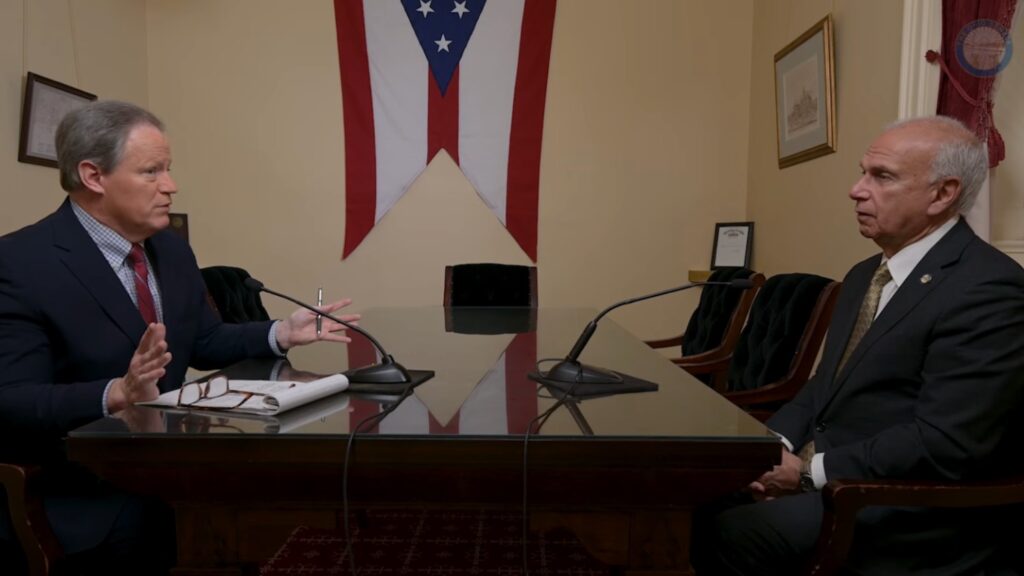
During the regularly scheduled Friday podcast of “The Views, The News, Excludes,” Ohio’s Senate Republicans sounded the alarm over a grassroots campaign to abolish property taxes statewide, warning that the proposal could create a massive funding gap for local governments without a clear replacement plan.
The initiated constitutional amendment, backed by groups like Citizens for Property Tax Reform and AxOHTax, would prohibit taxes on real property, including land, buildings and attached improvements that fund local municipalities.
Local property taxes currently generate about $24 billion annually for Ohio’s counties, cities, schools and other entities, funding schools, which receive 60-70% of revenues, police, fire departments, emergency services, roads, libraries and senior programs.
In contrast, the state’s General Revenue Fund, drawn from sales, income, and other taxes, totals roughly $30 billion annually.
Senate Finance Chairman Jerry Cirino, R-Kirtland, described the repeal effort as “totally irresponsible” during his appearance on the podcast. Frustrated, Cirino emphasized that citizen organizers have told local officials that state lawmakers would just need to “figure it out,” shifting the burden of a $24 billion deficit without alternatives.
Yet, even if alternatives were proposed, such as marijuana tax disbursements now going out to host communities, the $33 million pot, which could go a long way in offsetting property taxes, is not enough to fully cover the deficit.
Cirino, who has met with more than 40 mayors and city managers in northeast Ohio, highlighted strong local opposition, including a near-unanimous resolution against the measure. He also argued that the General Assembly is unlikely to raise state income or sales taxes dramatically to “bailout local governments.”
In a February memo, Director Kimberly Murnieks of the Ohio Office of Budget and Management outlined risks of volatile funding, loss of local control, and threats to essential services, as the estimate to replace property taxes would likely require sizable hikes in income and sales taxes. The memo estimates that state income tax rates could increase to 11-15% from the current flat rate of 2.75%, while sales tax could jump to 15-18% from the current 5.75% base rate — potentially driving economic harm, cross-border shopping and regressive impacts on low-income residents.
Republican Gov. Mike DeWine has echoed these concerns, warning of potential sales tax hikes as high as 20% and “catastrophic” effects on local budgets.
Moreover, lawmakers point to recent legislative reforms, including bills signed in late 2025, aimed at providing targeted property tax relief by curbing increases not specifically approved by voters, enhancing homeowner credits and tying levies to inflation—expected to deliver billions in savings. Cirino and others argue that these efforts are designed to tackle burdens without risking the chaos of an outright abolition of property taxes.
The proposal remains in the signature-gathering phase, with organizers hoping to gather over 600,000 signatures to qualify the measure for the November 2026 ballot. According to state election law, they must collect at least 415,000 valid signatures from registered voters in at least 44 of Ohio’s 88 counties by July 1. Organizers are shooting for that target to ensure validation.
If approved, the measure would significantly shift Ohio’s tax structure, potentially forcing major service cuts or state-level replacements for education budgets.
Related Stories
Guatemalan pleads guilty to making false statements as part of unaccompanied minor smuggling scheme in Ohio

Migrants who flooded border under Biden dispersed across nation’s heartland, including Ohio