Ohio schools consider switching from property taxes to income taxes

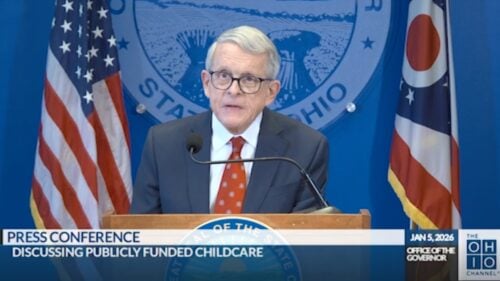
In August 2025, Ohio Gov. Mike DeWine joined local leaders, students, and community members to celebrate the groundbreaking of the new Athens High School. (Photo courtesy Gov. Mike DeWine's office)
As frustration mounts over repeated property tax defeats, school districts across Ohio, including New Philadelphia City Schools and Parma City School District, are increasingly turning to earned income taxes as an alternative to fund themselves.
The districts are preparing income tax issues for the May ballot, according to WOSU.
Earlier this month, New Philadelphia City Schools in Tuscarawas County voted to place a 1.5% earned income tax proposal before voters after four unsuccessful attempts to pass a property tax levy.
“We’ve been at the ballot four times,” Treasurer Julie Erwin said. “And our public, our community, every time has voted it down, 60–40, and they make it very well known that they can’t afford it.”
Erwin added that farmers and senior citizens in the district, especially, cannot afford the increased property taxes, which prompted the district to examine alternatives.
“Our farmers can’t afford additional property taxes, so we looked at our funding options and decided an earned income tax would help those that say they can’t afford it the most, which is senior citizens, our farmers and our businesses,” he said.
Unlike traditional property levies, an earned income tax does not apply to retirement income, investment funds, or Social Security benefits.
Aside from New Philadelphia City Schools and Parma City School District, other districts, such as Willoughby-Eastlake City Schools and Pickerington near Columbus, are either planning or considering earned income tax issues for voters this spring.
Tom Hosler, CEO of the Ohio School Boards Association, said there has been a modest increase in districts pursuing this option since 2020.
“Traditionally, you see and find income taxes in more rural communities,” Hosler told WOSU. “Rural communities often have farmers who own lots of property, and so their value of that property is very high, and yet their income isn’t.”
Hosler also suggested that support for income taxes may be spreading beyond rural areas, citing recent voter approval of a school income tax in Westerville.
“They’re not a farming community anymore, and it was pretty well supported,” he told WOSU. “So I think, again, it’s an option. I think boards are studying carefully.”
If approved, New Philadelphia’s income tax would help fund a major rebuild of all district buildings, many of which are outdated.
“Our oldest building was built in 1913,” Erwin told WOSU. “These buildings weren’t built for the current safety standards today.”
In Parma, the board is advancing a 1.75% earned income tax to support daily operations while also offering property tax relief by allowing three existing levies to expire.
“There’s a lot of talk at the state level about eliminating property tax, and we felt we needed to pivot,” Superintendent Scott Hunt said. “We already know our voters have said loud and clear, ‘We’re not gonna support an increase in property taxes.’”
Republican Gov. Mike DeWine signed several property tax-related bills at the end of last month, helping Ohioans address the problem.