Ohio schools rank poorly for free speech
Ohio’s colleges rank poorly for free speech, but the state’s D- grade matches the national average.
That’s according to the 2027 College Free Speech Rankings released by the Foundation for Individual Rights and Expression, a civil liberties nonprofit. The analysis ranked 261 schools nationwide and 13 schools in the Buckeye State based on student surveys from nearly 63,000 students, campus policies, and recent speech-related controversies.
In the Buckeye State, Wright State University was the state’s top-ranked school, ranking No. 64 overall. The school, which has adopted the pro-free speech Chicago Statement, holds a “yellow light” Spotlight rating and ranks in the top 25 for “Administrative Support.”
FIRE said that suggests students trust administrators to protect speech.
Conversely, the University of Dayton ranks lowest in the state and No. 237 overall. It has a “red light” rating.
Most Ohio schools have yellow light ratings, according to the group. Ten Ohio schools have adopted the Chicago Statement, but The Ohio State University was the only one to adopt “a statement on institutional neutrality.”
The schools could improve their speech climates by modifying “restrictive written student policies and adopting institutional neutrality,” FIRE said.
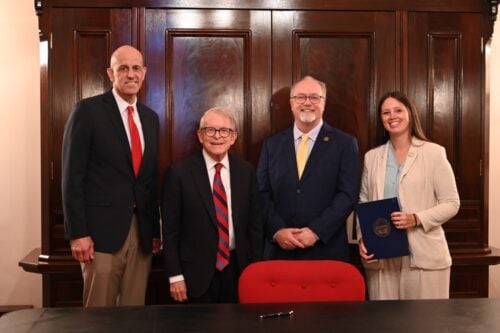
Free speech has been a hot-button issue in Ohio. Lawmakers passed Senate Bill 1, the Advance Ohio Higher Education Act, which Republican Gov. Mike DeWine signed in March 2025. The wide-ranging measure banned DEI programs, barred faculty strikes, and created new guidelines for intellectual diversity.
State Sen. Jerry Cirinino, R-Kirtland, said progress has been made in many areas, adding that it will take time, noting that this is only the second full semester that Senate Bill 1 has been signed into law. He also pointed to the Chicago Statement, which FIRE describes as “a model free speech policy statement that many universities have adopted, affirming their commitment to free expression.”
“It does bolster the motivation as to why we felt these higher ed reforms were necessary,” Cirino told Ohio.News. “But it also should reinforce the view that monumental change like what we outlined is going to take some time to be perceptible. It’s like turning an aircraft carrier. But we are seeing. I am encouraged, and I am seeing compliance generally to Senate Bill 1. But again, a lot of this is cultural, and it’s going to take some time to change the culture a bit in our in our on our campuses.”
Nationally, the University of Chicago ranked as the best college for free speech. FIRE ranked New York University as the worst college for free speech.
“I wasn’t surprised to see the University of Chicago top on the list because it’s the Chicago principles that I have referred to many times,” Cirino said. “If you really adopt them and embrace them, and not many do, a lot of them just adopt them, and then they ignore them. But if you really follow the Chicago principles, it’s diversity of thought, it’s exposing students to different sides of issues, and not indoctrinating them, helping them learn information and get the facts so that they can make up their own minds. And I think the Chicago principles are something that every university, public or private, needs to aspire to support.”
Undercover videos obtained by Ohio.News have shown that some schools have flouted the state requirements.
“At a tumultuous time for higher education, we are seeing some progress in campus free speech policies and indications that students may be less willing to tolerate shoutdowns and violence on campus compared to recent years,” FIRE President and CEO Greg Lukianoff said in a release. “But the overall state of free speech on campus is grim.
“Too many college administrators wield their power to cancel controversial speakers, cave to government or student calls for censorship, and limit academic freedom,” Lukianoff added. “This report emphasizes the need for colleges to embrace their constitutional obligations wholeheartedly.”