Ohio think tank warns data center tariff could burden ratepayers long-term
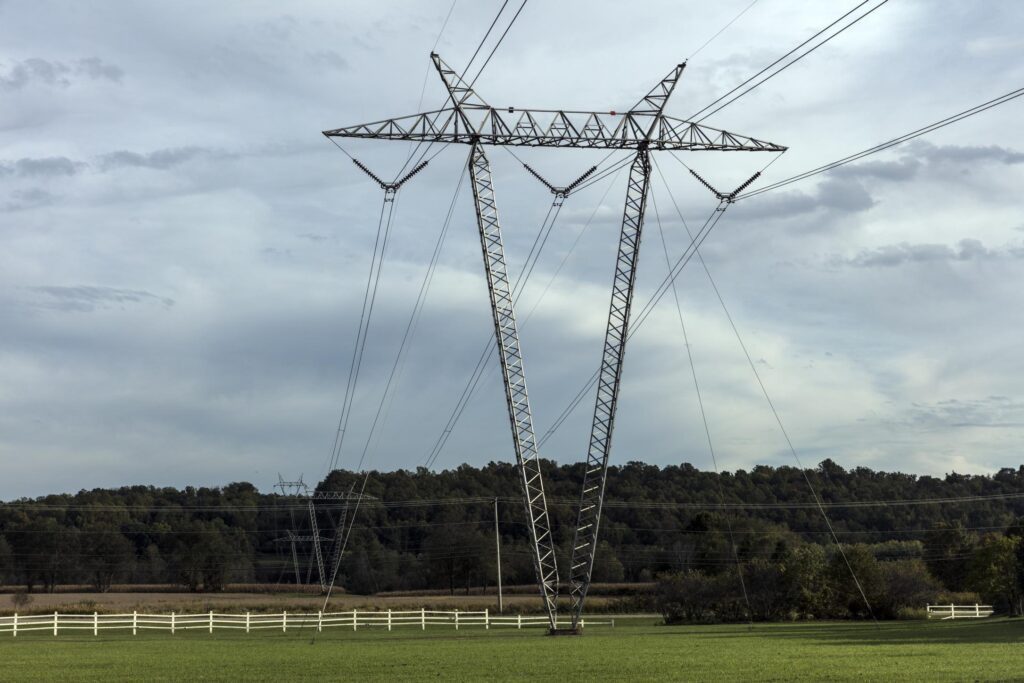
A line of enormous power towers and electric cables in Muskingum County, Ohio. (Photographs in the Carol M. Highsmith Archive, Library of Congress, Prints and Photographs Division.)
American Electric Power Ohio’s tariff on proposed data centers that the Public Utilities Commission of Ohio approved risks undermining the state’s economic growth while inadvertently leaving residential ratepayers to shoulder infrastructure costs, a Columbus-based think tank said in a new policy brief.
The seven-page analysis, titled “Undermining Ohio’s Competitive Edge: How AEP’s Data Center Tariff Harms Ohio” and released this week by the Buckeye Institute, criticizes the tariff’s structure as inverted pricing that penalizes the most flexible, high-growth customers.
Specific to the type of business — rather than the actual cost of service — the tariff imposes an 85% minimum demand charge over a 12-year contract term in which companies must pay a fixed amount regardless of actual consumption. For facilities projected to use over 25 megawatts, this 12-year “take-or-pay” contract must be agreed to in advance and includes steep exit penalties.
“While PUCO’s approval of AEP’s data center tariff was a short-term win for the utility, it will produce a long-term loss for Ohio,” Aswin Prabhakar, an economic research analyst at The Buckeye Institute and the author of the brief, said in a release. “If Ohio persists in treating data centers as threats instead of opportunities, these companies will respond. Data centers will still be built and will still create high-tech jobs—just not in Ohio.”
It would be like trying to buy a home and to having electricity connected in the future, having to approximate energy use for the next 12 years, enter into a contractually binding agreement for that possible use, and then agree to pay steep fees for breaking that contract, all before knowing if the offer will even be accepted.
Yet AEP had taken it one step further by unilaterally imposing a 28-month moratorium on new data center connections. Following intense stakeholder negotiations, the PUCO ended AEP’s moratorium in July 2025, yet approved the tariff structure for larger users.
While the stated intent was to have larger energy users cover more infrastructure costs, thereby shielding ratepayers from subsidization via rate hikes based on projected load forecasts, critics argue the opposite occurred.
Energy is a speculative business.
Distributors, such as AEP, must estimate energy demand and the costs of supplying their customers in advance. Prior to purchasing wholesale from Regional Transmission Organizations like PJM, state-regulated companies like AEP must file with the Public Utilities Commission, especially if that energy is anticipated to cost more.
However, when AEP approached the PUCO in May 2025 to request a rate increase, it used speculative load projections of 30 GW. The utility was also caught making unproven claims of transmission “constraints” while double-counting signed agreements. Catching the errors, the PUCO settled the base load distribution case at a much lower rate than the utility requested.
Yet critics such as the Ohio Manufacturers Association allege that AEP inflated PJM load forecasts by about 3.3 GW, driving up regional wholesale capacity and transmission costs passed on to everyone. Alleging discriminatory pricing, OMAEG also appealed the tariff approval to the Ohio Supreme Court.
Concurring, the Buckeye Institute is also urging the court to reverse the tariff — simultaneously encouraging policymakers to embrace the moment as an important opportunity for Ohio’s future.
According to Prabhakar’s report, these moves signal that AEP views certain customers as liabilities rather than opportunities—producing “a long-term loss for Ohio,” Prabhakar writes.
Given that Ohio’s data center demand could rise from about 600 megawatts today to as much as 3.7 gigawatts by 2030, based on signed agreements, the brief urges policymakers to direct the billions in private investment on the table toward infrastructure upgrades — shifting the burden away from ratepayers in the long term.
Currently, Prabhakar argues, policy inverts efficient pricing principles by imposing the highest markups on elastic loads like data centers and crypto miners, which can relocate projects entirely or force developers to self-supply power behind-the-meter.