Ohioans become victims of the national ‘ghost students’ fraud

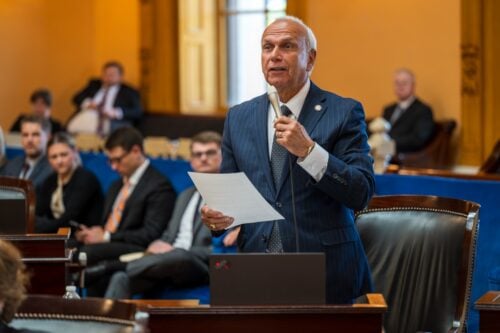
In January 2026, Lt. Governor Jim Tressel helped cut the ribbon on the new University Hospital on Ohio State’s campus.
Ohioans became the latest victims of the nationwide “ghost students” fraud, with the Buckeye State joining the ranks of Washington, D.C., North Carolina, California, and Pennsylvania.
As part of the “ghost students” fraud, scammers steal people’s identities, enroll in college, and obtain student loans.
One woman living in northeastern Ohio is currently battling the system, trying to prove she didn’t take out a student loan, according to News 5 Cleveland.
“This is no longer my identity. Someone else has everything about my life,” Jocelyn Predina told the station, claiming that she found out that someone had taken out loans for a community college in Baton Rouge, Louisiana, in her name without her approval.
Predina told the news station she has never been to Baton Rouge.
Facing the possibility that she could be forced to repay a $16,000 loan she never took, Predina, with the help of her mother, Joan, tried to resolve the situation by proving she never took the loan. She provided multiple IDs and police reports, as well as pointed out that there was fake information on Jocelyn’s “paperwork,” presented by the fraudster.
“Her application has 20 things wrong on it, and it still was approved,” the mother told News 5 in Cleveland. “And nobody cares.”
They contacted the U.S. Department of Education three times, but the department said that it could not respond to their questions because of the government shutdown. The news source said it contacted local community colleges, which reported identifying more than 300 accounts last year alone that could be classified as fraudulent.
Ohio is not the only state targeted by the scammers. Jason Williams from the Office of Inspector General for the U.S. Department of Education told ABC News that the department now has approximately “200 investigations open nationwide,” adding that during the past five years, the department discovered that the scammers stole $350 million.
“It’s a huge issue,” Williams told ABC News. “As they’re stealing identities … these loans are not being repaid. They’re being assigned to people [who] don’t even know they have a debt with the U.S. Department of Education … [until] the Internal Revenue Service says you owe the Department of Education money.”
Williams added that this type of fraud intensified after the COVID-19 pandemic, as remote online learning made it easier for fraudsters to steal money from the system using artificial intelligence.
Similar fraud incidents happened in Washington, D.C., North Carolina, California, and Pennsylvania, according to local ABC news sources.