Ohio’s new energy law may give the state an advantage over its northern neighbor

A measure intended to increase Ohio’s power generation could improve the state’s advantage over its neighbor to the north.
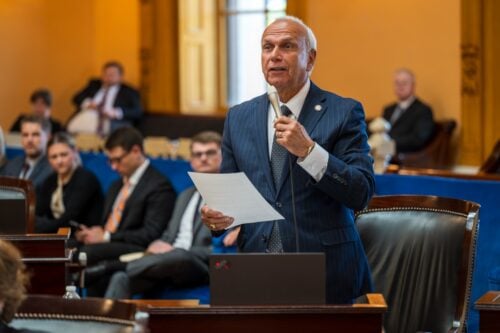
House Bill 15, sponsored by Ohio Rep. Roy Klopfenstein, R-Haviland, aims to improve affordability and reliability amid several high-profile and high-energy demand economic development projects, including projects by Anduril Industries and Intel.
The measure, which was similar to Senate Bill 2, repeals elements of Ohio’s controversial House Bill 6, which lawmakers passed in 2019 and resulted in a $60 million dark money bribery scheme that has been called “one of the largest public corruption conspiracies in Ohio history.”
The legislation, which Republican Gov. Mike DeWine signed into law in May, eliminates the option for utility companies to file an Electric Security Plan. Additionally, they must take rate cases to the Public Utilities Commission of Ohio.
The measure also mandates that utility companies undergo a more comprehensive review to determine consumer rates and allows for intrastate transmission. Proponents argued that it should lead to more providers entering the market, thereby increasing competition and expansion while lowering costs.
In prepared testimony to the Senate Energy Committee, Ohio Rep. Roy Klopfenstein, R-Haviland, said the measure aims “to ensure reliable, affordable, and available energy for all Ohioans.”
He continued: “Over the past five years, we have witnessed an unprecedented surge in energy demand, with data centers alone consuming 600 megawatts of electricity,” Klopfenstein said. “AEP forecasts that this will increase to 5,000 megawatts by 2030. This trend is not likely to reverse,” adding, “Ohio has been fortunate to be ranked number one nationally in infrastructure and economic development investment, as demonstrated by new projects like data centers, Intel, and Anduril Industries. However, these investments bring with them concerns, as projections from PJM suggest that without new generation, we could face potential shortages.”
Proponents of the legislation said the measure, which would save Ohioans roughly $500 million between now and 2030, includes stronger disclosure requirements and transparency from electric utilities regarding the rates they charge consumers. They will now have to show that rate increases are “transparent and justifiable.”
The possibility that Ohioans should see better power rates has riled some in “That State Up North.” An energy expert in Michigan said the Buckeye State could widen its competitive energy gap over the Wolverine State.
“Even before Ohio implements these policies, Michigan is at a competitive disadvantage,” Ted Bolema, a senior fellow at the Mackinac Center for Public Policy and a fellow with the Innovators Network Foundation, told Michigan Capitol Confidential via email.
“This gap will grow even wider as Ohio goes forward with its new policies, while Michigan regulators keep allowing rate increases by its monopoly utilities,” Bolema added.
The measure bars electric distribution utilities from owning and operating generation facilities and ends subsidies for the Ohio Valley Electric Corporation. It also halts the collection of new money for the Solar Generation Fund and settles an existing agreement with “current qualified solar projects,” allowing PUCO to refund the remaining funds to ratepayers.
“It is not the role of the state to favor one form of generation over another,” Klopfenstein said. “Instead, we should open the market to dispatchable energy generation to address future energy shortages.”
DeWine signed HB 6 in 2019. It was sold as a ratepayer-funded bailout of two nuclear power plants after Akron-based FirstEnergy Solutions filed for bankruptcy in March 2018 and announced plans to close Davis-Besse Nuclear Power Station in Oak Harbor and Perry Nuclear Power Plant in Perry.
Federal prosecutors eventually charged former Ohio House Speaker Larry Householder, R-Glenford, and others. The feds said the former House speaker and his enterprise conspired to violate racketeering laws and received millions of dollars in bribes.
A federal appeals court upheld Householder’s conviction.