State Supreme Court upholds ban on RPA Energy, rules that $1.44 million fine must be recalculated
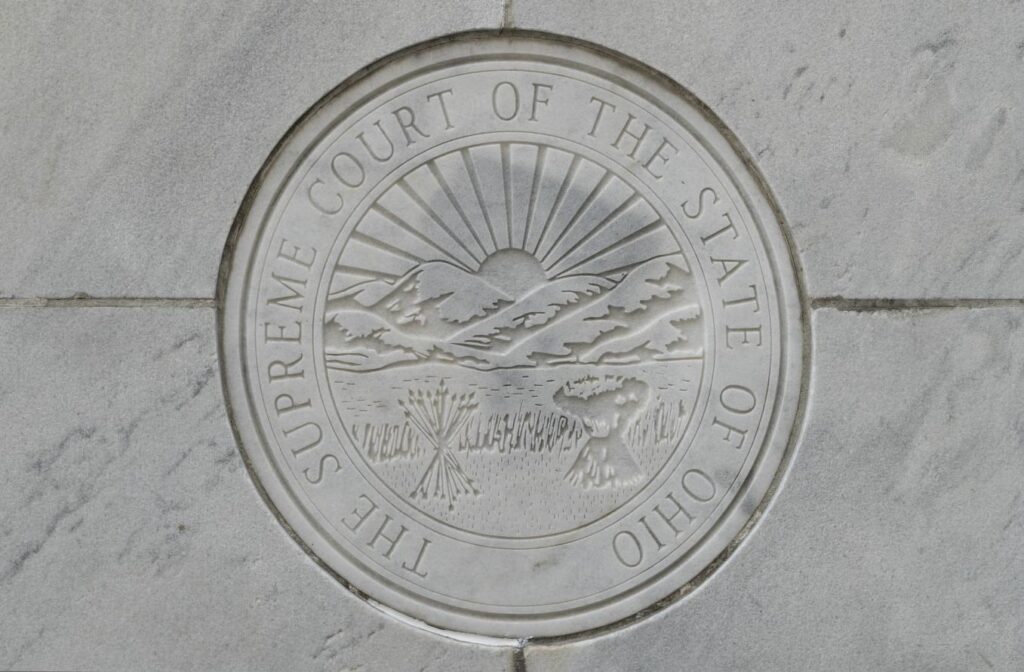
The Ohio State Seal, inscribed into the Thomas J. Moyer Ohio Judicial Center, home of the Ohio Supreme Court in Columbus, Ohio, designed by architect Harry Hake. (Highsmith, Carol M., 1946- Carol M. Highsmith Archive via the Library of Congress)
The Supreme Court of Ohio has ruled that the Public Utilities Commission of Ohio must recalculate fines for an energy company that was banned from the state for deceptive practices.
RPA Energy was banned from conducting business in the state of Ohio by PUCO for engaging in illegal door-to-door solicitations and telemarketing practices in 2023, according to a write-up on the Supreme Court’s website.
“These statutory and rule violations harmed consumers, and the commission did not abuse its discretion in determining RPA should no longer operate in Ohio,” the ruling said.
The ban came after PUCO began receiving complaints about the company from Ohio residents in 2021.
RPA Energy previously operated in Ohio under the name Green Choice Energy.
An investigation found that RPA Energy used “spoofed” phone numbers to impersonate competitors and local high school organizations, offered deceptive rewards promotions, and sent forged contracts to residents after speaking with them over the phone, even though the recipients said that they had not agreed to the contracts.
The company was also fined $1.44 million for violations of state laws and rules, and ordered to re-rate some customers who had switched on the premise of lower utility bills.
The Supreme Court upheld the ban on the company operating in the state in its Tuesday ruling, staying that RPA Energy engaged in “numerous unfair, deceptive, or unconscionable acts or practices and that it lacked managerial capability.”
The court also ordered PUCO to recalculate the fine, with Justice Daniel R. Hawkins saying that it was unclear how the original fine was calculated.
PUCO was authorized to fine the company up to $10,000 for each violation and originally presented the fines in a spreadsheet prepared by a staff member, but did not specify what specific violations of laws or rules the fines were for.
“In sum, based on the spreadsheet, it is impossible for us to determine how the commission calculated the total number of violations,” said Hawkins.
PUCO originally alleged more than 150 items as violations, the staff member multiplied $10,000 by 150 to arrive at $1.5 million in fines, and only provided the spreadsheet listing 75 incidents where multiple violations occurred as evidence.
The Supreme Court’s ruling stated that the spreadsheet included what appeared to be violation categories, but did not reference specific laws or rules.
PUCO then reduced the staff member’s proposal by $60,000 after overruling six alleged violations and fined the company $1.44 million.
RPA Energy objected to the fines, saying that the amount was excessive and that PUCO violated Supreme Court precedent by basing the calculation on the information in the staff member’s spreadsheet report, according to a September 2025 Supreme Court Press Release.
The Supreme Court previously ruled that PUCO could not adopt a staff report without making its own findings and legal conclusions before issuing a ruling in a 2021 decision.