U.S. Supreme Court could hear challenge to home distilling ban involving Licking County resident
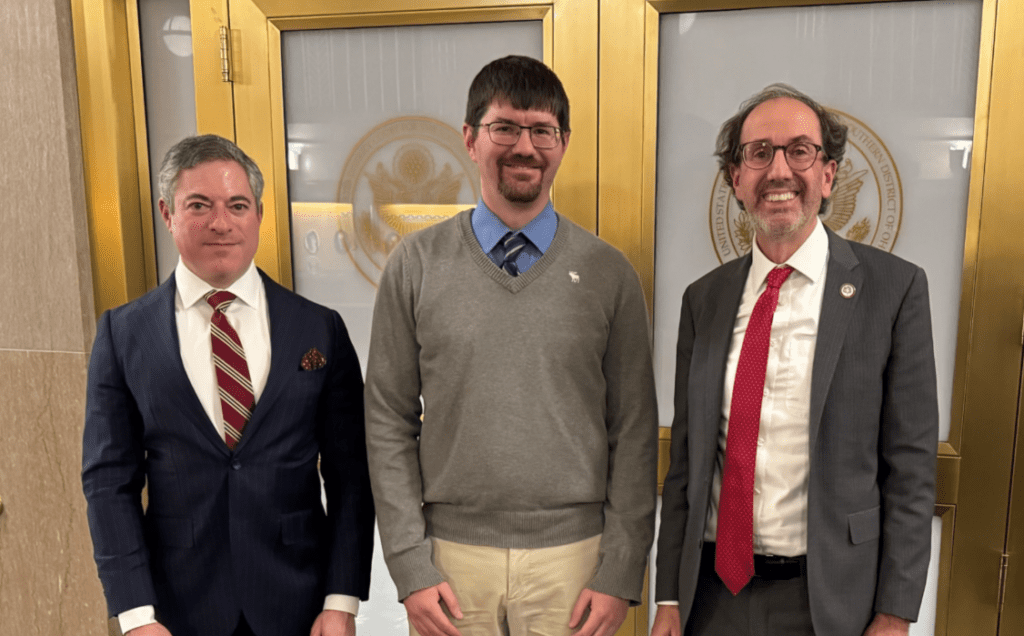
Pictured left to right Andrew M. Grossman, John Ream, and Robert Alt. (Photo courtesy of The Buckeye Institute)
The U.S. Supreme Court could be the next step for a case challenging a 158-year-old federal ban on home distilling involving Licking County resident John Ream.
The Buckeye Institute is representing the plaintiff and said that it will ask the Supreme Court to hear Ream v. U.S. Department of the Treasury after a federal appeals court upheld the ban and contradicted a previous ruling.
The U.S. Court of Appeals for the Sixth Circuit ruled that the ban could continue to be enforced on April 21, 11 days after the U.S. Court of Appeals for the Fifth Circuit ruled that the ban was unconstitutional in a separate case also represented by the think tank.
“This decision upholding the federal ban on home distilling creates a circuit split, and we anticipate the U.S. Supreme Court resolving the conflict between the U.S. Courts of Appeals for the Fifth and Sixth Circuits,” Andrew M. Grossman, a senior legal fellow at The Buckeye Institute and a partner at BakerHostetler, who presented Buckeye’s oral argument in the case, said in a release.
As Ohio.News previously reported, the Buckeye Institute appealed a 2025 dismissal by the U.S. District Court for the Southern District of Ohio in Ream’s case.
Internal Revenue Code Sections 5178 and 5601 currently prohibit distilleries from being used in homes, sheds, yards, boats, at facilities where beer or wine is produced, or on the premises of businesses that are not distilled spirits plants. Violating the ban is a felony offense.
The ban on distilling was originally passed in 1868 as part of legislation that was intended to prevent home distillers from evading federal excise taxes, according to the Sixth Circuit’s opinion.
Ream, the owner of Trek Brewing Company in Newark, Ohio, has practiced home brewing as a hobby for years, could face a felony conviction, $10,000 in fines, and five years in prison if he took up whiskey making as a hobby.
The Sixth Circuit said that while the court disagreed wth the District Court’s dismissal, Congress could ban home distilleries.
“We disagree with the district court’s conclusion that Ream lacks standing to bring his claims; but we hold that the ban is a necessary and proper means of collecting the federal excise tax on distilled spirits,” the Sixth Circuit’s opinion said.
The Buckeye Institute is representing Hobby Distillers Association members Rick Morris, Scott McNutt, John Prince, and Thomas Cowdrey in a separate lawsuit that also challenges the federal ban on home distilling, McNutt v. U.S. Justice Department.
The Fifth Circuit ruled in McNutt that the ban on home distilling is unconstitutional on April 10.
“The government defends the statutory prohibition on at-home distillation of spirits as a ‘necessary and proper’ exercise of Congress’s power to ‘tax,’’ the Fifth Circuit’s ruling said. “We disagree. First, contrary to the government’s assumption, Section 5178 and Section 5601 are outside the scope of Congress’s taxing power under the Constitution.”
“Second, contrary to federalism principles, the statutory prohibition is not plainly adapted to executing Congress’s taxing power and violates the Necessary and Proper Clause.”
The U.S. District Court for the Northern District of Texas, Fort Worth Division, ruled that the ban on home distilling was unconstitutional in Hobby Distillers Association v. Alcohol and Tobacco Tax and Trade Bureau, a lawsuit involving the plaintiffs in McNutt, in 2024. The Bureau appealed the decision to the Fifth Circuit.
Related Stories
Husted calls for national ban on driver’s licenses for illegal aliens

Questions emerge about Canfield Fair incident involving Amy Acton after man charged with misdemeanors, given $5,000 bond