Russo says that LaRose shared non-public voter information, LaRose pushes back
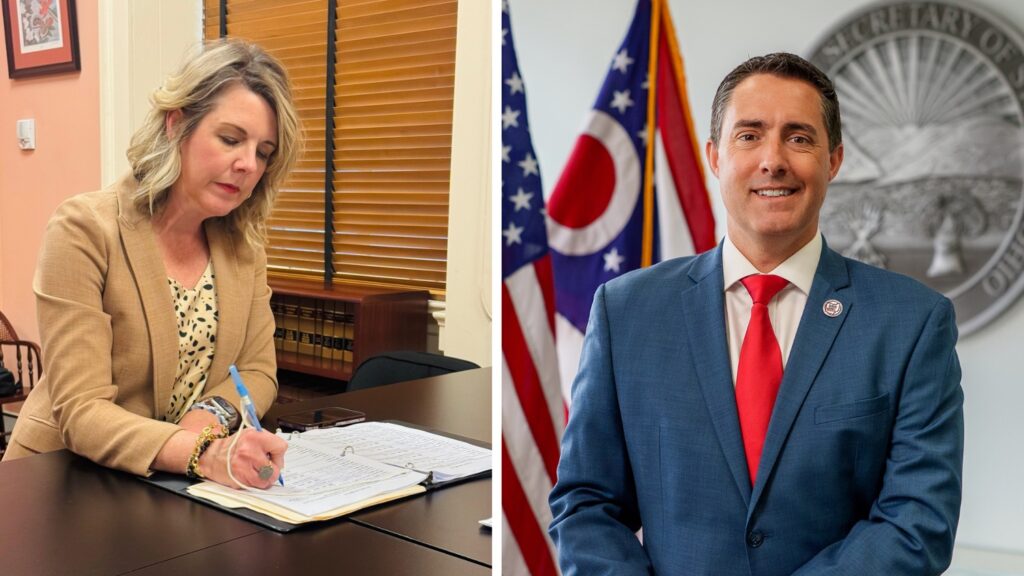
Secretary of State candidate and state Rep. Allison Russo, D-Upper Arlington, accused Secretary of State Frank LaRose of violating the law by sharing Ohio voters’ private information with the federal government, prompting her to introduce a bill to protect Ohio voters.
However, LaRose pushed back at Russo, saying Democrats are opposing efforts to ensure the integrity of the state’s voter rolls.
“Not all voter registration data for each registered voter is public,” Russo told Ohio.News in an email. “The files released by the SOS contained the non-public information as well.”
While some voter information is public, such as a full name, residential address, and voter status, and available for everybody via the Ohio Secretary of State’s website, some information remains private, such as “an elector’s full or partial social security number, driver’s license or state identification card number, telephone number, or electronic mail address,” according to the Ohio Laws and Administrative Rules.
However, LaRose responded to Russo’s introduction of the bill by pointing out the alleged hypocrisy.
“These are the same people who want to hand Ohio’s voter records over to an unaccountable NGO that refuses to be audited. They don’t care about your privacy. What they really care about is protecting dirty voter rolls. Open borders. No illegal immigration enforcement. No voter verification. No election safeguards. It’s all part of the same playbook,” he wrote on X.
These are the same people who want to hand Ohio’s voter records over to an unaccountable NGO that refuses to be audited. They don’t care about your privacy. What they really care about is about protecting dirty voter rolls.
Open borders. No illegal immigration enforcement. No… https://t.co/5WZqN5hktl
— Frank LaRose (@FrankLaRose) March 28, 2026
LaRose appears to be referring to the Electronic Registration Information Center, also known as ERIC, a nonprofit organization that provides interstate voter data-sharing and list-maintenance services to participating states. Ohio was a dues-paying member of ERIC until LaRose withdrew the state in March 2023, according to American Oversight.
LaRose previously sent Ohio’s personal voter registration data for nearly 8 million Ohioans to the U.S. Department of Justice to demonstrate that the Buckeye State complies with federal election law, telling Assistant Attorney General Harmeet Dhillon in a Feb. 13 letter that he is willing to cooperate with the federal government.
Ben Kindel, LaRose’s press secretary, told NBC 4 that LaRose’s office shared private information about voters, including driver’s license records and the last four digits of voters’ Social Security numbers, with the DOJ.
“When Ohioans are required to provide private personal information to participate in our democracy, they deserve absolute confidence that their data will be protected,” Russo said, according ot NBC 4. “I have grave concerns about how this information could be used or manipulated in ways that undermine the will of American voters.”
Despite Kindel’s confirmation, LaRose told Dhillon in his letter that the list he is sending her is a “static snapshot,” meaning he will never be able to “give the Department a demonstrably perfect image of our database.”
“Voter list maintenance is always a work in progress,” he wrote.
LaRose sharing the private information of Ohio voters prompted Russo to introduce the Ohio Privacy Act, a bill that would “bar state entities from collecting, recording, or sharing an individual’s identifying information or personal data unless otherwise required by law or permitted” for operational purposes, thereby “strengthening privacy protections for Ohio residents,” according to Russo’s press release.
“Government use of personal information relies on public trust, and Ohio has a compelling interest and obligation in protecting individuals’ privacy and personal information,” Russo said in a release. “This legislation provides clarity and transparency for all Ohioans who are required to provide their personally identifiable information to state government entities. Trust is built when agencies are transparent about data collection policies, provide clear, plain-language privacy notices, and use data only for the purpose explained to the public.”