Acton’s public record fuels questions in Ohio Governor’s race
As the Democratic nominee for Ohio governor, Amy Acton continues to present herself as a pragmatic moderate and problem-solver who worked across the aisle under Republican Gov. Mike DeWine.
Yet, Acton’s financial record, endorsements and public policy support have led many to question her bipartisan branding.
In a state that hasn’t elected a Democrat as governor in more than two decades, Acton’s shift to portray moderate positioning appears strategic. Yet, her record paints a picture that’s anything but moderate.
From 2017 to 2018, Planned Parenthood received just over half a million dollars in grants from the Columbus Foundation, during Acton’s tenure as the Community Research and Grants Management Officer. Those grants came under scrutiny in November of 2019 when Acton unexpectedly reissued a license to a notorious late-term abortion facility as Ohio’s Director of Health, despite the state’s efforts to close the facility down for significant regulatory and health violations.
In a Breitbart News report last week, questions about Acton’s ideological leanings resurfaced in connection to grants awarded during her tenure at the foundation.
IRS Form 990 filings, verified by Ohio.News show the Columbus Foundation awarded left-leaning organizations millions in pass-through dollars between 2017 and 2018, including the Council on American Islamic Relations, a designated terror group in two states with a history of allegedly financing terrorism.
Though her campaign has not directly responded to questions about these grants, Acton has strong financial backing and endorsements from some of these same groups.
With over $10 million raised, Acton has secured Planned Parenthood’s endorsement, while receiving thousands of dollars from far-left progressive groups like EMILY’s List, along with tens of thousands from nearly every public sector union, including the Ohio Education Association, Ohio’s chapter of the NEA. In addition to organizing recent May Day protests, the teachers’ union is also behind Vouchers Harm Ohio, an effort to dismantle the EdChoice program.
Acton, who has pledged to protect abortion, strengthen collective bargaining, and “rein in” the resource-draining EdChoice voucher program, frames the growth of public sector union jobs as aggressive action against billionaires and special interests. While critics note the fuzzy campaign math of simultaneously promising tax cuts and medical debt forgiveness, the bigger questions remain centered on how Acton’s ideological leanings could impact state policies.
My opponent stood in front of cameras with a white coat claiming the mantle of “science,” while failing to follow the actual science. It was unforgivable. Ohio families are still suffering because of it & they can’t afford to ever trust Dr. Lockdown again. pic.twitter.com/yXpS20KDBD
— Vivek Ramaswamy (@VivekGRamaswamy) May 9, 2026
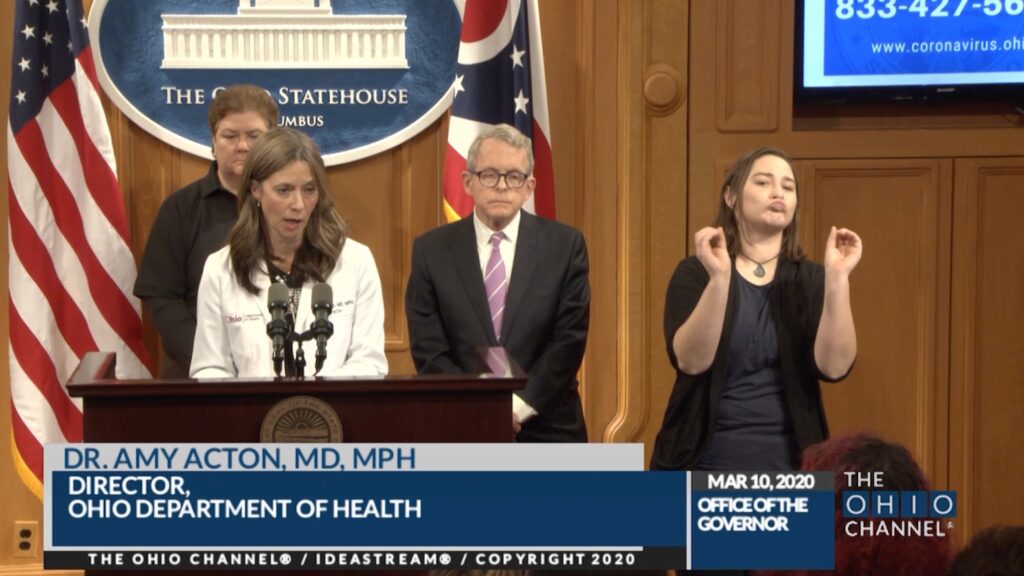
Acton’s tenure as director of the Ohio Department of Health in 2019 and 2020 remains a flashpoint.
Acton was the public face of strict lockdown measures and the controversial last-minute closure of polling in March 2020. While DeWine has publicly stated that she was acting on his orders, Acton’s public testimony tells a different story.
During her public testimony on HB 166 in March 2019, Acton asked Buckeye lawmakers to grant the governor the authority to declare public health emergencies.
“In order to give the Governor more flexibility and tools to address the drug epidemic and future public health emergencies, ODH is proposing language that allows the Governor to declare a ‘public health emergency’ which is not expressly authorized under current law,” Acton said in the prepared version of her testimony.
HB 166 also funded various initiatives that Acton spearheaded as Health Director, such as the Ohio Public Health Fund, in-home visits for Newborns, which led to an annual increase in parental rights terminated, and the SmartOhio Operating System — an interoperable government surveillance hub.
Acton also incorporated the Healthy People 2020 agenda into the fabric of the State Health Improvement Plan.
After resigning as Ohio Health Director in June 2020, Acton directed RAPID 5, an environmental nonprofit “focused on connections between natural resources and wellbeing.” Calling her work “the ultimate public health project,” Acton’s time at RAPID 5 focused on redefining public health as a calculation of “well-being.”
Well-being is a newer public policy and economic framework that “moves beyond economic growth,” and traditional GDP in favor of collective metrics around equity, social connection, environmental health, and government-directed flourishing. Critics argue this post-liberal economic theory is akin to the Chinese Communist social credit system, as it similarly subordinates individual rights and private property to the collective “well-being.”