Ohio lawmakers set to start considering $3.7 billion capital budget
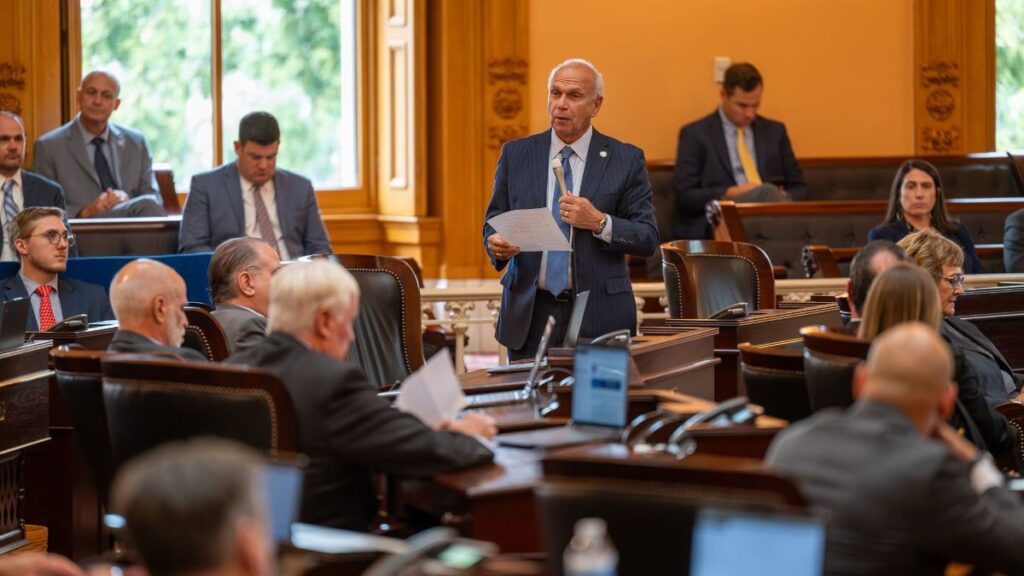
Senate Finance Chairman Jerry Cirino speaking on the Senate Floor
State lawmakers are set to start considering different versions of a $3.7 billion capital budget that would send money to every one of Ohio’s 88 counties.
As introduced, the state Senate’s version, Senate Bill 450, authorizes roughly $3.4 billion in new debt. It includes $645 million for the Public Works Commission, $611 million for the School Facilities Commission, $425 Million Higher Education Institutions, $385 million for the Department of Behavioral Health, and $265 Million for the Department of Natural Resources.
The House’s version, House Bill 959, includes $600 million for local school building aid through the Ohio Facilities Construction Commission and $500 million for the state capital improvements program for local infrastructure projects via the Ohio Public Works Commission.
The bills are pending before the finance committees in their respective chambers.
In a release, Senate President Rob McColley, R-Napoleon, said the budget, funded through the sale of bonds, “provides critical funds for many construction and maintenance programs for state agencies ranging from schools to state parks.”
“These are projects that people notice, use, and expect,” he added.
However, not everyone is as bullish on the budget, with one leading think tank questioning the spending, especially if state lawmakers want to eliminate the income tax.
“Over the past 13 years, the Ohio House and Senate have done yeoman’s work to responsibly lower income taxes, which is exactly the right move to make Ohio more competitive, stimulate economic growth, and relieve financial pressure on hardworking Ohioans,” Robert Alt, president and chief executive officer of The Buckeye Institute, said in a statement.
“In order to eliminate Ohio’s income tax altogether, though, the General Assembly will need to reduce state spending, including through its capital budget,” Alt added. “Continuing with business as usual does not lay the foundation for Ohio to join the no-state-income-tax club.”
The state currently collects more than $10 billion annually in income tax.
The 297-page budget reads like a wish list of pet projects from around the state, allowing lawmakers to fire off news releases trumpeting money flowing to their districts. Projects range from $900,000 for enhancements and renovations to a swimming pool in the Village of Spencerville to more than $3.9 million for the Ohio and Erie Canal to $10 million for an expansion of the Supercomputer Center.
“The Capital Budget is one of the most important tools we have to invest in our communities. These dollars will support projects that improve quality of life today while laying the foundation for future economic growth across the Dayton region,” state Rep. Tom Young, R-Washington Twp., said in a release.
In a release, state Rep. Brian Stewart, R-Ashville, chair of the House Finance Committee, said the budget “is well-rounded, with support for local projects that equally prioritizes both rural and urban communities across Ohio.”
Cleveland.com reported that the House and Senate each traditionally develop versions of the budget, then reach a compromise version that they send to the governor for his consideration. The report also indicates that lawmakers usually pass the measure during election years.
Related Stories

Questions emerge about Canfield Fair incident involving Amy Acton after man charged with misdemeanors, given $5,000 bond

Ohio delays SNAP sugary drink restrictions at federal government’s request