Death penalty bills face uphill battle despite renewed debate over capital punishment
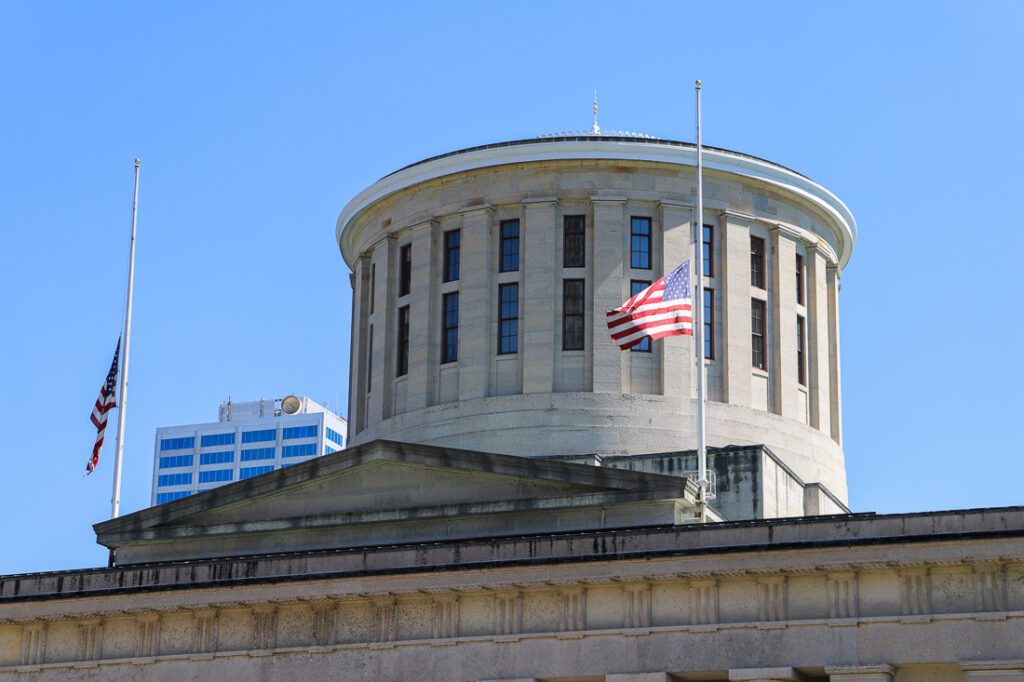
An April 2026 view of the Ohio Statehouse. (Photo by T.A. DeFeo)
Ohio lawmakers have introduced competing death penalty bills, but they’re unlikely to gain traction during the upcoming lame-duck session.
The death penalty debate has sparked chatter among Ohioans and spurred some lawmakers into action after the botched lethal injection of Tennessee death row inmate Christa Pike last month.
In Ohio, State Reps. Adam Mathews, R-Lebanon, and Jean Schmidt, R-Loveland, have co-sponsored House Bill 72, which would end the death penalty in Ohio. It also includes provisions to ban public funding for drugs that induce abortion or assist with suicide.
A second bill, House Bill 36, would keep the death penalty legal and expand the method of execution to include nitrogen hypoxia.
Pike’s failed execution renewed the decades-old controversy over the death penalty on moral and legal grounds, including in Ohio, where it has been part of the state’s justice system since the early 1800s, according to the Department of Rehabilitation and Correction.
The state’s current statute took effect on Oct. 19, 1981. The DRC carried out the last execution in the state on July 18, 2018, when Robert J. Van Hook was executed via lethal injection for a 1985 murder in Cincinnati.
However, capital punishment has been a moot point in recent years, after Republican Gov. Mike DeWine took office in 2019 and put the practice on hold. He’s delayed each scheduled execution date—some, more than once—during his two terms as governor.
In June, DeWine asked the Ohio legislature to abolish capital punishment for good or take it to voters if lawmakers decide not to act. In August, the governor issued three reprieves for inmates on Ohio’s death row, saying the state can’t procure the drugs needed to carry out the executions.
DeWine used to be in favor of the death penalty but announced in June that he had changed his mind on the practice. He said the “moral justification” that had led him to support the death penalty “simply no longer exists.”
Mathews said there has been increasing support among his colleagues, and the public in general, for abolishing the death penalty, Statehouse News Bureau reported.
He told the outlet “there’s a bipartisan conversation going that recognizes the immense power that the state has in this situation where, if it makes a mistake, whether in the execution method or in the finding of guilt, you cannot take it back.”
One of Mathews’ Republican colleagues, Rep. Brian Stewart, R-Ashville, disagrees and believes the death penalty still has widespread support among residents in Ohio.
As the joint sponsor of House Bill 36, Stewart said there have been problems with obtaining drugs for lethal injection. It’s been cited as the main reason for halting executions in Ohio, which is why his bill would allow death by asphyxiation.
Both Mathews and Stewart told the Bureau they don’t expect the bills to advance when lawmakers reconvene after the Nov. 3 election.
With DeWine out at the end of the year, his successor and the next General Assembly will be left to decide whether to resume or abolish executions in Ohio.
“So long as we have a governor that is determined to disregard these unanimous sentences from Ohio juries, I don’t think we have a belief that he’s going to sign a bill that clears the way for those to resume,” Stewart said in an interview with the Bureau.
Related Stories

Amy Acton faces renewed criticism for banning recording of campaign events, denying media entry

Advice and consent? Sherrod Brown pledges to block all Trump judicial nominees