61 organizations file in support of Ohio distiller, challenging federal overreach that hits homes
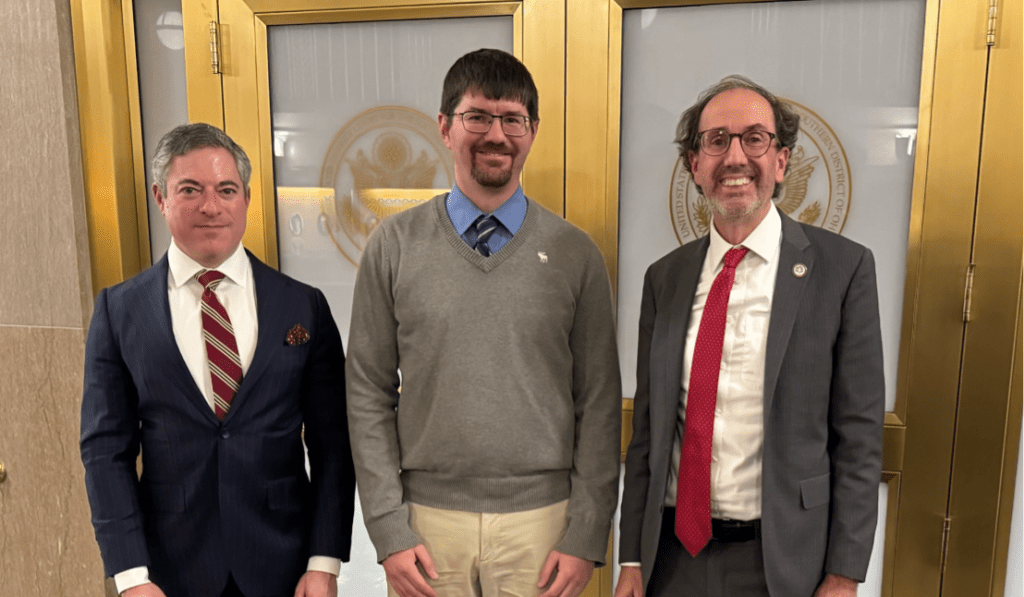
Pictured left to right: Andrew M. Grossman, John Ream, and Robert Alt. (Photo courtesy of The Buckeye Institute)
Sixty-one separate organizations have now filed in support of Ohio home-brewer John Ream’s case, challenging Congress’s authority to regulate anything with revenue-generating potential, The Buckeye Institute announced.
With the price of beef making headlines again, Ream’s challenge offers a prescient rebuke of interpretations that the Commerce Clause grants unlimited centralized regulatory authority, which critics attribute to marketplace consolidation and skyrocketing costs.
In its supporting document, the Cato Institute argues that “prominent founders, like George Washington hosted successful distilleries on their homesteads. Yet today the federal government bans home distilling outright.”
“Mr. Ream is right that this ban exceeds Congress’s constitutional powers.” Cato’s brief continues by quoting James Madison: “The powers delegated by the … Constitution to the federal government are few and defined.”
Conversely, intrastate commerce, defined as activity occurring entirely within one state, was left to local and state governments under the Tenth Amendment. Over decades, however, Cato argues that courts expanded the clause to cover almost any local activity that, in the aggregate, might “affect” interstate markets.
“Accordingly,” Cato’s amicus argues, “Congress possesses only those powers enumerated in the Constitution. Yet over time, judicial expansion of the Commerce Clause and the Necessary and Proper Clause has transformed a limited power to regulate interstate trade into a sweeping license to regulate nearly all human activity—and even inactivity.”
This expanded interpretation of Congress’s authority has allowed D.C. to regulate or ban purely local conduct — from home distilling to selling meat — simply because it could generate taxable revenue or touch the broader economy. Overturning the ban would reaffirm that states have the authority to regulate intrastate commerce, limiting federal authority to true interstate and international trade rather than to home, backyard, or farm activities with revenue potential.
While the issue touches nearly every aspect of transacting, the regulation of red meat has recently made headlines as four corporations have cornered 85% of the beef industry, effectively eliminating independent competitors. Again, the Commerce Clause is at the center of the issue, as only USDA-regulated facilities can process meat for sale.
According to critics, the inability of states to operate meat processing plants has limited farmers’ access to the marketplace and constrained consumer choice, leading to inflated prices.
Jeff Jennings, an attorney for the Pacific Legal Foundation, told Ohio.News that the case is ultimately about individual freedom and private property.
“The Founding generation understood that limiting the federal government to matters of truly national concern protects individual freedom,” Jennings said. “The Supreme Court departed from that principle in the 1930s, with far-reaching consequences for Americans’ ability to use their own property and resources. This case involves a personal hobby, pursued in one’s own home, with no connection to interstate commerce. The Supreme Court should hear this case and restore the Constitution’s limits on federal power and its protection of individual choice.”