AEP ordered to reimburse energy customers amid criticism over joint venture with FirstEnergy
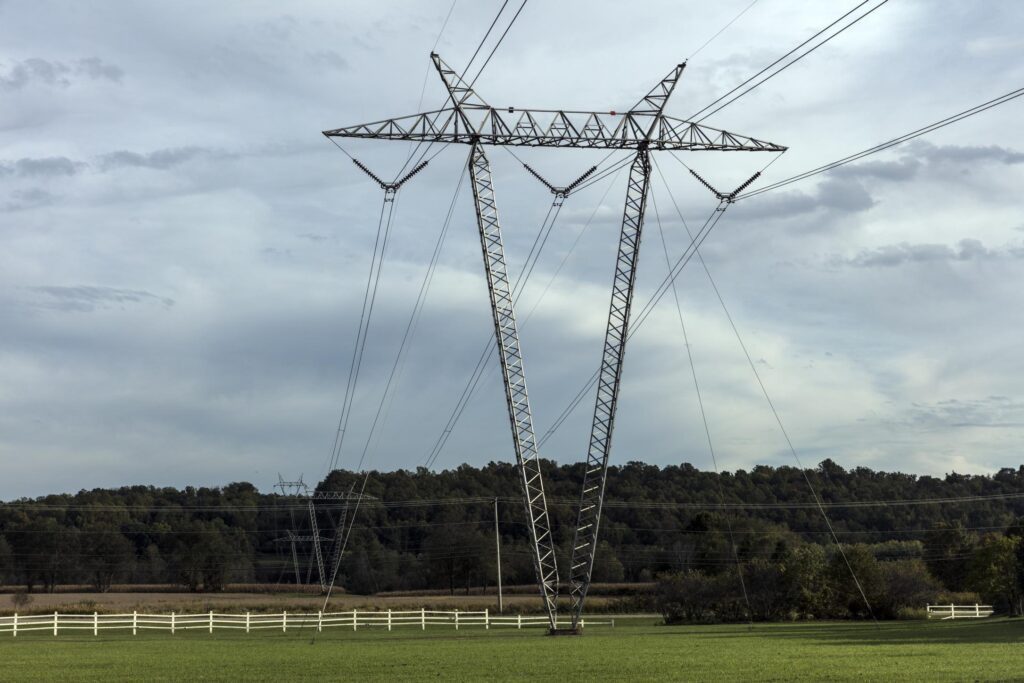
A line of enormous power towers and electric cables in Muskingum County, Ohio. (Photographs in the Carol M. Highsmith Archive, Library of Congress, Prints and Photographs Division.)
AEP ratepayers will soon receive a modest, yet much-needed break on their electricity bills after Ohio regulators sharply curtailed the utility’s rate increase request.
However, some critics warn that relief may prove temporary as infrastructure costs and a controversial joint venture with FirstEnergy threaten to increase future bills.
On April 1, the Public Utilities Commission of Ohio approved a settlement in AEP Ohio’s distribution rate case that grants the utility only an $11 million increase in base distribution revenues — dramatically less than the $97 million originally sought. As part of the agreement, AEP Ohio must also return approximately $105 million to customers over the next 18 months due to tax-related credits tied to federal tax cuts.
“The settlement we’re approving today focuses on utility affordability and ensuring that new data centers are responsible for the costs they impose on the grid, while providing the utility with the tools it needs to focus on system reliability,” PUCO Chair Jenifer French said in a release.
Consumer Advocates Weigh In
While the net result is an overall annual revenue reduction of about $58.7 million for the utility, for the average residential customer using 1,000 kWh per month, this translates to a temporary monthly credit of about $1.22. That may not seem like much, but the rate increase could have added roughly $12 or more per month to the average household’s bill.
“Not so fast,” warn consumer advocates. Critics say those tax credits are already owed to customers and, similar to healthcare premium tax credits, once they expire, customers could face much higher bills.
That’s because the federal tax credits are meant to insulate or offset consumer rates as utilities work to expand grid capacity amid rising demands.
To meet rising demand, AEP and FirstEnergy have proposed a controversial $1.1 billion high-voltage transmission partnership known as Grid Growth Ohio. The joint venture, involving Transource Energy and FirstEnergy Transmission, calls for new 765-kV and 345-kV lines primarily to serve surging demand from AI data centers in central Ohio.
However, ratepayer advocates argue that Ohio consumers could shoulder about 60 percent of the costs — roughly $660 million — plus related local upgrades, while the project offers the utilities a proposed 10.8 percent return on equity.
“Ohio customers could end up paying a very large share, about 60%. If you think about 60% of $1.1 billion, we’re talking about $660 million. And then that doesn’t even take into account local projects that would be needed to support it,” the Ohio Consumers’ Counsel’s Maureen Willis told WOSU.
“What we’ve talked about is how much of the need is really being driven by the data centers and is it fair to have residential consumers subsidize that growth,” Willis added.
PUCO Looks to Leverage Federal Tax Dollars
PUCO appears to have a different plan altogether, having just capped AEP’s approved return on equity at 9.84%.
In addition to the federal tax credits, the Trump administration has recently retooled a $1.9 billion SPARK grant to help quickly upgrade and expand transmission infrastructure. PUCO is actively seeking to leverage this funding to address Ohio’s infrastructure needs without solely burdening ratepayers.
Just days after the AEP settlement, the commission submitted a concept paper seeking up to $150 million of the federal grants through the U.S. Department of Energy. The funding would support advanced technologies — including high-performance conductors, dynamic line ratings, and power flow controls — to optimize existing transmission lines rather than relying exclusively on costly new construction.
This approach appears to reflect PUCO’s broader regulatory strategy: restrain direct rate increases on distribution service while pursuing non-ratepayer dollars for high-voltage upgrades driven by rapid load growth. If approved, utilities such as AEP and FirstEnergy could soon see these federal dollars offset the costs of grid expansion — while equity return rates likely remain capped.