‘Buckeye Buzzkill’: DeWine signs executive order targeting ‘intoxicating hemp’
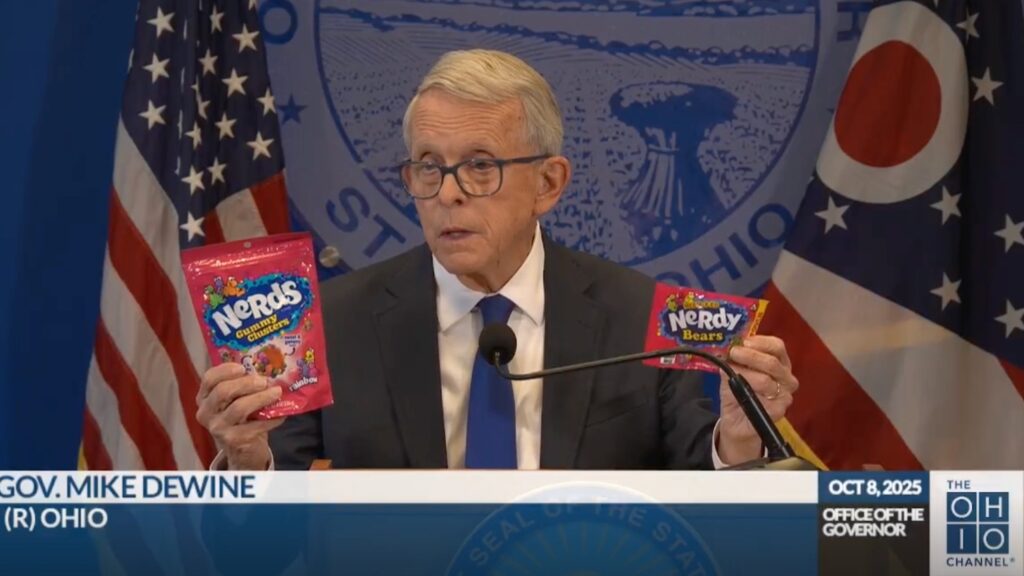
Gov. Mike DeWine on Wednesday declared a state of emergency for consumer products with what he dubbed “intoxicating hemp.”
In a media briefing that seemingly caught lawmakers off guard, DeWine said he signed an executive order targeting hemp products with high levels of THC. The products, the governor said, are unregulated, untested and packaged to mimic candy, which he said is a clear sign they are intended to target children.
“It’s really become a problem in Ohio; it’s become a problem across the country,” DeWine said during the press conference.
“They do it on purpose; they do it to attract kids,” the governor said in his briefing. “…Intoxicating hemp is dangerous.”
Several lawmakers asked by Ohio.News said they were caught off guard by the action.
“Some retailers are concerned and confused,” one Republican lawmaker told Ohio.News.
In September 2016, state lawmakers passed House Bill 523, legalizing medical marijuana in the state. In November 2023, Ohio became the 24th state to legalize adult-use cannabis, with 57% of voters casting ballots in favor of Issue 2.
The passage of the 2018 federal farm bill included the federal legalization of hemp. In 2019, state lawmakers passed Senate Bill 57, legalizing hemp in the Buckeye State.
Unlike marijuana, DeWine said hemp has low levels of THC. While hemp and marijuana are both cannabis, federal and state law differentiate hemp and marijuana according to their THC content, with hemp being below 0.3% THC, DeWine said.
“After these laws were passed, chemists began manipulating compounds in the legal, non-intoxicating hemp plant, turning these compounds into intoxicating THC, including delta-8 and delta-9, which are, of course, found in marijuana,” DeWine said.
DeWine, citing data from the Ohio Poison Control Center, said that exposure to delta-8 and delta-9 among those 19 years of age and younger has increased more than 200% in the past few years, from 419 recorded exposures in 2021 to 994 recorded exposures in 2024.
The executive order changes the definition of hemp within administrative law to state that intoxicating hemp is not hemp. It also declares an adulterated consumer product emergency, mandating that retailers remove the products from their shelves by Tuesday and stop selling them.
The emergency will last for 90 days. Then, lawmakers must decide whether to extend the emergency or let the order expire.
The order does not apply to non-intoxicating hemp.
“I’m doing what I can do,” DeWine said. “This is the action I can take, and I’m taking it.”
DeWine previously said he could not sign such an executive order. However, he told reporters that he asked his lawyers to investigate whether he could do so and opted to move forward based on their advice.
Separately, in April, the state Senate passed Senate Bill 86. The measure would ban the sale of intoxicating hemp products to anyone under 21 and also levy a 10% tax on intoxicating hemp products.
He also promised to revisit kratom, a plant that is native to Southeast Asia and has gained popularity in the United States in recent years. The Republican governor previously said he wants the Ohio Board of Pharmacy to designate kratom compounds, including natural and synthetic iterations, as illegal drugs.
The U.S. Food and Drug Administration has not approved its use for medical purposes or consumption.
The governor’s office declined Ohio.News entry into the press conference.
Related Stories

New poll shows tight Senate, governor’s races

The slow walk to socialism: Undercover video lifts lid on Ohio Democrats’ plan for state