DeWine delivers final State of the State, critics argue the child focus leaves Ohio families behind
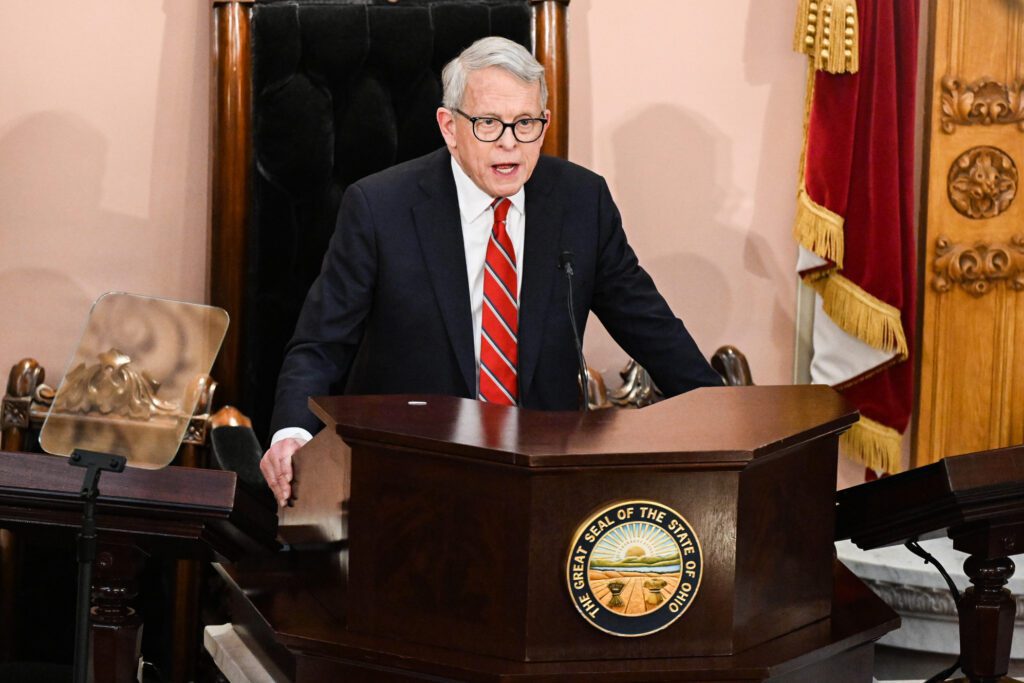
Gov. Mike DeWine used his final State of the State address on Tuesday to reflect on his administration’s achievements while calling for a continued focus on government approaches to children’s well-being.
However, as he enters the last year of his term-limited tenure, critics are calling his reflections more of an inflection point than a legacy.
Speaking to a joint session of the Ohio General Assembly in the Statehouse, DeWine, a Republican, highlighted progress in literacy through the Science of Reading mandate, cellphone bans in classrooms, expanded career-technical education, and economic development wins that drew major employers like Anduril and Joby Aviation. He emphasized reducing infant mortality, balancing budgets, cutting taxes and ranking Ohio third nationally for economic development.
Yet, it was his central themes of growing the size of government, coupled with calls for excessively interventionist policies, that have members of his own party lamenting.
DeWine’s child focus led to the hot-button issue of chronic absenteeism, which he’s pledged to reduce by half before 2029. Emphasizing the statistics, he tied poor attendance to lower proficiency in reading and math and to reduced graduation rates.
However, in spite of innovative market-based approaches heard in the Senate last week – permitting pharmacists to screen and treat common colds – DeWine called for an expansion of controversial and invasive school-based health clinics to minimize health-related absences. He also proposed requiring every school district to adopt clear attendance policies for early identification and “family intervention,” announcing the launch of a Statewide Attendance Dashboard on April 15 for real-time weekly data tracking.
He then promoted the OhioSEE pilot, which would add optometry services to school-based health clinics, a move similar to that of states like Oregon and California. In Oregon, school-based optometrists are now indemnified gender affirming care providers, following House Bill 2002.
HB2002 mandates access to puberty blockers, cross-sex hormones, and "gender affirming" surgeries such as double mastectomies and hysterectomies to children and adults. It also protects the doctors that perform these "treatments".
Children should be protected from this stuff.… https://t.co/6BZeaFX0al
— Real Diehl for Governor (@Real_EdDiehl) August 16, 2023
DeWine also touted broader child safety initiatives like bans on AI-generated child pornography, parental controls on devices, and road safety pushes for a primary seatbelt law — glazing over the larger fight for parental rights in education.
While the Republican governor framed his record as evidence-based and child-focused, conservatives were quick to point out that Ohio families deserve better.
A critical response, issued by Americans for Prosperity-Ohio, summarizes shared criticisms.
“Governor DeWine has had a long career of public service, and we appreciate the progress made through initiatives like Common Sense Initiative to modernize Ohio’s regulatory system,” State Director Donovan O’Neil said in a statement.
“But too often he blocked the biggest opportunities to move Ohio forward. The governor’s vetoes of the REINS Act, property tax relief, and reforms supporting Ohio’s school choice landscape prevented Columbus from delivering the accountability, relief, and education freedom Ohio families deserve.”
O’Neil called for a “next chapter” with bolder reforms: a 0% income tax, a real REINS Act to curb unelected regulators, truly universal school choice, and energy policies that unleash abundance and lower costs for Ohio’s families.
The criticisms stem from DeWine’s 2025 budget vetoes of 67 line items in House Bill 96, including data center tax exemption reforms, expansions of school vouchers, property tax restrictions on school levies and reserves, and REINS Act-style oversight of agency rules — viewed as missed opportunities to deliver on promises of taxpayer relief and parental rights.
DeWine’s speech not only avoided engagement with his party’s critiques but also focused on the incremental growth of government and bureaucracy through radical teacher-union-aligned health clinics, rather than market-driven alternatives.
As Buckeye State lawmakers attempt to navigate sound solutions to chronic absenteeism and rising medical costs, property tax relief and data center tax-exemption reforms, DeWine’s State of the State delivered the opening salvo in what will likely become a heated legislative session.
“In his last State of the State, Governor DeWine highlighted several initiatives that will define his legacy, including the importance of childhood education and the science of reading,” Rea S. Hederman Jr., executive director of the Economic Research Center and vice president of policy at The Buckeye Institute, said in a statement.
“But there is more that Governor DeWine and the General Assembly have accomplished over the past seven years, including the enactment of universal school choice, landmark energy reform, and a low flat income tax rate—second lowest in the nation,” Hederman added. “Unfortunately, these wins for Ohioans were missing from the governor’s speech, as was a call for further action to lower property taxes and reform local government, which are critical to help Ohioans still struggling with high tax bills.”
Related Stories
Guatemalan pleads guilty to making false statements as part of unaccompanied minor smuggling scheme in Ohio

Migrants who flooded border under Biden dispersed across nation’s heartland, including Ohio