DeWine signs $1.9 billion capital budget
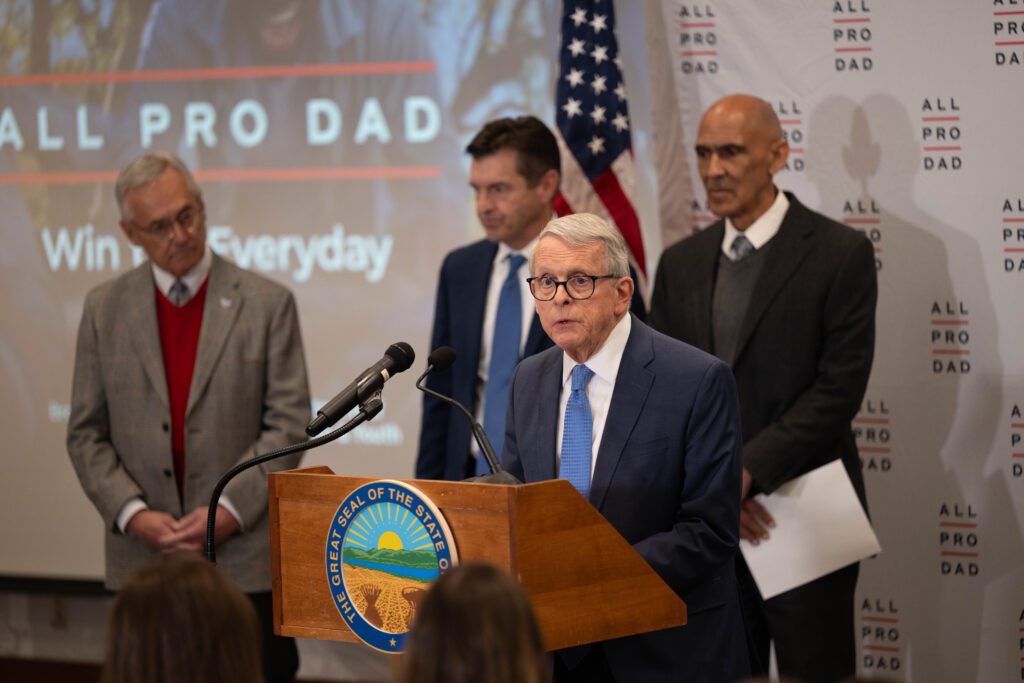
In March 2026, Gov. Mike DeWine and Lt. Governor Jim Tressel were joined by former NFL Head Coach Tony Dungy to announce a new partnership between the Ohio Department of Children and Youth and All Pro Dad.
Ohio plans to spend more than $1.9 billion on capital projects over the next two years after Republican Gov. Mike DeWine signed House Bill 730.
The measure also makes supplemental appropriations to House Bill 96, the main operating appropriations bill that lawmakers passed last year. The additional appropriations include roughly $14.2 million in fiscal 2026 and roughly $52.3 million in fiscal 2027 for 21 state agencies.
Included in the bill is $12.5 million — $10 million in General Revenue Fund allocations and $2.5 million in federal funds — in fiscal 2027 for the Department of Job and Family Services. The money will go to county departments of job and family services to administer the Supplemental Nutrition Assistance Program, or SNAP.
The Department of Job and Family Services will spend another $500,000 in fiscal 2027 to work with the Department of Medicaid to contract with a vendor to conduct “a comprehensive assessment of the financial network disbursement systems used by each department,” according to an Ohio Legislative Service Commission analysis.
In prepared testimony to the Ohio Senate Finance Committee last month, Hamilton County Commissioner Denise Driehaus, president of the County Commissioners Association of Ohio, said that under federal policy changes codified as part of the One Big Beautiful Bill Act budget reconciliation measure that Congress passed, the federal match rate for SNAP administrative costs will be reduced from 50% to 25% starting Oct. 1.
“This federal change will result in a significant loss of $38.2 million for counties in the remainder of state fiscal year 2027,” Driehaus said. “The projected loss for individual counties varies based on a variety of factors including SNAP administrative caseloads.”
In addition to the funding change, states must keep its error rate below 6% to avoid financial penalties. If a state’s error rate rises above 6%, it is liable for 5% to 15% of the state’s SNAP benefit costs.
“A penalty this size in Ohio would trigger hundreds of millions of dollars in benefit costs shifted to the state,” Driehaus said.
In prepared testimony to the committee, Department of Job and Family Services Executive Director Jon Honeck said, “Ohio’s SNAP payment error rate has consistently been below the national average since 2017.”
The biennial capital budget is one of the Buckeye State’s five main budgets and runs from July 1 through June 30, 2028. It focuses on “brick-and-mortar” projects, such as local jails, parks, and technology centers, funded by state bonds.
In 2024, lawmakers approved, and DeWine signed a $4.2 billion capital budget.
Related Stories

New poll shows tight Senate, governor’s races

The slow walk to socialism: Undercover video lifts lid on Ohio Democrats’ plan for state