How will Amy Acton interact with the media?
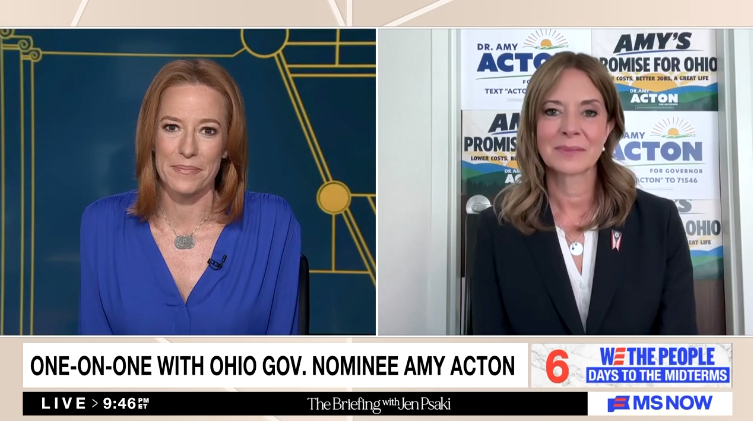
As Amy Acton prepares to take office, questions are starting to surface about how Acton will engage with the press.
Acton, a political novice, has tapped a Columbus insider to serve as her transition chair. John Haseley previously served as chief of staff to Ted Strickland in both the governor’s office and in Congress.
Acton left her role as director of the Ohio Department of Health during the COVID-19 pandemic. She didn’t answer questions from Ohio.News about the policies she pushed in that role, and the legacy media largely avoided the topic during the campaign.
Jon Handler on Amy Acton: "The press is going to circle the wagons and protect the COVID queen." Winning an election doesn't erase the record. The scrutiny starts now. https://t.co/MPSgs93ile pic.twitter.com/B9rhbuf6Ru
— jackwindsor (@jackwindsor) November 5, 2026
However, as governor, she likely won’t be able to avoid interacting with the media entirely. What could help Acton, who was elected following endorsements by the Cleveland Plain Dealer, The Columbus Dispatch and other media outlets, is the Ohio Legislative Correspondents Association, an organization of mostly legacy media outlets that controls access to the statehouse.
While it purports to “support the free flow of information between state government and the people by fostering a strong, independent press corps at the Ohio Statehouse,” the group can freeze out publications it dislikes since lawmakers decades ago gave the organization the power to issue credentials for Ohio Statehouse access.
Your fake news outlet — the Ohio Capital Journal — and the legacy outlets that run OCJ's progressive propaganda as straight news (News 5 included) played a huge role. Congratulations. Take your victory lap.
As one of the few remaining members of a free and independent press in… pic.twitter.com/eKjMqCTuUa— jackwindsor (@jackwindsor) November 4, 2026
Acton’s persona on the campaign trail was carefully curated. She limited media interactions, and her campaign barred recording of events.
Even with a legacy media that is friendlier to Democrats than Republicans, it will likely be hard for Acton to clamp down on coverage. The president of the Ohio Legislative Correspondents Association did not respond to a previous request for comment on Acton’s decision to bar recording at campaign events and whether it “would concern the media that could potentially soon cover a Gov. Acton administration should she be elected.”
Adam Guillette, president of Accuracy in Media, which has released several undercover videos showing leaders at Ohio schools flouting state law, told Ohio.News before the Nov. 3 election that the “legacy media has lower views and lower levels of trust than at any time in the history of our lifetimes.”
“Legacy media is no longer like the legacy media that we grew up with,” Guillette said. “The previous media used to try to get a broad audience of people of all political opinions. They don’t do that anymore.
“The media landscape is incredibly fragmented. So those outlets, many of the legacy ones, are only interested in going after far-left voters, so with that in mind, they know that if they publish stories that aren’t of interest or don’t share the views of a far-left audience, their readers are going to click away,” Guillette added. “Their viewers are going to change the channel, so they’re going to simply tell their audience what their audience wants to hear, whether or not they know it to be true, because otherwise they won’t have an audience.”
Meanwhile, Ohio is headed for what might be one of the more interesting lame-duck sessions. While Republicans lost their supermajority in the state House and the governor’s office, they could act to remove some of the governor’s powers before Acton even takes office.
Ohio’s election is over.
Democrats took the Governor’s race.
What happens next?
Over the next few months, the Republican legislature’s lame-duck supermajority will look to dismantle executive power.
Essentially all of Ohio’s gubernatorial authority is statutory, not…
— Will Hinman (@WorkforceWill) November 4, 2026
However, Republican Gov. Mike DeWine could be a roadblock to any reforms lawmakers try to pass.