LaRose uncovers 1,200 cases of possible voter fraud as lawmakers consider election integrity bills

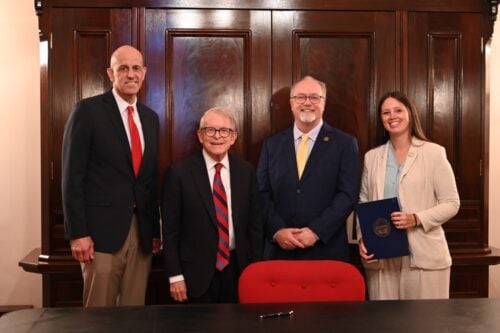
In this June 2025 photo, Ohio Secretary of State Frank LaRose certifies the official results of the 2025 Primary and Special Election, marking the completion of the statewide canvass by Ohio’s 88 county boards of elections and formally affirming the winners. (Courtesy Ohio Secretary of State's Office)
After uncovering nearly 1,100 cases of noncitizens either registering to vote or voting in an election, Ohio’s Secretary of State has referred them to the Justice Department for possible federal prosecution.
Ohio Republican Secretary of State Frank LaRose on Tuesday announced the findings of an investigation, which revealed evidence of illegal immigrants on the state’s voter rolls and other alleged federal election crimes.
The 1,200 criminal cases involve 1,084 noncitizens who appear to have registered to vote unlawfully in Ohio. Among those, 167 noncitizens appear to have voted in a federal election during the past four election cycles, from 2018 to 2024.
The investigation also found another 100 other people who appeared to have voted in a federal election twice in two separate states, and 16 people who allegedly voted twice in Ohio in the same election.
“We now have an executive administration at the White House and the Department of Justice that has expressed an interest in actively reviewing and potentially prosecuting evidence of federal election crimes,” LaRose said in a letter to the U.S. Department of Justice’s Criminal Division regarding the criminal cases.
Republicans raised concerns over election integrity and noncitizens voting in federal elections leading up to the 2024 presidential election, following four years of President Joe Biden allowing millions of illegal immigrants to flood the country.
Republicans in Congress also pushed the SAVE (Safeguard American Voter Eligibility) Act, which would require proof of citizenship to register to vote. The bill passed the U.S. House in April, but it has not been brought to a vote in the Senate and has yet to become law.
Other states, including Texas, have been investigating potential noncitizens on voter rolls.
Last week, Texas Secretary of State Jane Nelson said 2,724 potential illegal immigrants were flagged through a federal database cross-check. The cases have been sent back to counties for a 30-day citizenship verification process, Fox News Digital reported.
In Ohio, LaRose has pushed to investigate and purge the voter rolls of fraudulent voters. State law empowers the Secretary of State to “investigate the administration of election laws, frauds, and irregularities in elections in any county, and report violations of election laws to the attorney general or prosecuting attorney, or both, for prosecution,” according to his office.
“Ohio has earned its reputation as the Gold Standard, and our Election Integrity Unit continues to prove why,” LaRose said. “We work tirelessly to ensure that every eligible voter’s voice is heard, and anyone who tries to cheat the system will face serious consequences.”
In 2022, Secretary LaRose announced the creation of a Public Integrity Division in his office to focus full-time resources on investigations and to better assist with criminal prosecutions.
In 2024, LaRose found 137 suspected noncitizens on the state’s rolls and took action to confirm and remove them.
LaRose’s office created the state’s first full-time Election Integrity Unit, staffed by former law enforcement professionals with investigative backgrounds, in 2022 to help prosecutors bring justice in the election and voter fraud cases.
The office also established a stronger working relationship with the Ohio Attorney General’s statewide investigative agency, which has the authority to aid in the investigation of election crimes.
In June, the Ohio Senate passed Senate Bill 4, legislation to expand the powers of the division’s Election Integrity Unit.
“Ohioans deserve absolute confidence in the honesty and accuracy of their elections,” LaRose said in a news release on the legislation. “This unit’s professional investigations have resulted in hundreds of criminal referrals, and they’ve helped position Ohio as a national leader in election integrity.”
Election integrity has been a hot topic in the Ohio Legislature. Various committees heard testimony on three election integrity bills that would establish an Election Integrity Unit, require proof of citizenship, and set mail-in ballot deadlines.
Chad Ennis, vice president of Honest Elections Project Action, provided testimony in the Ohio House and Senate General Government Committees on Senate Bill 4, Senate Bill 153 and Senate Bill 293.
Creating a dedicated Election Integrity Unit through SB 4 would further deter election fraud and bolster public trust in outcomes, according to Jason Snead, Executive Director of Honest Elections Project Action.
Similarly, SB 153 proposes several changes to the Ohio Election Code designed to bolster public trust in election outcomes, including requiring proof of citizenship to vote, among other provisions.
And SB 293 would require all mail ballots to be received by Election Day to “eliminate any shadow of doubt that ballots may have been cast fraudulently after the election.” It would also speed up vote tabulation, ensuring timely results, thereby enhancing public trust in outcomes.
“The bills considered today in the Ohio House and Senate General Government Committees would significantly enhance election integrity in Ohio,” Snead said. “Too often, Democrats dismiss concerns about election fraud because they claim it doesn’t happen very often. In 2024, there were eight elections in Ohio that were either tied or decided by one vote. Even one fraudulent ballot is too many considering how close election margins can be.”
Of the 1,200 cases LaRose referred to the Justice Department, other cases of concern include 14 people who appear to have voted in a federal election after the date of their death, four people allegedly engaged in ballot harvesting and two people who registered at an unlawful address.
LaRose’s office sent a letter and evidentiary materials related to the alleged voter fraud to the U.S. Department of Justice Criminal Division for further review.
“I have made numerous criminal referrals throughout my administration, with much of the evidence related to unlawful registration and voting activity,” LaRose said in the letter. “These cases have encountered varying degrees of adjudication from Ohio’s 88 county prosecutors.”