Legislation would prohibit local officials from entering NDAs
Legislation that would prevent local officials from signing nondisclosure agreements with corporations is currently being considered by the Ohio House of Representatives.
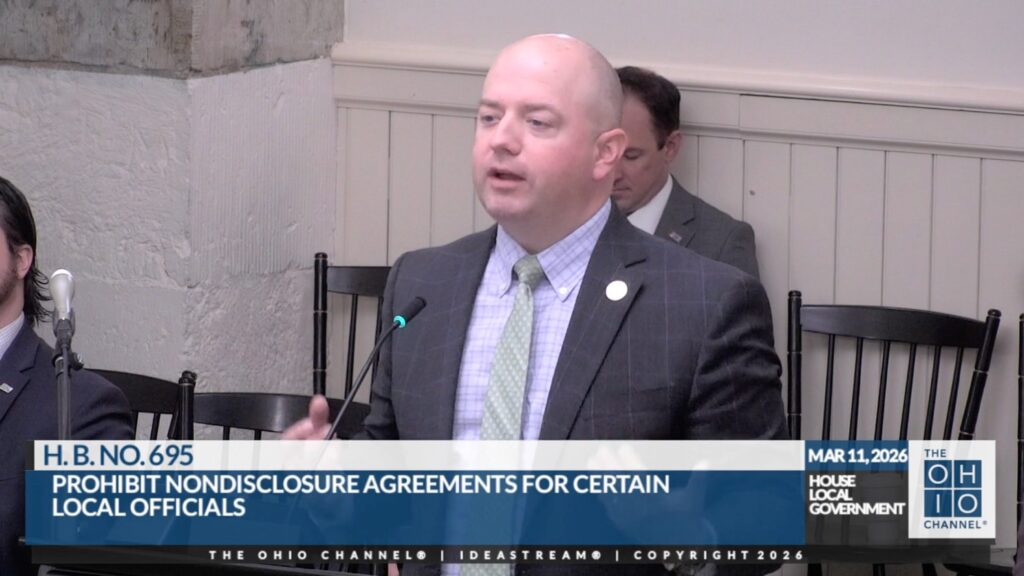
House Bill 695, sponsored by Reps. Adam Bird, R-New Richmond, and Brian Stewart, R-Ashville, would prohibit specific local elected officials from entering into NDAs in response to some officials withholding information from residents about plans for data centers.
“Elected officials should be transparent with their neighbors and constituents,” Bird said in prepared sponsor testimony. “Democracy is undermined when public awareness is delayed until after key decisions are finalized. In many communities, residents are left wondering what development is being planned and have no opportunity to provide input.”
The prohibition on entering into NDAs would apply to the board of county commissioners, township trustees, village mayors, and members of village councils. Officials who violate the law could face up to $1,000 in civil fines.
“Coerced secrecy sows distrust amongst our residents and violates the spirit of Ohio’s open meetings and public records laws,” Stewart said. “A nondisclosure agreement gags elected officials from discussing, describing, or commenting on important matters related to their official duties. This is, thankfully, a fairly recent development, but it is bad policy, and we should draw a clear line against it now.”
As Ohio.news previously reported, the Scioto County Commission granted Google a 75% tax abatement for a data center that the company plans to build in Franklin Furnace, but did not share details with residents until a January commission meeting, after the project had been approved. Residents expressed concerns about the Commission’s lack of transparency.
All three members of the Commission signed NDAs with Google, according to documents obtained by the Portsmouth Daily Times in February.
Scioto County Commissioner Scottie Powell said that HB 695 is “lazy” and would create challenges for local governments trying to attract investment, according to the Daily Times.
In his testimony for the bill, Stewart said that when he served as a Pickaway County Commissioner, he never signed an NDA “and never would.”
“Signing NDAs is also just unnecessary to compete and win projects in our state,” Stewart said. “Ohio’s growing communities have thrived for years before NDAs became a factor.”
“Residents understand that competing for big projects may require some discretion from time to time, but that’s a far cry from signing a legally enforceable gag order the moment a company walks through the door.”
Officials in other counties have also withheld details about proposed projects from residents after entering into NDAs with corporations.
Mt Orab officials made “emergency” changes to the village’s zoning code to accommodate a more than 1,000-acre data center and did not inform residents about the proposed center until recently.
Attorney Nick Owens, who works as a solicitor in another Brown County village, told WKRC Local 12 that he has questions about officials’ handling of the data center proposal, including the NDAs signed by Mt Orab council members and Mayor Joe Houser.
“It’s frankly disgusting,” Owens said. “No government should be run that way. No government official should be signing an NDA to keep the citizens away from the public’s business. It should never happen.”
The names of the companies behind two data centers planned for Miami County locations have not been named due to NDAs and are expected to be announced this year, according to a report from WHIOTV7.
The Cleveland City Council voted on $54 million in tax breaks for a proposed data center and did not learn that the company behind the center was Google due to NDAs signed by Mayor Justin M. Bibb and city employees, according to a report by Cleveland.com.
“If a project or impending deal to bring a business into a local community is a net positive for the community, elected officials should make the case and sell it to the community,” Bird said. “These agreements are often used in economic development to hide the identity of companies receiving public subsidies.”
“This allows developers to hide information while benefiting from public infrastructure and tax breaks.”
HB 695 is pending before the House Local Government Committee.