Ohio bill would expand E-Verify requirements amid fraud concerns
Ohio lawmakers are considering legislation that would expand employment eligibility verification requirements to schools, childcare providers, government agencies and residential construction projects as state officials continue examining fraud prevention measures in taxpayer-funded programs.
The proposal comes as state officials and lawmakers continue pursuing new anti-fraud measures in Medicaid and other taxpayer-funded programs following a series of audits and investigations highlighting potential vulnerabilities in state systems.
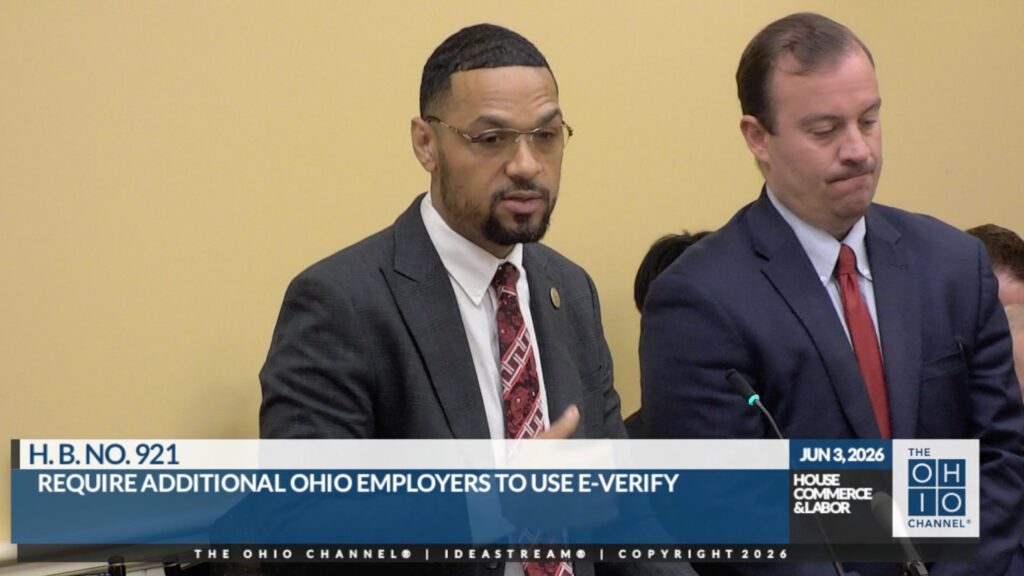
House Bill 921 received its first hearing this week before the Ohio House Commerce and Labor Committee. The legislation would expand Ohio’s E-Verify Workforce Integrity Act by requiring additional employers to verify new employees’ work eligibility through the federal E-Verify system.
E-Verify is an online program operated by the U.S. Department of Homeland Security and the Social Security Administration that allows employers to confirm whether newly hired employees are authorized to work in the United States.
Under current Ohio law, E-Verify requirements primarily apply to contractors, subcontractors and labor brokers working on nonresidential construction projects. HB 921 would extend those requirements to employees working in childcare centers and day camps, schools, colleges and universities, state and local government positions, and residential construction projects.
State Reps. Joshua Williams, R-Sylvania Township, and D.J. Swearingen, R-Huron, said the proposal builds on previous legislation approved by the General Assembly that expanded E-Verify requirements in portions of Ohio’s workforce.
Earlier E-Verify legislation considered by the General Assembly passed both the Ohio House and Senate without a single “no” vote, according to the bill sponsors.
“House Bill 921 advances that same principle by closing gaps in existing law and applying a consistent standard across additional sectors where public trust and taxpayer resources are involved,” the lawmakers wrote in sponsor testimony.
The bill would require covered employers to maintain verification records and terminate employees who receive a final nonconfirmation from the E-Verify system. Employers that fail to comply could face investigations by the Ohio Attorney General’s Office, civil penalties and temporary disqualification from bidding on state contracts.
According to an analysis prepared by the Ohio Legislative Service Commission, first-time violations for failing to use E-Verify could result in a $250 fine per violation, while employers who fail to terminate workers after receiving a final nonconfirmation notice could face penalties of up to $5,000 per violation. Repeat violations carry significantly higher penalties.
Williams told lawmakers the legislation is intended to close what he described as gaps in Ohio’s existing employment verification requirements, particularly in taxpayer-funded programs and public institutions.
“Ohio’s public benefits systems, like publicly funded childcare and Medicaid, have absolutely no restrictions on who can be employed for these jobs,” Williams said in testimony before the committee.
Williams and Swearingen argued the bill would help ensure taxpayer-funded positions and public institutions are employing individuals legally authorized to work in the United States while creating a consistent verification standard across multiple sectors of Ohio’s workforce.
Last month, Ohio Auditor Keith Faber told lawmakers the state needs stronger safeguards against fraud, waste and improper spending. Faber cited audit findings showing that more than half of home care services paid through Medicaid were not processed through the state’s Electronic Visit Verification system, representing an estimated $1.1 billion in claims that were not matched to a verified visit record.
“Ohio does not have a shortage of warning signs,” Faber told the Joint Medicaid Oversight Committee. “Ohio needs stronger controls, better data, more accountability, and clearer authority to act when public dollars are at risk.”
Williams and Swearingen said HB 921 continues the General Assembly’s previous efforts to strengthen employment verification requirements while preserving safeguards against improper investigations. The bill prohibits investigations based solely on race, color or national origin and protects employers from penalties resulting from isolated technical errors or E-Verify system malfunctions.
HB 921 remains under consideration in the House Commerce and Labor Committee.