Ohio caps whirlwind week with new congressional district map

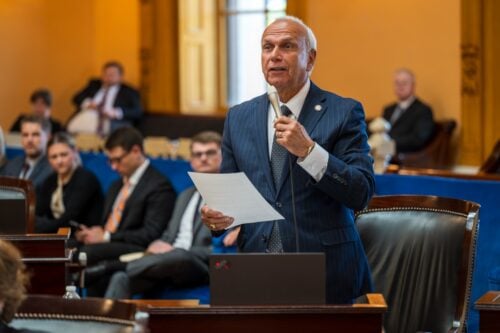
The Ohio Redistricting Commission unanimously approved a new congressional district map on Friday morning, capping a whirlwind couple of days in Columbus.
The maps emerged on Wednesday evening after Republicans and Democrats struck a deal. The commission had until Friday to pass the maps with bipartisan support; otherwise, the process would have returned to state lawmakers, who could have passed the new districts with a simple majority.
However, passing the new map through the Ohio Redistricting Commission averts the threat of a citizen ballot initiative that could have delayed the process.
“The congressional redistricting process approved by 75% of the voters in 2018 requires both parties to consider all alternatives and evaluate the potential benefits and pitfalls of each,” Senate President Rob McColley, R-Napoleon, said in a statement. “While it may not be perfect, the map passed by the Redistricting Commission avoids the potential for a referendum funded by special interests to repeal any map that might’ve been passed by the General Assembly.
“According to Ohio’s constitution, a successful signature gathering effort in the next 90 days to place a referendum on the ballot would have delayed a legislatively passed map until 2028,” McColley added. “Given how much special interest money has been spent in Ohio over the last decade, this signature gathering effort would likely have been successful. Instead, this map approved by the redistricting commission will be in place for the 2026 election, thereby providing stability and eliminating confusion for voters over the next six years.”
The Ohio Redistricting Commission held hearings on Thursday afternoon and Friday morning. A stream of witnesses lambasted the maps, the process and the politicians themselves.
“This is the process working,” state Rep. Brian Stewart, R-Ashville, co-chair of the commission, told the Ohio Capital Journal. “There are pros and cons to all different aspects of this process, but I think those legislators did what the constitution envisions, which is accept those pros and cons and come to an agreement.”
While the map likely has 12 of Ohio’s seats tilting toward Republicans, Democrats seem to accept the deal to avoid a worst-case scenario of 13 seats solidly favorable to Republicans. The new districts put in play seats held by Democratic U.S. Reps. Greg Landsman, who represents the first district in the Cincinnati area, Marcy Kaptur, who serves the ninth district in the Toledo area, and Emilia Sykes, who represents the 13th district in the Akron area.
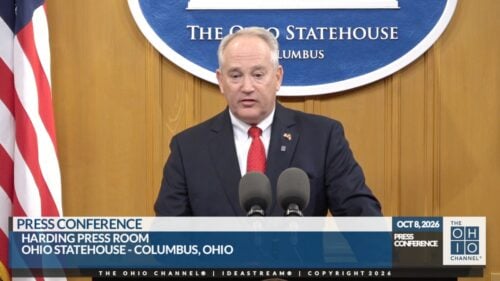
“I ran the numbers for this map, and I’ve run the numbers for a lot of other maps,” Ohio Auditor Keith Faber said during the meeting, WFMJ-TV reported. “This map across all 15 districts breaks down on an average of 55% of the concentration as Republican [and] 45% as Democrat.
“Geography and political geography in Ohio mean that you’re going to have some districts that are going to be Republican and some districts that are going to be Democrat,” Faber added, per the report. “That is a fact. This concept that you’re going to be able to draw districts within that range without gerrymandering is false. And if you’re going to do that … you never get to a statewide distribution of 55-45.”
The new map remains in effect until a new one is drawn after the 2030 census.
“House Republicans have the money, message, and momentum to win in 2026 in Ohio and across the country,” National Republican Congressional Committee Spokesman Zach Bannon told Ohio.News.