Ohio commission unveils new congressional maps in surprise 11th hour move

In a surprise move with the deadline looming, a bipartisan commission unveiled proposed new congressional maps for Ohio following an apparent deal between Republicans and Democrats.
While the new districts favor Republicans, they don’t tilt the scales as far in their favor as many insiders expected.
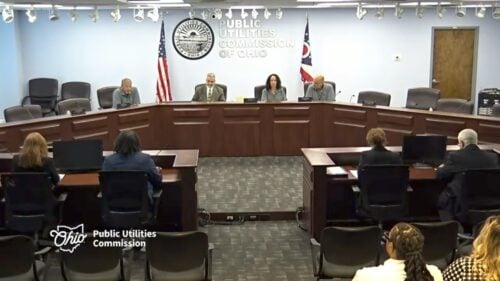
News of the deal went public on Wednesday evening, and the Ohio Redistricting Commission formally accepted the maps during a Thursday afternoon meeting, during which a stream of Ohioans blasted the maps and lawmakers. The commission is expected to consider the maps during a Friday morning hearing.
The commission, which first met about 10 days ago, has until the end of October to pass a map. Should they not approve the maps, the matter returns to state lawmakers, who could approve new districts with a simple majority.
At the statehouse this week, insiders gossiped about a forthcoming deal, which they indicated was a surprise.
In the new maps, 13 of the congressional districts have 786,630 residents, while two have 786,629 residents. In the end, two districts remain solidly Democratic-leaning, while 11 are solidly Republican-leaning. The remaining two seats could be classified as toss-ups.
In the revised map, which could be described as the best possible outcome for Buckeye State Democrats, seats held by Democratic U.S. Reps. Joyce Beatty, who represents the third district in the Columbus area, and Shontel Brown, who represents the 11th district in the Cleveland area, remain favorable to Democrats.
However, it puts in play seats held by Democratic U.S. Reps. Greg Landsman, who represents the first district in the Cincinnati area, Marcy Kaptur, who serves the ninth district in the Toledo area, and Emilia Sykes, who represents the 13th district in the Akron area.
Seats held by Republican U.S. Reps. Max Miller, who represents the seventh district south of Cleveland; Mike Carey, who represents the 15th district between Dayton and Columbus, and Mike Turner, who represents the 10th district in the Dayton area, are likely more competitive.
The fact that state lawmakers didn’t seek to pass a map more favorable to Republicans was a surprise to some political watchers. Democrats agreed to the deal after Republicans floated a different map with 13 seats leaning Republican.
A Punchbowl News report indicated that Democrats, including U.S. House Minority Leader Hakeem Jeffries, a New York Democrat, might seize the opportunity to raise money to support an initiative to require voter approval of any legislatively approved map. It would require collecting 250,000 signatures.
During the Thursday afternoon meeting, which started about 10 minutes late, commissioners voted to accept the revised map, even though it hadn’t been uploaded to the Ohio Redistricting Commission’s website, which also allowed Ohioans to upload their own versions of maps. The lack of a map at the start of the meeting drew jeers from meeting attendees.
About 40 minutes into the meeting, it devolved into chaos, with one attendee launching expletives at the committee and asking for a delay until Republican Gov. Mike DeWine and additional media were present. State Representative Brian Stewart, R-Ashville, the commission’s co-chair, called out the woman for trying to derail the meeting.
The live feed broadcast on The Ohio Channel was muted, and the protester was removed.
Before opening the meeting to public comment, state Sen. Nickie J. Antonio, D-Lakewood, blasted the process as “broken.”
“At the heart of this issue is [the] simple, incontrovertible fact that Ohio redistricting lacks balance, transparency and accountability, and we’re all just a little bit worse off for that,” Antonio said. “No matter how we view this process, we can’t ignore the harsh reality that here in Ohio, elected officials pick their voters, not the other way around.”