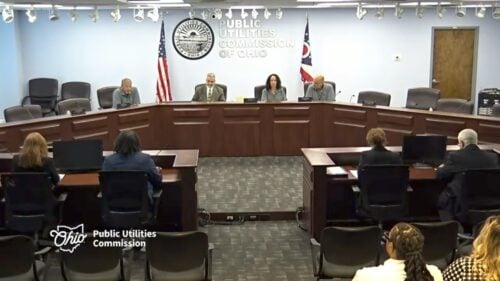
Ohio Consumers Counsel pushes for greater voice at PJM and in PUCO appointments
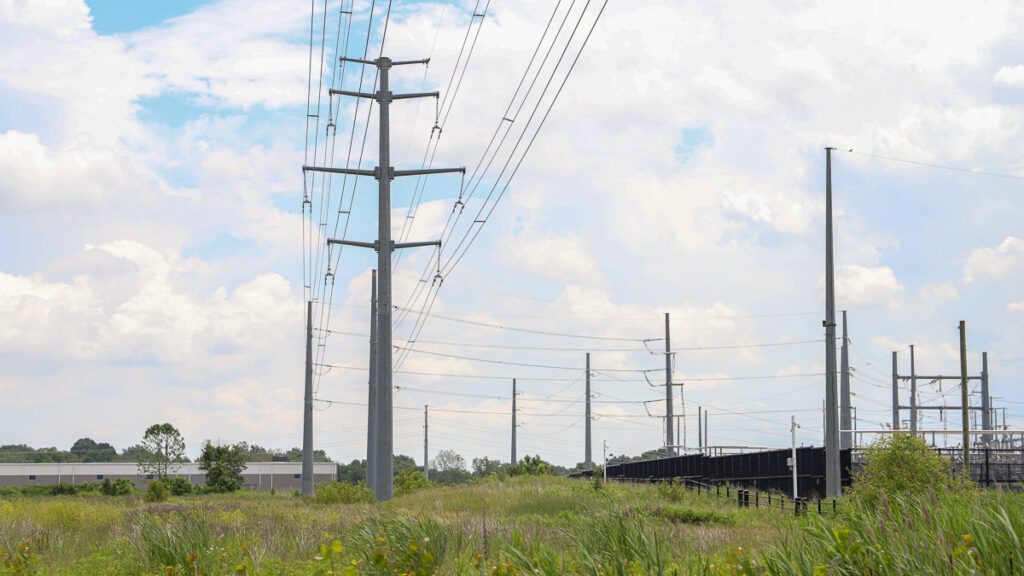
Power lines in New Albany. (Photo by Todd DeFeo)
State consumer advocate offices across the PJM Interconnection region, including the Office of the Ohio Consumers’ Counsel, are intensifying calls for expanded influence over wholesale electricity decisions that affect residential bills.
PJM, which manages the grid and markets, serves 13 states and the District of Columbia. Statutory consumer advocates currently hold one vote per jurisdiction — about 14 votes total. In lower-level committees where many proposals take shape, the combined share of state advocacy groups often falls below 2 percent.
Advocates, such as the OCC, have argued this under-represents the households that ultimately pay the costs of capacity, energy and transmission decisions.
This week, the OCC announced that it had filed comments with the Federal Energy Regulatory Commission—part of a coordinated push by the Consumer Advocates of the PJM States.
The effort, while coordinated, began with an invitation by FERC under the Trump administration, explicitly asking the PJM state advocacy agencies for input.
In May, FERC opened the formal request for comments to examine PJM governance and stakeholder processes. Questions included whether voting should become advisory as opposed to binding, if states should gain filing rights to propose changes to rates, terms, and conditions, and how to balance market-participant influence with public-interest concerns.
In response, offices from Pennsylvania, Maryland, New Jersey, Illinois, Delaware, Ohio and others have submitted packages on large-load issues and reliability backstops, urging the PJM Board and FERC to give consumer advocates and states a more formal role.
A July technical conference and subsequent mediated discussions have given the advocates a high-profile forum to address ratepayer concerns over energy costs and data center development.
While increasing the weighted stake of state advocacy groups on PJM’s board could create a more meaningful voice for consumers, sources tell Ohio.News that it would be improper for these state agencies to dictate PJM’s board members.
According to sources close to the issue, an “imaginary wall” exists between state consumer advocacy groups, like the OCC, and the independent regulatory agencies that oversee utilities. That wall is part of a delicate balance, preventing interventionist state overreach regardless of the justification.
Yet as state consumer advocacy groups scramble to address affordability concerns, pressure is mounting on states to take more direct action.
Separately, the OCC has recently renewed its long-standing request that one commissioner of the Public Utilities Commission of Ohio be required to have a consumer-representation background and that OCC have the authority to approve that appointment.
Current law, which places the governor in charge of appointments, allows for suggestions and input prepared by a nominating council, but the final responsibility rests with the governor.
OCC, framing the effort as necessary to counter structural advantages held by utilities and market participants, has advanced legislative proposals, board resolutions and most recently a rehearing application in an effort to alter that law.
While some view OCC’s successive public statements and structural demands as an attempt to expand the agency’s formal authority, others have taken a neutral approach urging balance.
Greg Lawson, a senior research fellow at The Buckeye Institute, told Ohio.News that balance is key.
“The Buckeye Institute supports consumer input, while also supporting a balanced approach to affordability, reliability, resiliency, and economic development,” Lawson said.
The activity coincides with rising data-center loads, capacity shortfalls and higher residential rates across the region that have brought highly technical and nuanced policy issues to the forefront of the November midterm.
While administrative functions are typically non-partisan, heightened awareness of data centers and energy capacity could easily create political mountains out of FERC’s rule changes to PJM voting and whether the Ohio General Assembly decentralizes executive authority over commissioner appointments.