Ohio lawmakers seek to address state’s potentially insolvent unemployment fund

Ohio lawmakers may soon be forced to address the state’s unemployment fund, which could become insolvent during the next economic downturn.
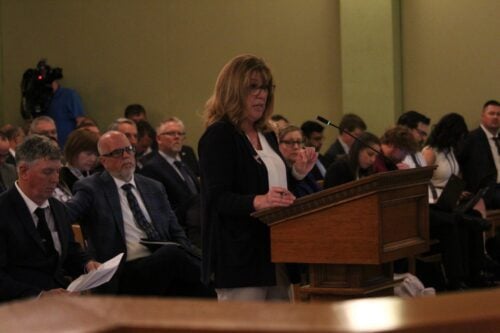
“For several decades, Ohio’s unemployment insurance trust fund has been bordering on insolvent, meaning a moderate recession or economic downturn would rapidly exhaust the balance of the fund,” National Federation of Independent Business Ohio Assistant State Director Cameron J. Garczyk said in prepared testimony to the Ohio House Public Insurance and Pensions Committee. “The fund’s insolvency, however, is an issue that only tends to reappear at the forefront every few years when our economy faces an economic downturn.”
Cleveland.com reported that since 1974, the feds have considered Ohio’s unemployment fund to be insolvent. That’s because the state hasn’t maintained a reserve large enough to cover a full year of benefits during a recession, as recommended by federal standards.
“The reason our fund is insufficiently financed is because the tax system is out of whack,” Bailey Sandin, the work and wages fellow at Policy Matters Ohio, told lawmakers in prepared testimony. “Any tax expert — liberal or conservative — will tell you that taxes should have a broad base.”
According to the U.S. Department of Labor’s 2025 trust fund solvency report, Ohio’s UI trust fund had a balance of more than $1.9 billion as of Jan. 1.
Ohio lawmakers are now considering two proposals.
One, House Bill 321, would increase employers’ and employees’ contributions to Ohio’s unemployment fund. The other, House Bill 376, would cut the maximum number of weeks that Ohioans can receive unemployment benefits.
“If we hit another downturn, that fund gets wiped out in six months,” Cleveland.com quoted Rick Carfagna, a lobbyist for the Ohio Chamber of Commerce and a former state lawmaker, as saying.
According to Cleveland.com, HB 321 would cost someone earning $75,000 about $100 per year.
“I had always assumed we would do one big, beautiful bill, if you will, that solved the problem for the foreseeable future,” Cleveland.com quoted Ohio Rep. Bob Peterson, R-Sabina, as saying. “But maybe we don’t. Maybe we do steps.”
According to an Ohio Legislative Service Commission analysis, House Bill 321 “would increase contributions to the Unemployment Compensation (UC) Fund by about $539 million from 2025 to 2036, an estimated annual average of $49 million.”
This includes both employer and employee contributions. The bill would have no effect on the amount of unemployment benefits paid out.
Specifically, the measure would raise “the taxable wage base used for calculating employer contributions from $9,000 to $9,500, beginning on January 1, 2026.” It would also create “an employee tax of 0.14% on an employee’s gross remuneration to be paid by the employees of contributory employers with negative contribution rates.”
“With Ohio’s unemployment rate low and job demand high, it is time for Ohio to break the cycle of borrowing, tax increases, and eventual loan repayments, and set a course for the state to, at the minimum, be able to repay loans to the federal government within a window of less than two years before penalties kick in and employers have to foot the bill,” Garczyk added. “That is why necessary, meaningful revenue and benefit reforms should be instituted [to] create certainty for Ohio employers.”
Sandin urged lawmakers to increase the taxable wage base.
“But with the exception of a temporary two-year period, Ohio has left its taxable wage base at the same $9,000 for the past 30 years,” Sandin told lawmakers. “If it had increased with inflation since then, it would now be over $16,000. The average taxable wage base across the country is also over $16,000.
“When the UC system originated under the Social Security Act of 1935, both UC and Social Security were taxed on the same earnings,” Sandin added. “Now, the tax base for Social Security is $176,100. While it’s helpful that H.B. 321 would increase the taxable wage base, $9,500 is way too low.”
The second measure, HB 376, sponsored by state Rep. Michelle Teska, R-Clearcreek Township, would reduce the number of weeks Ohioans could receive benefits to 20, down from the current 26 weeks.