Ohio lawmakers urge Congress to rein in the national security issue of bureaucratic bloat
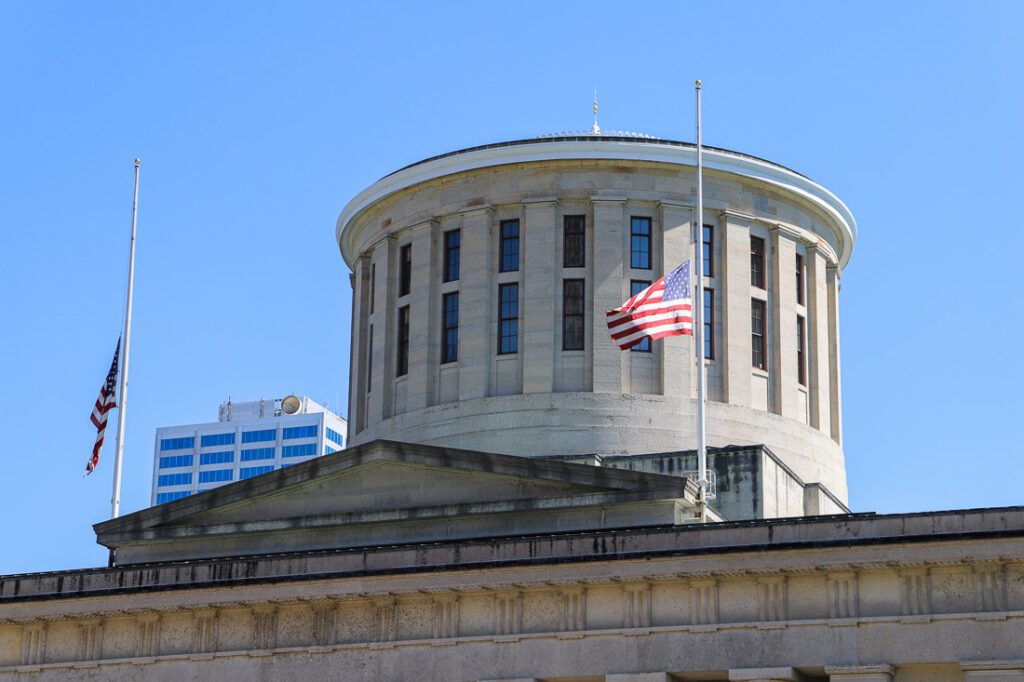
An April 2026 view of the Ohio Statehouse. (Photo by T.A. DeFeo)
Ohio lawmakers are pressing Congress to tackle the nation’s soaring debt and overhaul lengthy federal permitting rules for energy projects, arguing both issues threaten affordability for families and national security writ large.
House Concurrent Resolution 24 declares the U.S. national debt a national security threat and urges congressional action to promote budgetary and spending restraint. The measure, led by Reps. Roy Klopfenstein, R-Haviland, and David Thomas, R-Jefferson, highlight a debt exceeding $37 trillion — more than 123% of gross domestic product — with roughly $8 trillion held by foreign investors.
“When $8 trillion of debt is owned by foreign countries, the United States has a total debt of $37 trillion, and spends $6-7 million per minute, we cannot fund the functions necessary to keep our citizens safe,” Klopfenstein said in sponsor testimony. “Debt is threatening our national security, and everyone must recognize the importance of this issue, as our safety is at risk.”
The resolution notes that the debt equates to about $108,000 per Ohio resident and that interest payments now rival defense spending, potentially crowding out critical priorities.
Separately, House Concurrent Resolution 35 calls on Congress to streamline federal permitting and environmental reviews to speed deployment of energy infrastructure. Sponsored by Rep. Beth Lear, R-Galena, the resolution targets delays that lawmakers say inflate costs and hinder grid reliability.
“Right now, it simply takes too long to build major energy projects in this country,” Lear said. “Federal permitting and environmental review processes can take years to complete, often delaying or stopping projects that would improve our energy grid and support economic growth.”
Emphasizing that delays increase reliance on imports from nations that do not impose the same environmental regulations as the United States, Lear highlighted that bureaucratic red tape is undermining environmental goals and urged streamlining permitting processes.
“This resolution does not eliminate environmental protections. Instead, it encourages Congress to streamline the process so projects can move forward more efficiently while still protecting our environment,” Lear added.
Americans for Prosperity-Ohio backed both measures during testimony this week before House committees. Legislative Director Hannah Kubbins spoke in support, while State Director Donovan O’Neil framed the resolutions as interconnected affordability solutions.
“As Ohio families continue facing higher costs, lawmakers must remain focused on policies that improve affordability, strengthen economic opportunity, and ensure government is operating responsibly,” O’Neil said. “Whether it’s addressing unsustainable federal debt or modernizing our energy permitting system, these reforms are about creating a stronger, more affordable future for Ohioans.”
“Permitting reform and fiscal discipline are fundamentally affordability issues,” he added. “Ohioans are paying the price for government inefficiency, delayed infrastructure, and unsustainable spending.”
America’s $37T debt isn’t just a number—it’s a national security risk.
HCR 24 urges Congress to act, budget responsibly, and get spending under control.@DavidThomasOH pic.twitter.com/Podri0lEwP
— AFPOhio (@AfpOhio) May 20, 2026
The nonbinding concurrent resolutions await further action in the Republican-controlled House. Proponents say they send a unified message from Ohio amid ongoing national debates over debt reduction and energy development.