Ohio think tank praises Senate Bill 294 as step toward national energy leadership
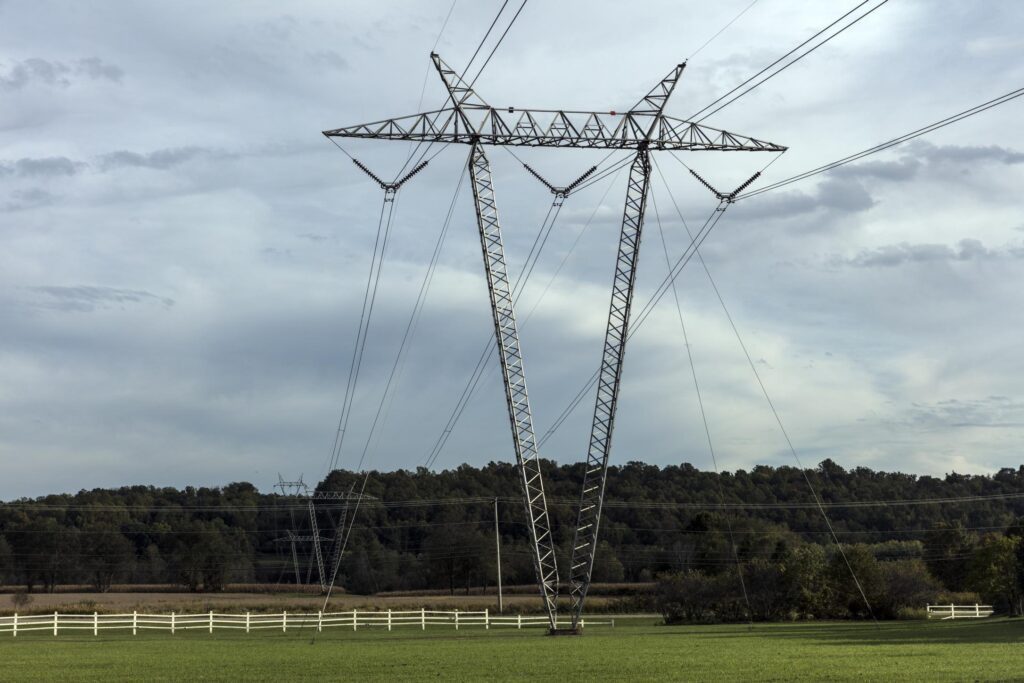
A line of enormous power towers and electric cables in Muskingum County, Ohio. (Photographs in the Carol M. Highsmith Archive, Library of Congress, Prints and Photographs Division.)
An Ohio-based think tank on Tuesday hailed pending legislation that would reshape how the state evaluates major energy projects, arguing it positions Ohio as a leader in delivering low-cost, reliable power amid surging demand from artificial intelligence, data centers and manufacturing.
Greg R. Lawson, senior research fellow at The Buckeye Institute, testified before the Ohio Senate Energy Committee in support of Senate Bill 294. The measure, sponsored by Sens. George Lang, R-West Chester, and Mark Romanchuk, R-Ontario, would enact a formal state energy siting policy that guides the Ohio Power Siting Board in reviewing applications for utility facility certificates, such as power plants and transmission lines.
In his testimony, Lawson said the bill builds on recent reforms in House Bill 15 and Senate Bill 103, that have similarly incorporated recommendations from The Buckeye Institute, a free-market policy organization. Lawson also credited lawmakers for advancing efforts to supply affordable electricity critical to Ohio’s economy and national competitiveness.
“Senate Bill 294 only furthers the state’s effort to supply low-cost, reliable electricity for our data technology, advanced manufacturing, and national defense sectors,” Lawson said in prepared testimony.
The legislation requires the siting board to give careful considerations to whether proposed facilities will produce affordable, reliable and clean energy, prior to approvals. In addition, the board would be required to consider if projects prioritize domestic production, minimize reliance on foreign adversaries for materials or manufacturing, and deliver actual affordable energy based on true-cost accounting that accounts for full, unsubsidized lifecycle costs rather than subsidy-distorted prices.
Lawson highlighted growing U.S. electricity demand driven by AI, electric vehicles, cryptocurrencies and data centers, which could consume nearly 10% of national power by 2030. He contrasted this with China’s aggressive energy expansion to dominate AI, warning that reliable power is vital to national security and the U.S. competition with Beijing.
“Reliable, affordable electricity plays a vital role in America’s national security,” Lawson said. “The stakes could hardly be higher.”
The testimony comes one week after the Ohio Power Siting Board on Feb. 3 approved construction of the 350-megawatt Apollo Power Generation Facility, a natural gas-fired plant in Wood County. The “behind-the-meter” facility, developed by Will-Power OH LLC, will supply power directly to an adjacent data center operated by Liames LLC, without connecting to the regional grid—framed as a missed opportunity for needed grid and energy expansion.
Should SB 294 be signed into law, however, future projects would be prioritized for their potential to increase grid capacity or expand affordable energy for Ohio ratepayers—as opposed to a single facility.
Prior to concluding, Lawson urged other states and federal policymakers to adopt a similar emphasis on cost stability and reduced exposure to intermittent sourcing due to foreign dependencies.
Lawson closed by thanking the committee and General Assembly for keeping Ohio “at the forefront of energy and technology in the 21st century.”
The bill, introduced in late 2025, remains in committee. Supporters view it as promoting energy security and domestic priorities, while critics, including some renewable groups and the Ohio Chamber of Commerce, have raised concerns that it could favor certain energy sources over subsidy-intensive wind and solar.